New Shipyards Entering Cruise Business Face Uphill Challenge

Two new shipyards have entered the cruise ship building business recently, while an additional yard with a surprise cruise order has some passenger vessel history, but all will be facing a set of staggering challenges when it comes to building customized ships for picky clients and pulling off a flawless hotel build.

The major players in the cruise-ship building business have been going at it for decades, and most specialize in passenger vessels.

Meanwhile, major cargo-ship building yards in South Korea have tried again and again to land orders without success.

In Japan, Mitsubishi has built for local companies along with Princess Cruises and AIDA Cruises, but late deliveries and cost overruns on the recent AIDA ships have not helped the cause.

Kleven

New Hurtigruten Ship Rendering

The last time a cruise ship was built in Norway, the shipyard went bankrupt. That was just over a decade ago with the ship being The World and the shipyard Fosen Mekaniske Verksted against a backdrop of an extremely expensive labor environment.

Earlier this year, Kleven entered into a contract with Hurtigruten to build a set of expedition cruise ships earlier this year, with an option for two more. The ship’s are being built on a Rolls-Royce technical platform.

Shipyard executives declined to speak on the record, but the yard’s website said Kleven was a family-owned operation dating back many decades.

The yard’s recent deliveries show no shortage of supply and platform vessels for the offshore industry, in addition to Coast Guard ships.

A log of ship deliveries back to 1961 shows everything from fish vessels to tug boats, with the last passenger vessel being the Finnmarken, which was built in 2002 for coastal service. The yard has only built three (coastal) passenger ships.

Uljanik Group

Scenic Elipse

In Croatia, Uljanik Group will build its first cruise ship for a new entry to the cruise ship market in Scenic.

The agreement calls for a five-star level expedition ship to be delivered in August of 2018, with an option for a second vessel. The ship is 16,500 tons with capacity for 228 guests.

In 2015 the yard delivered a 3,311-ton ro/ro ferry, the second in a two-ship order. However, the yard mainly builds barges and other supply vessels, but did deliver a series of car carriers as recently as 2008.

The Croatian builder can trade its history back to 1856, when it started out building ships for the Austro-Hungarian Navy.

In 2013, the yard added another facility and building site, 3.Maj, to its portfolio, which has upped its capacity.

The group also owns an engine factory, ULJANIK Diesel Engines Factory Ltd, and has recently delivered a number of large tanker vessels.

Brodosplit

New Star Clippers vessel

Another Croatian yard, Brodosplit, landed an order from Star Clippers for a sailing ship, and is believed to be working toward a separate order for smaller niche vessels.

Of note, the yard has built new motor vessel ships for Grand Circle Cruise Line over the years.

The shipyard is located in Split, Croatia, and was formed when several smaller ship repair facilities combined forces in 1922. The yard builds various types of ships including commercial, container and passenger vessels.

The new Royal Flyer for Star Clippers will be 162 meters long and 18.5 meters wide, and feature five masts and sails.

While it is a sailing ship, the vessel will have two fully independent electric propulsion engines and be compliant with Safe Return to Port rules with two engine rooms.

Carnival Corp ups full year revenue forecast on back of higher prices

Image result for carnival cruise

Carnival Corporation’s cumulative bookings for the next three quarters are at higher prices than last year and concentrated in the core cruise markets in North America and Europe.

Adjusted net profits for the last quarter edged up by $8 million year-on-year to $370 million as revenues grew from $3.7 billion to $3.9 billion on the back of a 4% increase in capacity.

The figures for the three months to May 31 were boosted by a 5% improvement in overall cruise ticket prices for the parent company of brands such as P&O Cruises, Cunard and Princess Cruises.

The improved rates affirmed efforts to increase demand “by building positive word of mouth through the delivery of exceptional guest experiences as well as our innovative marketing and public relations programmes,” said president and chief executive Arnold Donald.

The company expects full year 2017 net revenue yields in constant currency to be up approximately 3.5%, better than guidance given in March of up by around 3%.

Chief finance officer David Bernstein said: “Since the end of February, booking volumes for the next three quarters have been running in line with the prior year at nicely higher prices.

“At this point in time, cumulative bookings for the next three quarters are ahead of the prior year, again, at nicely higher prices.”

Looking forward, Donald said: “We are realising sustained strength in booking trends across all core products.

“We are delivering on our strategy to grow demand in excess of measured capacity growth while leveraging our industry-leading scale resulting in increased return on invested capital.”

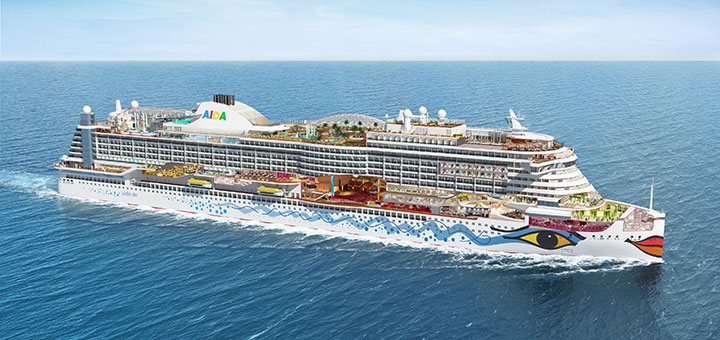
The world’s largest cruise conglomerate saw the delivery of Princess Cruises’ Majestic Princess, the first ship tailored for Chinese passengers, as well as the addition of AIDAperla to German brand, AIDA Cruises.

Image result for aidaperla cruise

AIDAperla.

Two additional Princess Cruises ships, Caribbean Princess and Royal Princess, were fitted with the technical requirements to switch them early next year to the Ocean Platform featuring Ocean Medallion, the interactive technology for passengers which will debut on Regal Princess in November.

Donald told analysts in a conference call: “We have and we’ll continue to create carefully engineered high-quality destination experiences that are uniquely tailored to our guest references from our private islands like Princess Cays and Half Moon Cay to the planned expansion of our cruise terminal in Barcelona to our most recently completed port destination Amber Cove, in the Dominican Republic.

“We’re providing exceptional guest experiences that enable our brands to capture a price premium. We have many more innovations planned in port development that we expect to rollout in the coming years.”

He identified “new destination opportunities” in Cuba, the Bahamas and China.

The company expects to benefit from growing populations, increasing wealth and developing countries in addition to increased spending by consumers on “experience versus products”, all of which are contributing to 4% annual growth expected in travel globally.

Carnival courts burgeoning Asian markets

Related image
Gentling Dream cruise ship

Carnival Corporation & plc is centre stage when it comes to developing Asia’s burgeoning cruise industry. COO Alan Buckelew tells Susan Parker why the corporation is growing its focus on China

Carnival courts burgeoning Asian markets

Image: James Bellorini

This article was first published in the Autumn/Winter 2016 issue of International Cruise & Ferry Review. All information was correct at the time of printing, but may since have changed. 

Carnival Corporation & plc entered China a decade ago with Costa Cruises. Today, the company has around 45% of the market share, is building three ships designed specifically for the market, and is taking two more brands east.

The corporation is also the first to have an office in China, showing its commitment to a country that values long-term business relations. Heading up the operation in Shanghai is Carnival’s COO Alan Buckelew. Although cruising is still in a nascent stage, Carnival is well aware of the potential of the region and, in particular, China. “In 2006, we identified China as having high potential but being a completely unpenetrated market,” recounts Buckelew. “About 130 million Chinese travelled internationally last year and fewer than a million took a cruise.”

With a target to corner the market, which is forecast to double by 2020, and with less than 1% penetration to date, Carnival has big numbers in its sights. However, marketing to an audience with little prior knowledge of cruising is not easy. “For any product, when it is new and unknown, it is a challenge,” Buckelew explains. “People cruising have positive things to say, but getting the word out to agents and con-sumers is the biggest hurdle. The challenge is how well we can market and sell to the Chinese. The onus is on us to communicate the efficacy of a cruise. China is the largest market we are focusing on in Asia, but also Japan, Taiwan and South Korea.”

Carnival has to tailor the product to consumer in each of these markets, taking into account printed material, food and entertainment. “We want to make it easy for passengers to enjoy the experience,” says Buckelew.

All of these products must be communicated to the different markets through the media, particularly in China, which is hot on social media. A benefit in China is that outbound travel agents act more like wholesalers, tending to charter the ships and market voyages through their own networks, according to Buckelew. “They do retail advertising and we do brand advertising so we marry the two.”

As the region is so new to cruise, there is much work to be done. “Today brand awareness is pretty weak because people have not cruised with multiple brands yet,” comments Buckelew. “The assumption is that everyone is a first-time cruiser.”

For now, explains Buckelew, it is all about showcasing the core elements of cruising and getting the word out. As with every region in the world, Carnival sees homeporting multiple ports as the best way of capturing the local market. Having a solid base of cruisers and travel agents is also a good start. Buckelew says there is plenty of room for expansion. “Around 90% of the [total] outbound China market is still focused on travelling in Asia.”

The Chinese have traditionally had short holidays, which has made long-haul travel less attainable. However, that is changing: “It varies from area to area and industry to industry, but there’s a lot of push from the Chinese government to provide vacations and longer vacations to all employees,” says Buckelew, adding that the middle and upper middle class market is growing fastest in this respect. “They look to the west and want some of the same benefits. They see themselves as equals on the world stage, and rightly so.”

In terms of growing the capacity, Carnival’s Princess Cruises and Costa Cruises brands have customised ships coming on stream in China. Princess will launch Majestic Princess in March 2017, while the two as-yet-unnamed Costa ships will debut in 2019 and 2020. Meanwhile, AIDA Cruises will start sailing out of China in 2017 and Carnival Cruise Line will follow in 2018.

While Majestic Princess is a sister ship to Royal Princess and Regal Princess, the Costa vessels are a blueprint. “We have looked at where Chinese behaviours are different and how can we reallocate space to maximise their experiences, so there are no dead nor overcrowded spaces,” notes Buckelew. He adds that there will be private rooms for high-stakes gambling, smaller spas, more luxury brands in the shops and tea-making facilities in the cabins and much more to tailor the ships to Chinese tastes.

In line with the Chinese central government’s five-year plan to build domestic cruise ships and grow domes-tic cruise companies, Carnival has agreed a joint venture with China State Shipbuilding Corporation (CSSC) and China Investment Corporation. Together, they plan to launch a domestic cruise brand in China in the coming years.

“We are very excited about it and it’s the right thing to do,” Buckelew remarks. “The Chinese government would like to have a domestic, Chinese-owned brand competing against us. We think it’s important to support growing the domestically-owned cruise market. It’s in our best interests long-term and fosters interests with the government which is very important. Having a joint venture clearly puts us in the driving seat as having the most visible commitment to the government.”

Buckelew adds: “We have to deliver on our commitment and we have every intention of doing so. To some extent it relies on how well we can market and how the Chinese take to our vacation. I don’t think it [joint venture] will give us any special benefits that our competitors won’t have. Like most governments, the Chinese want to treat the industry with equality so no company is given preference over another.”

Carnival is also keen to help bring China’s regulations, which are now focused on cargo rather than cruise ships, in parallel with other parts of the world. “This would lead to a better regulatory environment, which would be good for the entire industry,” says Buckelew.

Certainly, Carnival believes China has potential to be the largest market in the world. “We’re going to invest greatly not just in China, but also in Japan which has a population of 120 million and a population where most of the personal wealth is concentrated on the retired,” says Buckelew, adding that Carnival is also targeting Taiwan and South Korea. “The whole area is flush with potential. We think that most of our future growth will come from China and Northern Asia for the next decade and will be a big driver of our revenue growth as we move forward.”