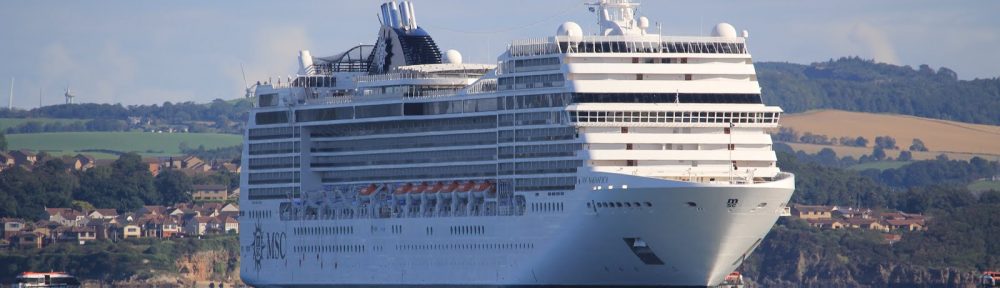
| MSC Magnifica.
The five largest cruise companies are projected to see dramatic capacity growth over the next 10 years, ranging from 114 percent for MSC Cruises to 36 percent for Royal Caribbean Cruises. The projections are based on new ships to be introduced and known ship withdrawals and deployment changes. Carnival Corporation is expected to grow its annual passenger capacity from approximately 11.1 million to 15.8 million passengers, for a 42 percent increase, and the largest industry-wide hike in terms of actual passengers, 4.7 million more passengers over 10 years. MSC will see the second largest estimated increase in terms of actual passenger capacity, going from 2.1 million to 4.6 million, an increase of 2.5 million passengers, or 114 percent. Royal Caribbean is projected to grow its annual passenger capacity from approximately 6.2 million to 8.4 million passengers, for 2.2 million more passengers, an increase of about 36 percent. Norwegian Cruise Line Holdings will see its capacity go from 2.5 million to 3.5 million, climbing 1 million, a 40 percent increase. Genting Hong Kong will grow its capacity from 1.2 million passengers to 2.0 million, for a 66 percent increase. The largest industry-wide growth year will be 2020 with global passenger capacity increasing 7.9 percent from the previous year. |
Tag Archives: capacity growth
Carnival Reports Record $2.8 Billion Profit in 2016
By https://gcaptain.com/
Carnival Corporation, the world’s largest cruise ship company, posted a record $2.8 billion profit for its full fiscal year 2016 as the company looks towards another solid year for the cruise industry in 2017.
Carnival Corp. reported the record full year and fourth quarter earnings Tuesday. Carnival announced net income for the full year 2016 of $2.8 billion, or $3.72 diluted EPS, compared to $1.8 billion, or $2.26 diluted EPS, for the prior year.
Carnival Corp. said revenues for the full year 2016 were $16.4 billion, $700 million higher than the $15.7 billion in the prior year.
“We achieved the most profitable year in our company’s history as well as record fourth quarter earnings,” said Carnival Corporation & plc President and Chief Executive Officer Arnold Donald. “The continued execution of our core strategy to drive consumer demand in excess of measured capacity growth, contain costs and leverage our industry-leading scale resulted in our third consecutive year of significantly higher earnings and return on invested capital. The delivery of over $5 billion in cash from operations for our shareholders enabled increased dividend distributions reaching $1 billion and the investment of over $2.3 billion in the repurchase of Carnival Corporation stock.”
Highlights from the fourth quarter 2016 included the U.S. debut of Carnival Cruise Line’s Carnival Vista. Holland America’s Koningsdam also made its North American debut in November while Seabourn took delivery of ultra-luxury cruise ship Seabourn Encore.

Seabourn Encore
During the quarter, Carnival Corp. also signed a memorandum of agreement with Meyer Werft for three new 180,000-ton cruise ships that will be powered by liquefied natural gas, the world’s cleanest burning fossil fuel. Two of the ships are for Carnival Cruise Line and are scheduled for delivery in 2020 and 2022. The third ship is designated for P&O Cruises (UK) and is scheduled for delivery in 2020. The company also signed an agreement with Shell to begin fueling its LNG-powered ships, starting with AIDA and Costa ships scheduled to launch in 2019.
Looking ahead, Carnival said it expects another solid year in 2017, forecasting adjusted earnings per share to be in the range of $3.30 to $3.60, compared to 2016 adjusted earnings per share of $3.45 in 2017.
“We are anticipating another solid year of operational improvement in 2017. Despite the unusual and significant impact of fuel and currency working against us simultaneously, the underlying strength in our fundamental business leaves us well positioned to achieve sustained double digit return on invested capital and to create continued value for our shareholders,” Donald added.
CLIA: Capacity up in developing markets
The report said these three areas recorded 20% capacity growth in 2013 and accounted for more than half the global increase in available bed days. Europe’s capacity growth slowed from 18% in 2011 to 3.5% last year.
CLIA said the number of passengers carried in 2013 by its member lines rose 3.9%, to 17.6 million (river cruises are not included in the tally).
Bed days increased 4.8% because the average cruise was longer and capacity was higher, CLIA said.
Passenger embarkations at U.S. ports fell 1.3%, to nearly 10 million, the first time in at least four years that happened. CLIA attributed the decline primarily to redeployments to markets more distant from the U.S.
Direct spending by cruise lines, passengers and crew in the U.S. crossed the $20 billion threshold, rising 2.4% to $20.1 billion in 2013. More than 80% of that was for wages, taxes, and goods and services. Passengers and crew accounted for $3.63 billion in spending.
CLIA member cruise lines in North America showed a net increase of one ship in 2013, to 178, with a combined capacity of 338,505 berths, the study said.

