Royal Caribbean Wants to Own Texas Market

Royal Caribbean Wants to Own Texas Market

Royal Caribbean Group has set its sights on the Texas cruise market.

“We’re expecting to own the Texas market as it relates to cruising into the Caribbean,” said Michael Bayley, president and CEO of Royal Caribbean International, speaking on the company’s first quarter earnings call April 30.

A new terminal that opened in 2022 in Galveston will now be supported by Perfect Day Mexico, Royal Caribbean’s destination development in the Gulf, which is expected to soft-open in the fourth quarter of 2027 before fully ramping through 2028.

The project had encountered a temporary pause due to environmental permitting issues, but Bayley confirmed on the call that those issues have been resolved and construction has resumed.

“All of that is now behind us,” he said.

When complete, Perfect Day Mexico will anchor what Royal Caribbean sees as a transformational combination of assets serving the Gulf and Texas markets: Perfect Day Mexico paired with Royal Beach Club Cozumel, expected to open in early 2028.

“The combination of the hardware, the brand and the destination, we believe, is going to be a massive accelerator for overall financial performance for the business,” Bayley said.

“(Texas) is a market which is much larger than Florida and its penetration rate is much lower than Florida,” Bayley said.

CEO Jason Liberty elaborated on the geographic reach the Galveston hub has.

“It’s also going to unlock, more potential in the West, really kind of west of the Mississippi,  as the cost to get to Houston and so forth is less than other parts of the country,” he said.

Fincantieri Reveals Plans for Major New Shipyard in Yucatan, Mexico

Italian shipbuilding group Fincantieri has revealed plans to manage a major new shipyard in Mexico’s Yucatan state capable of servicing some of the world’s largest cruise vessels, cargo ships and oil and gas vessels.

Fincantieri this week signed a letter of intent related to the project with the Yucatán Government offering Fincantieri a 40-year concession for the exclusive management of a new ship repair, conversion and maintenance yard at the Port of Progreso, the state’s main port located about 35km from the capital city of Merida. Fincantieri will also take part in the design and construction of the site.

The company said plans are to have two masonry dry docks, said to be “the largest in the Americas,” which will be able to hold ships up to 400 meters in length, “particularly cruise ships, large cargos and Oil & Gas vessels, which need complex operations,” Fincantieri said in a press release. The yard will also have a lifting platform for units up to 150 meters in length, about 1,000 meters docks, cranes, workshops, special equipment, offices, and warehouses, it said.

Construction is scheduled to begin in the first half of 2021 with completion by 2027 “after various steps,” the company said.

The government is expected to directly manage the initial work through a special purpose company that will handle the dredging and construction of infrastructure. “Fincantieri is to provide advice from the very beginning, to carry out the later stage, also involving other partners, building the advanced facilities, notably workshops and lifting equipment, and installing the equipment and finally starting activities,” the company said.

“Mexico exports close to 400 billion dollars of goods every year, importing around 350 billion dollars. A considerable volume of this import/export is made through shipments by sea. Not to mention, the significant cruise traffic along the coasts of the United States, in the Caribbean and in the Gulf of Mexico, where there are the renowned settlements of the Maya civilization.

“The new Progreso shipyard will be strategically placed to serve the merchant operators of this area, benefiting from the near Yucatán navigation channel, a natural outlet to the Atlantic Ocean. The Gulf is also a region with a strong concentration of Oil & Gas related operations, with offshore exploration, production and storage of oil and natural gas,” Fincantieri said.

Cruise Ship Passenger Safety In Focus After Woman Falls Overboard from Carnival Liberty

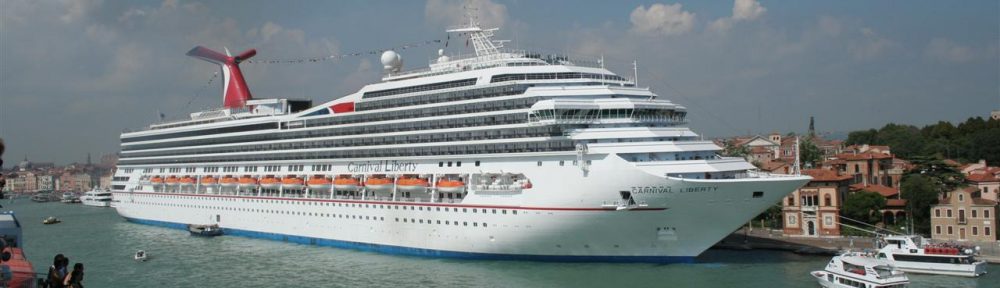
Carnival Liberty

Cruise ship passenger safety in once again in focus following a man overboard incident on a Carnival cruise ship in the Gulf of Mexico.

Samantha Broberg, 33, was reported missing at about noon Friday to crew members on board the Carnival Liberty. A search of the ship turned up empty, and crews later uncovered surveillance video to confirm that Broberg had fallen overboard from the 10th deck at around 2 a.m. Friday as the ship was about 200 miles southeast of Galveston.

A coordinated search involving the cruise ship and Coast Guard aircrews spanned 20 hours and covered some 4,300 square miles of ocean before it was called off Sunday night.

Carnival said in a statement that the video, which has not been released, suggests that Broberg was sitting on a deck railing when she fell back into the water.

A map of the search area provided by the U.S. Coast Guard.

According to the website CruiseJunkie.com, which tracks man overboard incidents on cruise ships, over the past five years an average of 23 people fall overboard from cruise ships each year. So far in 2016, there have been four such incidents, including an incident on May 11 where a man reportedly jumped overboard from the Coral Princess, according to the Cruise Law News website.

Cruise Law News, run by maritime attorney Jim Walker, has been critical of cruise lines for failing to install state-of-the-art video cameras to document such incidents, as well as high-tech motion detection systems that would alert the bridge as soon as a man overboard incident occurs. In the case of the Carnival Liberty, Walker slams the crew of the cruise ship over a 15 hour delay in reporting Broberg missing to the U.S. Coast Guard – the crew did not report Broberg missing until 5 p.m. Friday. Another issue Walker raises is the issue of Cruise Lines over serving alcohol to passengers, as alcohol seems to be the common thread in many of these accidents.

“My thought is that cruise lines owe a duty of reasonable care to passengers pursuant to maritime law,” Jim Walker writes on his website.

So this begs the question: are cruise lines doing enough to protect passenger safety?