‘Future-proofed’ ferries ready to go electric

The hybrid-electric, Island-class ferries will be converted to full electric once shore power is available
BC Ferries’ new hybrid-electric class is ready to be converted to fully electric propulsion

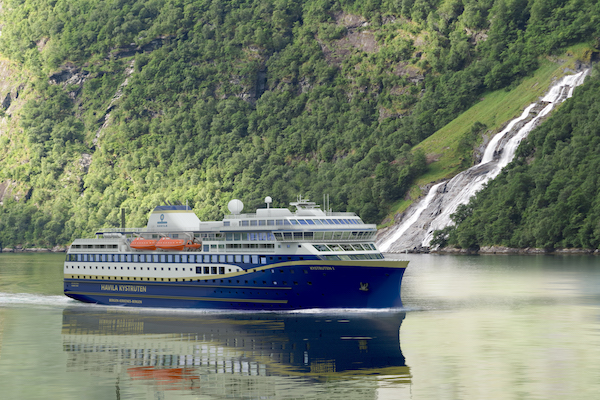
Damen Shipyards Group is building all six of BC Ferries’ new Island-class vessels at its Galati shipyard in Romania. The vessels are designed to carry 47 vehicles and up to 450 passengers and crew and will be capable of full-electric propulsion from new.

Two of the ferries were delivered in February 2020: Island Discovery and Island Aurora and are part of BC Ferries’ fleet renewal programme. These will replace 62-year-old North Island Princess and 51-year-old Quadra Queen II. In November, Damen announced it had secured a repeat order from BC Ferries for four additional Island-class ferries.

Discussing the transition from hybrid electric to full electric and the impact of this on the design and construction of the ferries, Damen product director ferries Henk Grunstra says: “When BC Ferries first started looking at using LNG for fuel, it was looking at adding the new Island-class ships to its fleet. It thought LNG for smaller ships was not the most attractive solution, so investigated using hybrid electric or full electric just as the Island-class was to be built.”

He explains the Canadian ferry operator needed a long-term solution, as the vessel will be deployed for the next 40-50 years. Therefore, BC Ferries decided it wanted to run the vessels as fully electric, but needed to start with hybrid-electric power as shore charging facilities are not currently available in the areas the vessels sail.

Mr Grunstra adds: “By starting with hybrid electric, BC Ferries can make the move later relatively easily. The hybrid technology is not a goal, but the first step to making vessels full electric.

“Electric sailing in British Columbia is very attractive as it has a lot of green energy. Therefore, BC Ferries kicked off with the battery pack and hybrid and we have made them ready for future developments so they can be converted to fully electric.”

Mr Grunstra says using hybrid technology makes the design of the vessels “a little more complicated” than full electric, as it requires building an energy power system that makes decisions about when to use batteries, when to use ultra-low sulphur fuel and when to use both. “That was a challenge,” he says “and we had to look at how BC Ferries would use the vessels in different locations. Since this is a class of vessels, the ships will sail in different locations and on different routes and one of the challenges was how to cater to different locations. The software and hardware have been arranged so they can be retuned for a specific operation.”

Island-class ferries have two battery rooms, each with 400 kW of batteries

Peak shaving

The hybrid-electric system will be used, among other ways, for peak shaving, to give the engines the most efficient load possible. Mr Grunstra says checking data from AIS and filtering out the way existing vessels operate was key to ensuring the engines were optimised. “These details determine the way the ship is operated. We had to start with the existing situation and see how the vessels were operating. Then we designed the hybrid solution for optimised operation.”

Over the next several months, the crew will be trained to sail the optimised system and the system may require fine-tuning.

The Island-class ferries have two battery rooms, each with 400 kW of batteries. There is room for these locations to be extended to each house 1,000 kW of batteries once the vessels are converted to fully electric.

Mr Grunstra says: “The electric systems in the ferries can cope with bigger batteries and they have been sized to do this; this means there is space in the switchboards. The only uncertainty is how the vessels will be charged – how the vessel connects to the existing infrastructure needs to be decided. But there are so many options this is not seen as an issue.”

Currently, within the hybrid-electric system, the engines charge the batteries. “We aimed for the engines to run at their most optimised setting,” he says. “The goal to make them fully electric means the energy savings will be much bigger than now.”

The Orca Energy batteries have been provided by Corvus, whose chief commercial officer Halvard Hauso explains: “These batteries are 800 kW which means they are not big enough for zero-emissions operations, but they are prepared for it. We sized the battery to the operational profile before shore power was installed. Once shore power is available, they will have room to expand the battery installation, by adding more to the same system. A hybrid ferry reduces costs and emissions by reducing fuel and at the same time reduces the need for maintenance as the engines are running fewer hours and at optimal loads. When they go full electric, they will save even more maintenance and emissions.”

Another strength of the Island-class ferries is the greatly reduced noise and vibration levels they offer.

Mr Grunstra says: “They are diesel-electric, which reduces noise and vibration and ensures the vessels are very quiet. The propellers are sized generously, so there is not a lot of load on the propulsion system, resulting in a very quiet ship. You can isolate the sources of noise easily on these ships and the electric-driven thrusters also reduce load noise. The propellers have a moderate load, which makes it easier to reduce vibration.”

Damen is also building two road ferries for Ontario that have a similar platform to the BC Ferries’ Island-class, but which will have shore charging included from the start. “They have bigger batteries and are charged at the shore after each run,” Mr Grunstra says. “They will run as full-electric all the time unless there are exceptional conditions.”

Henk Grunstra (Damen):“The hybrid technology is not a goal, but the first step to make vessels fully electric"

Henk Grunstra (Damen): “The hybrid technology is not a goal, but the first step to make vessels fully electric”

Snapshot CV

Damen Shipyards product director ferries Henk Grunstra has a long track record at Damen, starting in 1985 in the engineering department, later being responsible for high-speed and naval craft, luxury yachts and currently ferries

Costa Cruises ship cleared after coronavirus scare

 Image result for costa smeralda

The fear of a potential outbreak of coronavirus on one of the world’s largest cruise ships has turned out to be a false alarm.

Costa Cruises confirmed that Italian health officials diagnosed a passenger onboard the 6,000-passenger Costa Smeralda with the “common flu”.

Meanwhile, it has been confirmed that two members from the same family in England have the first cases of coronavirus in the UK.

Passengers on the Costa ship had been placed in quarantine as a precaution over a suspected case of the deadly virus in Civitavecchia, the port for Rome.

At least 66 British passengers were reported to be on board the vessel at the time.

A 54-year-old woman from Macau held in isolation on the ship with her husband had reportedly flown from Hong Kong to join the Mediterranean cruise.

A Costa Cruises spokesperson said: “Thanks to the protocols that are applied on board the fleet, Wednesday night our medical team promptly identified a suspected fever case in a 54-year-old woman, just a few hours before the ship’s arrival in Civitavecchia.

“As soon as the case was discovered, the required precautionary procedures were immediately taken. The relevant authorities were informed and, upon arrival of the ship in the port of Civitavecchia, they carried out all the required checks.

“While we appreciate the inconvenience caused, the procedures in force and our co-operation with the health authorities were effective in managing the situation and intended to ensure maximum safety for our guests, crew and the community as a whole.”

The ship will remain docked at Civitavecchia until today and miss the port of La Spezia before returning to its homeport of Savona.


MSC Magnifica in Queensferry, Scotland, photo credit Dave Jones

The scare came as rival line MSC Cruises announced a new series of strict “precautionary measures” across its fleet due to the coronavirus outbreak in China which has caused 213 deaths in the country and triggered a World Heath Organisation global health emergency.

Guests from all nationalities are required to fill out a pre-embarkation questionnaire to ensure no-one boards their ship who has travelled from mainland China or visited mainland China in the past 30 days. Anyone who has travelled from mainland China or visited mainland China in the past 30 days will be denied access to the ship;

Mandatory non-touch thermal scans conducted for all guests and crew prior to embarkation for every cruise operated by the company anywhere in the world, and persons with signs or symptoms of illness such as fever or feverishness, chills, cough or difficulty breathing will be denied embarkation;

Elevated deep-sanitation on every ship in the line’s entire fleet;

Guests who may have fever symptoms will be isolated in their cabin and the same measure applies for their close contacts, including guests staying in the same cabin and family members, as well as any crew member who may have served these guests.

A spokesman said: “While there are no cases of coronavirus on board any of MSC Cruises’ ships these measures are additional steps to secure the health and well-being of all guests and crew.”

“These measures follow previous actions that were taken last week,” the spokesman added.

“Guests and crew who travelled last week from mainland China were already screened for symptoms upon embarkation and were requested to report any symptoms of illness to the onboard medical centre.

“Since the outbreak of the coronavirus in China, MSC Cruises has been closely monitoring the public health and safety situation in each of the regions its ships sail.

“The company has been consulting with international and local health authorities to follow their advice and recommendations.”

The move came after the line cancelled the next three MSC Splendida sailings from Shanghai.

The ship’s four and five-night sailings from Shanghai to Japan on February 1, 5 and 9 will not operate.

MSC Splendida, deployed in Asia for the winter, will reposition to Singapore to start a 27-night repositioning voyage to the Middle East and Europe on February 14.

The line’s chief executive Gianni Onorato said: “The decision to reposition the ship from Shanghai to Singapore has been taken in the best interests of the safety and wellbeing for our passengers and crew, as was the decision to cancel our next three scheduled sailings from China.

“Many major airlines have either cancelled or reduced their flight frequency to China and the grand voyage, a maritime tradition whereby a ship moves from one part of the world to another for a new sailing season, was entirely booked with guests flying from abroad to enjoy the experience of a unique itinerary.

“In light of Singapore becoming a new embarkation port we have had to cancel calls to Naha, Japan and Hong Kong but it has also created an opportunity to update and enrich the grand voyage’s itinerary with four additional new ports; Langkawi, Penang and Kuala Lumpur in Malaysia, plus Ho Chi Minh City in Vietnam to create a new, one-of-a-kind memorable cruise.”

MSC Cruises expanding World-class, and more

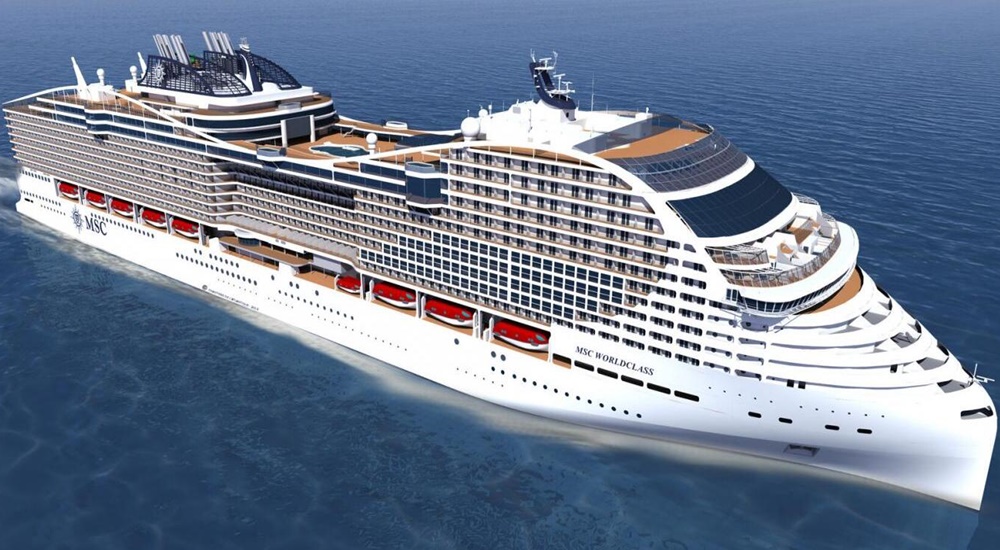
 MSC's first World class ship is due in 2022.
MSC’s first World-class ship is due in 2022. MSC Europa.

 MSC Cruises ordered two more cruise ships in its World-class and agreed to develop two additional ship classes. One will have at least four vessels and the other could use wind power.

The two firm ships orders and memorandum of understanding to build the two new prototypes represent a combined value of about $7 billion.

An agreement for the ships and prototypes was made with French shipyard Chantiers de l’Atlantique.

MSC placed orders for its third and fourth World-class ships, powered by liquefied natural gas (LNG), to be delivered in 2025 and 2027.

The new four-ship class will also be LNG-powered, MSC said, while another prototype will incorporate emerging technologies such as wind power.

MSC executive chairman Pierfrancesco Vago said that the investments “confirm this industry’s commitment to environmental sustainability.”

The four new vessels will represent a capital investment exceeding $4.4 billion, MSC said, adding to the $2.2 billion for the two additional World Class ships.

The Chantiers shipyard in Saint-Nazaire, France, is currently building the first two ships in the line’s World-class. The first of those 5,264-passenger, 205,000-gross-ton vessels, due to enter service in 2022, will be the largest ship operated by a European cruise line.