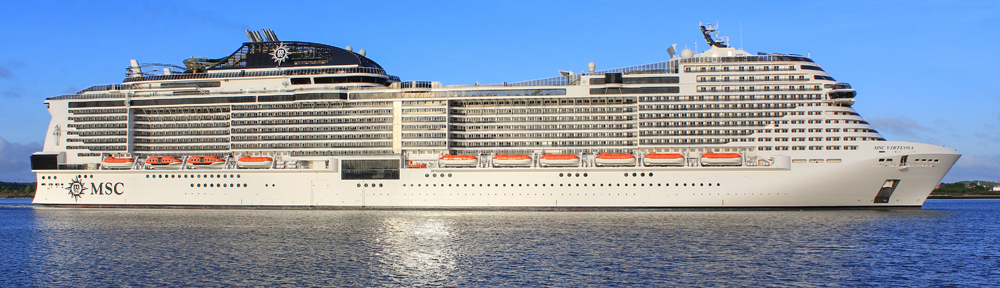
MSC Revving Up for Global Exposure

MSC Cruises is aggressively building up its global exposure through sponsorships of sports, including auto racing, soccer and basketball, in addition to the more traditional sales and marketing channels.

Comparing the cruise line to the worldwide Formula 1 racing series, Gianni Onorato, CEO of MSC Cruises, said: “We share common goals; we are focused on sustainability and driving new technologies, while also being in the entertainment business. F1 allows us to deliver our brand message across the world.

“This fits with our other sports sponsorships, such as the well-known soccer brands Paris Saint-Germain and Chelsea, and in basketball, the New York Knicks, which is drawing record spectator and (TV) viewer numbers.

“These sponsorships give us a high and positive visibility across the globe and in key markets,” Onorato added.

Showcasing MSC Cruises’ product this summer is the new 181,500-ton, 4,888-passenger (double occupancy) Euribia, built by Chantiers de l’Atlantique.

Onorato described the Euribia as the most environmentally sustainable cruise ship ever built and as for the new hull livery, he explained: “What is most important is not the decoration itself, but the message it sends with the hashtag ‘save the sea.’ Our assignment to the artist was to interpret our love of the sea and the need to care for and protect the sea.”

Built to run on LNG, the Euribia used biofuel on her first sailing, however, which meant net-zero greenhouse gas emissions, according to Onorato.

“The Euribia will allow us to sail in the heritage fjords of Norway,” he continued. “She will give us access to regions that in the future will become more restricted. In addition, our customers are also looking for a ship like this that is more environmentally oriented. I think that more and more sustainability will be a driver in people’s choice of holidays.”

The new ship is also fitted for shore power connection and will be dedicated to Northern Europe during its first year of operation.

Onboard features are shared with other ships of the same platform, Onorato said, noting that these have been fine-tuned. “Every time we introduce a new ship we work to improve and perfect certain aspects,” he said. “Thus, we have focused a lot on the entertainment and have three new shows on board as well as speciality restaurants ranging from Japanese to French and Italian cuisines, and bars similar to what you will find in high-end European destinations.”

Meanwhile, MSC continues to invest in new technologies like dual-fuel engines and systems to run on LNG, while also testing fuel cells, Onorato explained.

“For our legacy ships, we see non-fossil fuels as the solution, you can call it biofuels or synthetic fuels. And while our new ships run on LNG, longer-term solutions may also include hydrogen.

“We will do the necessary modifications to our ships so they will be ready to burn new fuels whenever these become available on a large scale.”

The clear target is net zero emissions across the entire fleet by 2050. Meanwhile, a target is to reach 40 per cent carbon intensity reduction by 2030, compared to 2008, is on track and already MSC Cruises is at 33 per cent, according to Onorato

“We believe the cruise market will continue to grow, and we are committed to maintaining our own leading position,” he said. “Our goal is not necessarily to be bigger than the other major brands, but to have our piece of the cake if I can put it that way.

“How far we will grow will be determined by our customers. What I can say is that we had 2.7 million passengers in 2019 and are on track to reach 4.2 million this year. So that means our customers love us.”

Photos: Gianni Onorato; MSC Euribia (Credit: Oceanliner Photos)

Excerpt from the Cruise Industry News Quarterly Magazine Summer 2023

MSC Cruises and Gasum Partner for LNG Solutions

The Cruise Division of MSC Group and Gasum have signed a long-term agreement for the supply of liquefied natural gas (LNG) to the new flagship of its MSC Cruises brand, MSC Euribia, as well as a Letter of Intent (LOI) with the goal of cooperating on the supply of synthetic e-LNG made with renewable energy, according to a joint company statement.

This is part of the cruise company’s strategy to achieve net zero greenhouse gas emissions from its marine operations by 2050.

The LOI between MSC Cruises and Nordic energy company Gasum is a landmark cooperation that aims at securing MSC access to liquefied synthetic gas, or e-LNG, which is produced using hydrogen, created by hydrolysis with renewable energy and captured CO2, the companies said.

Gasum and MSC Cruises are together creating an actionable roadmap for cutting emissions in MSC’s cruise operations with sizeable volumes of several thousand tons of e-LNG starting in 2026.

The companies also signed a long-term agreement on the delivery of LNG for MSC Euribia.

With this agreement, Gasum supports MSC Cruises in cutting emissions with the immediate use of LNG.

Linden Coppell, Vice President of Sustainability & ESG, MSC Cruises, said: “We are delighted to be partnering with Gasum on our journey to net zero greenhouse gas emissions. Securing a reliable supply of LNG and e-LNG is of critical importance to our decarbonisation efforts, and the LOI and long-term agreement that we have announced today are significant steps on that journey. Partnering with Gasum will enable us to access new and cleaner fuels needed to make net zero cruising a reality. We need more suppliers like Gasum to step up and support our industry with its environmental targets. We are ready and waiting to buy more of these new fuels.”

Mika Wiljanen, CEO, Gasum added: “As an alternative fuel supplier dedicated to the energy transition, Gasum is proud to offer support to MSC Cruises, a major maritime player, in their quest to improve the environmental footprint of their operations. At the same time, MSC Cruises is supporting the development of the most promising alternative fuel by proving demand for it. This LOI on e-LNG is a landmark agreement for the shipping industry as it demonstrates that e-LNG will be available to the maritime transport sector within a short timeframe. We are also very happy about the long-term LNG supply agreement which we believe is the start of long-lasting cooperation.”

MSC Expands Cruise Shore Power Plan to More Ports

MSC Euribia is 100% green-powered, the industry’s first.

MSC Group has unveiled what it said was the next phase of its shore power plan for both MSC Cruises and Explora Journeys.

At least 15 new ports between 2024 and 2026 will be added to the existing use for its vessels to plug into shoreside electricity grids to further demonstrate its commitment to, and continued progress towards, decarbonization, as well as reducing emissions from its fleet of ships while berthed in ports, the company said.

The new 2024-26 shore power plan includes at least five Italian ports; Barcelona and Valencia in Spain; Stavanger and Norfjordied, Norway; Miami, USA; Copenhagen, Denmark; Marseille, France; Rotterdam, the Netherlands; Valletta, Malta and Stockholm, Sweden.

The company intends for its ships, both MSC Cruises and Explora Journeys, to fully utilise shore power facilities at all other ports where it operates throughout Europe and the rest of the world when they are made available.

MSC Cruises ships have since February 2023 successfully used shore power at the ports of Southampton, UK and Kristiansand, Norway and later this summer the company will test the facilities at the Norwegian port of Haugesund. Other European trials this year are planned for a range of MSC Cruises’ ships at Bergen and Alesund in Norway and Warnemunde in Germany.

MSC Virtuosa taking shorepower in Alesund, Norway, photo credit Spacejunkie2(Flickr)

MSC Cruises will also use shore power in the German ports of Hamburg this winter and at Kiel in the summer of 2024.

MSC Cruises last year signed a memorandum of understanding with Cruise Baltic for shore power in the Baltic Sea area. Cruise Baltic has 32 ports and destinations in its region that are committed to increasing the number of shore power facilities, the company said.

Shore power capability has been fitted on all MSC Cruises’ new ships as standard since 2017 and together with retrofits completed on other vessels, 67 per cent of MSC Cruises’ total capacity is equipped with the technology. More ships will be retrofitted as the ports on their sailing itineraries make shore power available.

All Explora Journeys’ ships will also feature shore power capabilities. Explora I, the first ship in the new brand’s fleet, will first come into service on July 17 this year.

Linden Coppell, VP of Sustainability & ESG, MSC Cruises, said, “Shore power is an essential factor on our journey towards net zero greenhouse gas (GHG) operations. All of our newbuilds since 2017 are equipped with the ability to plug into local power grids and we are rolling out retrofits on the other vessels in our fleet.

“Our shore power plan actively demonstrates our ambition and that we are fully committed to reducing emissions from our ships, including while in ports,” she said.

“We have invested heavily in hybrid exhaust gas cleaning systems to substantially reduce local air quality emissions and we now need more ports across Europe and beyond to introduce shore power as quickly as possible. By making significant reductions to emissions in ports, we are fulfilling our responsibility to the docks and coastal communities that our ships visit and serve.

“Together with the use of LNG fuel, improving energy efficiency, utilizing innovative wastewater treatment and waste recycling, we are making positive strides in playing our part to address climate change and protect ocean biodiversity.”