EU Shore Power Regulations Fall Short of Potential

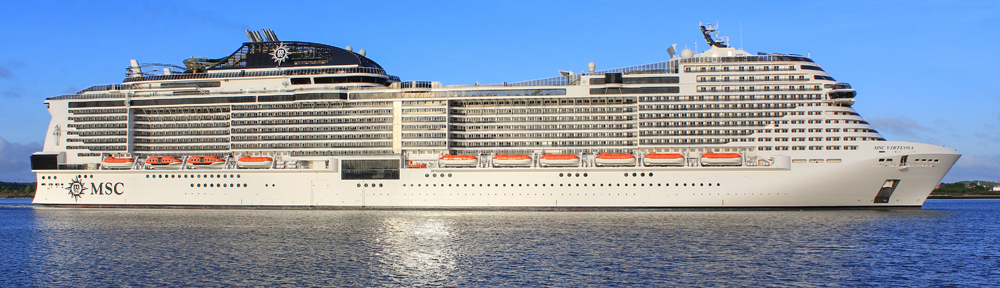
MSC Virtuosa connected to the Shoreside Power System  photo credit Spacejunkie2 (flickr)

The European Union (EU) is in a race to decarbonize the commercial shipping industry, and part of the strategy includes a requirement for ships to plug into shore power across the bloc’s ports. In line with the FuelEU Maritime Regulation and the Alternative Fuels Infrastructure Regulation, container and cruise ships over 5,000 GT must connect to shore power in the largest EU ports come January 2030.

The regulations have been hailed as critical measures in decarbonizing maritime transport, which accounts for three to four percent of total CO2 emissions in the EU. However, achieving shore power ambitions will be a herculean task. According to the International Council on Clean Transportation (ICCT), the bloc will only achieve a 24 percent reduction of at-berth CO2 emissions under the current setup.

The NGO contends that to achieve a 100 percent at-berth reduction in CO2 emissions, the forthcoming revision of both regulations should include a requirement for all ships greater than or equal to 400 GT to connect to shore power in EU ports. To achieve this, the EU will require nearly 1,929 MW of additional shore power installation to meet average at-berth annual energy demands, and 3,342MW for peak energy demand.

It also argues that boilers should also be retrofitted, electrified, or connected to shore power facilities, just like auxiliary engines, because they are responsible for 44 percent of all at-berth CO2 emissions. Boilers would require 36 percent of all needed shore power for ships berthing in EU ports.

The paper highlights that increasing the level of ambitions by including at-berth electricity demand for all ship types greater than or equal to 400 GT could reduce CO2 emissions by 42 percent. Adding more ports would help to avoid 58 percent of the total at-berth CO2 emissions.

Currently 51 ports in 15 EU member states are equipped with 340 shore power connectors, and Sweden, the Netherlands and Germany lead the pack. The current shore power network supplies around 309 MW, mostly for container, passenger and cruise ships.

Though cargo ships are the most common docking in EU ports, accounting for 43 to 46 percent, their energy demands are relatively low at 14 percent of the total. In contrast, despite their small absolute number in the fleet, the energy demand of cruise ships stands at 21-28 percent of the total. 

The largest additional shore power installations will be needed in Italy, Spain and France where energy demand cumulatively stands at 3,004 GWh, mainly due to high cruise ship traffic. Cruise ships alone in the three countries would account for 59 to 63 percent of shore power needed. 

MSC Cruises and Gasum Partner for LNG Solutions

The Cruise Division of MSC Group and Gasum have signed a long-term agreement for the supply of liquefied natural gas (LNG) to the new flagship of its MSC Cruises brand, MSC Euribia, as well as a Letter of Intent (LOI) with the goal of cooperating on the supply of synthetic e-LNG made with renewable energy, according to a joint company statement.

This is part of the cruise company’s strategy to achieve net zero greenhouse gas emissions from its marine operations by 2050.

The LOI between MSC Cruises and Nordic energy company Gasum is a landmark cooperation that aims at securing MSC access to liquefied synthetic gas, or e-LNG, which is produced using hydrogen, created by hydrolysis with renewable energy and captured CO2, the companies said.

Gasum and MSC Cruises are together creating an actionable roadmap for cutting emissions in MSC’s cruise operations with sizeable volumes of several thousand tons of e-LNG starting in 2026.

The companies also signed a long-term agreement on the delivery of LNG for MSC Euribia.

With this agreement, Gasum supports MSC Cruises in cutting emissions with the immediate use of LNG.

Linden Coppell, Vice President of Sustainability & ESG, MSC Cruises, said: “We are delighted to be partnering with Gasum on our journey to net zero greenhouse gas emissions. Securing a reliable supply of LNG and e-LNG is of critical importance to our decarbonisation efforts, and the LOI and long-term agreement that we have announced today are significant steps on that journey. Partnering with Gasum will enable us to access new and cleaner fuels needed to make net zero cruising a reality. We need more suppliers like Gasum to step up and support our industry with its environmental targets. We are ready and waiting to buy more of these new fuels.”

Mika Wiljanen, CEO, Gasum added: “As an alternative fuel supplier dedicated to the energy transition, Gasum is proud to offer support to MSC Cruises, a major maritime player, in their quest to improve the environmental footprint of their operations. At the same time, MSC Cruises is supporting the development of the most promising alternative fuel by proving demand for it. This LOI on e-LNG is a landmark agreement for the shipping industry as it demonstrates that e-LNG will be available to the maritime transport sector within a short timeframe. We are also very happy about the long-term LNG supply agreement which we believe is the start of long-lasting cooperation.”

Norwegian Cruise Line Holdings Completes Biofuel Trial

PRIO, a producer of biofuels in Portugal, and Norwegian Cruise Line Holdings in collaboration with World Fuel Services (WFS), have successfully completed the first trials with sustainable biofuels produced in Portugal, according to a press release.

Following the launch of ECO Bunkers B15 and taking the first step towards the decarbonization of maritime transport in the Iberian Peninsula, PRIO has announced a blend of Biofuels with 30 per cent renewable base material.

This milestone was achieved in collaboration with Norwegian Cruise Line Holdings and the Florida-based energy and services company World Fuel Services.

The new fuel, ECO Bunkers B30, contains a blend of 30 per cent of advanced biofuel from waste raw materials and it is produced at PRIO’s biodiesel plant in Aveiro. This enables the company to scale up production as demand increases and to adjust the percentage of Biodiesel blends (up to a 100 per cent renewable product).

Luis Nunes, a member of PRIO’s Executive Board said: “Advanced biofuels, produced from residual raw materials, i.e., the result of circular economy, are the solution of the present and that allows us to immediately meet the growing needs of our clients. They are “drop-in” solutions, meaning that they did not require any modifications to the engine or tank of Norwegian Cruise Line Holdings’ cruise ships and, in this way, allowed an immediate impact without any need for additional investment in these ships.

“We are at a crucial moment in the world’s response to climate and biodiversity emergencies, so PRIO believes we can already accelerate the energy transition if we increase the contribution of advanced biofuels in the maritime sector,” he added.

PRIO has established itself as the ideal partner for maritime companies on the road toward decarbonization of the sector.

With the help of World Fuel Services, two Norwegian Cruise Line Holdings ships were fueled with a total of 400 tons of B30 supplied by PRIO last year.

The Norwegian Star received 200 tons of ECO Bunkers B30 in Lisbon in November.

The following week, the Norwegian Epic, received another 200 tons of ECO Bunkers B30. This has enabled the cruise company to avoid approximately 440 tons of CO2 emissions.