Polar Latitudes and Albatros Expeditions to Merge

Polar Latitudes and Albatros Expeditions to Merge

Polar Latitudes and Albatros Expeditions are set to merge their operations ahead of the 2026 season in the Arctic.

The two expedition brands joined forces earlier this year, coming together under the same ownership group.

While the merger was confirmed in a social media update, additional details of the joint operation will be announced in mid-October.

“We are very excited about our future in the expedition cruise industry, which we intend to lead through innovation, collaboration, and leading responsible tourism initiatives,” Polar Latitudes stated.

The brand added in a social media update that the merged operations will be highlighted by operating “the most fuel-efficient fleet” in polar areas.

In an interview with Luxury Australian Travel Trade News (Latte), Albatros Expeditions’ CEO Patrick Shaw said that the new company will be named Polar Latitudes Expeditions.

Shaw will reportedly serve as CEO of the newly created entity, having previously served as CEO and President of Quark Expeditions.

“Given this exposure and experience, I have been in a unique position to appreciate the possibilities that this merger affords, and I am honoured and delighted to be a part of this transformation,” he told Latte.

He noted that the new brand will operate “more durable, efficient and expertly led” ships, highlighting the company’s field staff training and integration with communities.

Polar Latitudes currently operates the Seaventure for seasons in Antarctica, while Albatros Expeditions sails the Ocean Victory and the Ocean Albatros.

The Ocean Albatros operates for the brand on a year-round basis, offering expeditions in Antarctica and the Arctic.

Chartered from SunStone Ships, the Ocean Victory sails for the brand seasonally, offering itineraries in Antarctica and South America.

Polar Latitudes Expeditions’ new website is expected to launch in mid-October, when the company is also set to organise a series of online events for trade members and customers.

MSC Cruises to Reduce Fleetwide Emissions by Up to 15%

MSC Magnifica is anchored in the Firth of Forth just under the Forth Railway Bridge for more Images of Magnifica follow the link.https://flic.kr/s/aHsm7BUfg3

MSC Cruises is set to reduce fleetwide emissions by up to 15 per cent in 2026 by implementing a new itinerary planning optimization tool, OptiCruise, according to a press release.

Developed in collaboration with OPTIMeasy, the new mathematical model reportedly analyzes various factors influencing the planning of MSC Cruises’ itineraries. The goal is to achieve maximum efficiency while maintaining or enhancing guest satisfaction, the company stated.

The MSC Bellissima was selected to test the prototype technology over 12 months while sailing between 17 ports in the Mediterranean Sea.

Michele Francioni, chief energy transition officer at MSC Cruises, said: “We have identified and developed this new technology to optimize the decision-making process of itinerary planning to further reduce emissions across our fleet from 2026.  

 “The OPTIMeasy team calculates that the average fuel savings made, and emissions reduced by using OptiCruise are in the range of 10-15 per cent which is a significant step forward in our ambition to achieve our net zero greenhouse gas emissions target by 2050 for our marine operations.” 

According to the company, voyage planning in the global cruise industry has traditionally focused on the appeal of ship destinations to potential holidaymakers.

OptiCruise aims to expand this approach by incorporating a range of factors that affect itinerary efficiency. These include the sequencing of port calls, departure and arrival times, a ship’s speed, destination attractiveness, shore excursions and operational costs such as fuel, port charges and food provisions.

The tool’s algorithms analyze this data to identify optimized itineraries that maintain guest appeal while enhancing energy efficiency.

MSC Cruises’ strategy to reach net zero greenhouse gas (GHG) emissions by 2050 for its marine operations centres on three key areas: ship and engine technology, operational efficiency and renewable fuels. OptiCruise falls under the operational efficiency category, aiming to enhance energy consumption through increased digitalization.

OptiCruise was developed under the European Union’s Project CHEK, which explores low-carbon shipping technologies and innovative designs.

Fincantieri: ‘Covering All Brands’ with Eye on Future Fuels

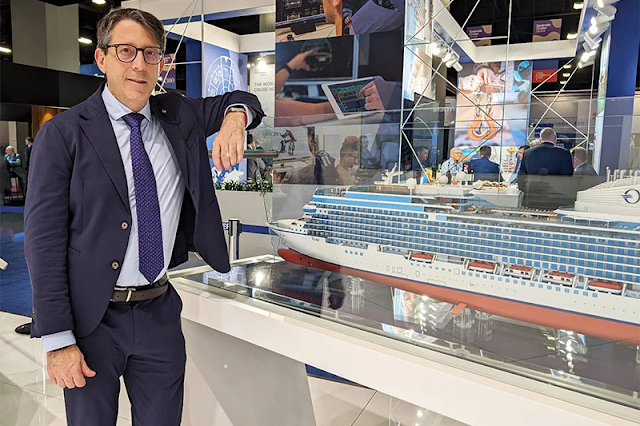
Coming off a big newbuild order from Norwegian Cruise Line Holdings, Daniele Fanara, director of new building and after-sales at Fincantieri, is positive about the future.

“We are serving all segments of the market, from small luxury vessels to mega-size vessels to upper premium,” said Fanara, speaking to Cruise Industry News. “This covers all the brands in the cruise industry.”

Fanara said Fincantieri was very proud to be working with a variety of operators and being able to serve each of them in a tailored customized way.

“We have cross-fertilization with our technology, including the capacity to design the vessel,” he added.

NCLH Order

The new Norwegian Cruise Line Holdings order for eight ships includes orders for all three company brands, with new classes of ships for each of them. Norwegian, Oceania and Regent will all get new bigger ships, with orders for the Norwegian brand stretching to 2036.

“We are proud of the trust that Norwegian gave us to develop such an important program,” said Fanara.

Looking at future technologies, Fanara said the ships were being developed.

“Our attention is focused on three main fuels,” he said. “One is LNG, one is methanol, and one is hydrogen. Hydrogen is the most innovative one. We are developing new ideas on how and when we can implement hydrogen onboard the vessels.”

New ships for Oceania and Regent are being developed to be methanol-ready.

“Today there is no real answer on the fuel of the future,” Fanara continued. “It’s a matter of availability. What’s important from our side is that we are always studying the latest technology available. We are also exploring CO2 capture technology.”

Fanara said among the alternative fuels, LNG was notable in the fact it was being used today.

“Ships are sailing on LNG. The other technology is in a different phase of development. We need to monitor them so we are ready to implement them if necessary,” he explained.

Questions are coming in from cruise lines on alternative fuel practicalities, Fanara said, but with the most questions on hydrogen.

“It is the most innovative, it is the most unknown.”

Industry

Fanara called the cruise industry resilient.

“Soon after Covid, the speed at which the industry recovered and came back to strong booking and revenue levels is incredible,” he said.

Fanara expects other orders to follow, citing market demand and the value gap between cruise- and land-based vacations.

Shipbuilding Costs

Costs are up to build ships.

“A greener vessel is for sure more expensive to build,” Fanara noted. “But is the value of this additional cost worth it for the industry?

“The owners can say the ships are more expensive. We had Covid, we had wars and the result of this has been inflation. If you mix inflation and the technology transition, the result is not less expensive ships.”