NCL, Oceania and Regent get permission to sail Cuba cruises

The Norwegian Sky will sail Cuba voyages from Miami.

After waiting for six months, Norwegian Cruise Line Holdings (NCLH) finally got the call it had been seeking from the Cuban government allowing it to start cruises to Cuba from Miami, beginning in March.

The authority is temporary and will expire in May. But it covers three brands (Norwegian Cruise Line, Regent Seven Seas Cruises and Oceania), the first time a cruise company has won approval to marshal multiple brands in a strategic foray into the Cuban market.

“We are tremendously excited to have all three of our award-winning brands receive approval from authorities in Cuba to offer cruises to Cuba from the United States,” said Norwegian Cruise Line Holdings CEO Frank Del Rio, who was born in Cuba.

“This is truly a dream come true for me, and I cannot wait for our loyal guests to experience the sights and sounds of my hometown of Havana and get to know its rich culture and its warm and welcoming residents,” he said.

Cruises will sail on the 1,928-passenger Norwegian Sky, the 1,250-passenger Marina and the 700-passenger Seven Seas Mariner.

Image result for seven seas mariner

Seven Sea’s Mariner,

The first Oceania cruise to Cuba will depart Miami on March 7, leaving less than three months to prepare the ship, the itinerary, the crew and to sell the cruises. The Marina voyages will include “many multiple-day calls to allow guests to explore Havana and its environs,” the company said.

The Norwegian Sky will sail a series of four-night voyages over nighting in Havana in May, while Seven Seas Mariner will call on Havana during two cruises in April.

Pricing was not released. On Carnival Corp.’s Fathom, the only other cruise line to gain approval to sail between Miami and Cuba, fares start at about $1,900 for a seven-day cruise.

Fathom’s ship, the Adonia, is older and much less luxurious than the Marina, which was built in 2011. The Adonia is about the same age as the Norwegian Sky.

It isn’t clear why Cuba is giving NCLH such a small window in which to operate. However, Fathom’s authority to sail to Cuba will also expire in May.

The opening for NCLH comes at a crossroads in relations between the U.S. and Cuba with both countries going through a transition in top leadership. Some analysts had expected a pause in new business approvals, while others saw an acceleration to take advantage of the Obama administration’s open stance towards Cuba.

Image result for cuba cruise
Fathom Cruise entering Havana

Cruise tourism to Cuba remains bound by the “people-to-people” framework in place since 1982. That requires shore excursions to be structured to promote exchange activities, such as cultural and humanitarian visits. Norwegian said its cruises would comply with Treasury Department rules.

To sail the new itinerary, Norwegian and Oceania will have to re-accommodate guests already booked. The March 7 Marina departure is currently listed as a 14-day cruise to ports in the western Caribbean, Central America and Colombia. The ship was scheduled to leave for Europe on April 10.

The Norwegian Sky does three- and four-day cruises from Miami that typically attract late bookings.

Image result for regent seven seas explorer
Regent Seven Seas Explorer

NCLH’s application to sail to Cuba has been pending for at least a year. At a July news briefing onboard the new Regent Seven Seas Explorer, also an NCLH-owned ship, Del Rio said he was “literally waiting on a phone call for the final, final approval” from Cuba.

But after the Adonia’s authority was granted in March, no other cruise ship approvals followed until now.

Royal Caribbean Cruises Ltd. is among the cruise companies with applications pending. It plans to use Royal Caribbean International’s Empress of the Seas to ply the Florida-Cuba route.

MSC Cruises sails to Cuba but does not market the cruises to U.S. residents. Celestyal Cruises offers seasonal Cuba cruises that Americans can take by flying to either Havana or Montego Bay, Jamaica, and enrolling in a people-to-people group program for shore excursions.
Cruise Lines Ordering Larger and Larger Ships

Related image

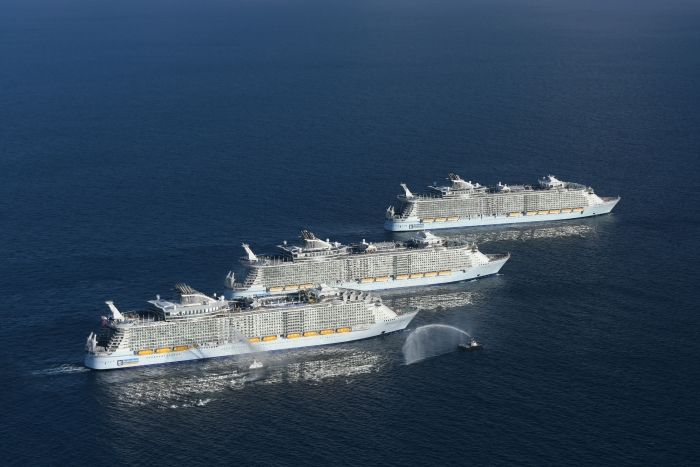
Oasis sisters cruising the Caribbean

The cruise industry has embarked on a newbuilding program unlike anything seen before. The IHS Markit database lists 62 vessels on order. However, if the 10 ships Genting Hong Kong group said it plans to build at MV Werften in Germany and other options are included, that figure moves closer to 80, a record high for the industry.

In the mass cruise ship market, which accounts for most of the existing fleet and new orders, owners are mainly ordering ships of 180,000 to 200,000 gt.

Recent examples are Royal Caribbean International’s two Icon-class 5,000-passenger capacity vessels the company said on 11 October it would build at Meyer Turku in Finland. They will have about the same capacity and probably a similar gross tonnage as the two 5,400-passenger, 180,000 gt vessels the US-UK cruise company Carnival Corporation & plc has ordered for the Miami-based Carnival Cruise Line. At the same time, it also ordered another similar unit at Meyer Werft in Papenburg for P&O Cruises in the UK.

About five years ago, the average size in the mass cruise ship market was in the 140,000 to 160,000 gt bracket, while the first 100,000 gt cruise liner – Carnival Triumph – was only built in 1996. Economies of scale drive this development: large vessels are hugely efficient, and large fleets of such ships transcend that efficiency from ship to company level.

 
Image result for carnival triumph


IHS Markit data shows that by mid-November, 25 cruise liners totaling 2.18 million gt had been ordered this year, with an average size of 87,200 gt. In the full year 2015, 12 ships totaling 1.3 million gt were ordered, which gave an average size of about 108,000 gt. The fall in average size is explained by several expedition cruise ships ordered this year as these are much smaller than the mass market and premium market units.

From the perspective of the shipbuilders, contractors, and suppliers working in this sector, the present situation and continued bullish outlook mean unprecedented opportunities. However, the ever-expanding commitment of capital for mainly very large vessels means that in the case of a severe downturn in the cruise industry, the negative effects would almost certainly be felt throughout the value chain. A sharp downturn in the global economy, geopolitical events, and terrorism could all potentially trigger such headwinds.

The boom is changing the landscape of operators, as MSC Cruises and Genting Hong Kong plan to add proportionally more capacity than their larger competitors, such as Carnival Corporation, Royal Caribbean Cruises, and Norwegian Cruise Line Holdings.

It has also changed the landscape of the cruise shipbuilding sector. While three key groups continue to dominate the scene, new entrants have emerged. Fincantieri in Italy, the Meyer group with yards in Germany and Finland, together with STX France remain by far the largest builders, both in terms of vessel numbers and their gross tonnage.

 
Image result for stx france


However, as slots at these yards have become increasingly difficult to obtain, the Genting Hong Kong group that owns Crystal Cruises in the US plus two Asia-focused lines, Dream Cruise and Star Cruises, acquired three shipyards in Germany that it renamed MV Werften. Genting’s aim is to build vessels for all three brands at its own yards.

This new departure involves both opportunities and risks. As slots are hard to obtain at the leading builders, Genting will be able to agree deliveries of newbuildings with a shorter lead time and at the intervals its brands require.

On the flip side, the complexity of managing such projects and the fact that the arrangement brings both ship operating and building risks under a single roof cannot be ignored. Maintaining a high rate of capacity utilization through design, steel work, and fitting out, plus the management of the projects so that deliveries take place on time and on budget are all elements Genting will have to ensure.

On 23 September, Carnival Corporation & plc said it had signed an agreement to build up to four 133,500 gt cruise liners at China State Shipbuilding Corporation (CSSC) in China for the local market.

The vessels will be based on the Carnival Vista class, a platform shared by the Carnival Cruise Line, Costa Crociere, and P&O Cruises Australia brands of the Carnival group, at Fincantieri, which has set up a joint venture with Carnival and CSSC to develop cruise shipbuilding in China.

 
Image result for stx france


This means that CSSC is taking a cautious approach in its entry to cruise shipbuilding. As both Fincantieri and the Carnival group have past experience of the Carnival Vista class, they are well-versed with the design and can pass on experience to CSSC. A series of four vessels means that CSSC has scope for a learning curve.

Mitsubishi Heavy Industries, which won an order for two 124,500 gt ships from AIDA Cruises, a German unit of Carnival group, has decided to pull out of cruise shipbuilding after major delays and deep losses from the two ships. These were prototypes and Mitsubishi did not team up with an experienced cruise shipbuilder to work on the project. Two vessels are unlikely to produce a learning curve, although AIDA might have ordered more units of the same type had the first two vessels been built on time and budget.

Operators of expedition cruises have started to place orders for new tonnage after the IMO in 2016 approved its Polar Code, which sets technical and crew training requirements for cruise ships that trade in high latitudes, north and south, from the start of 2017. So far, these new buildings have been in the 10,000 to 25,000 gt size range: they are much smaller than the contemporary market units now on order, but nevertheless larger than most expedition cruise ships currently in service. Most of them will also be fitted out to much higher standards than the majority of the existing tonnage in this category.

These smaller vessels do not fit in the production schedule of builders of large cruise liners, which means that yards in Norway that mainly built offshore services tonnage have found a welcome new market. MV Werften and Uljanik and Brodosplit in Croatia have also won expedition cruise ship orders.

 
Image result for mv werften
MV Werften to build Crystal Cruises’ polar-class ships


The smaller size of these vessels means that both the technical and financial risks linked to them are much smaller than those of very large vessels. As the expedition cruise market is not as developed as the mainstream one, many shipbuilders have produced their own portfolios of concept designs that they can offer their prospective customers. Whereas in mainstream cruise shipbuilding, it is mainly the owners who produce concept designs.

For the same reason, ferry owners have started to look at shipyards other than major cruise shipbuilders to carry out their newbuilding projects. A sharp fall in the price of oil since late 2014 negated a feared steep rise in bunker costs following the introduction of the Sulphur Emission Control Area (SECA) in northern Europe at the start of 2015. Ferry companies’ results have been better than were anticipated in 2014, and this has led them to begin renewing their often ageing fleets.

Cruise shipbuilding differs markedly from dry bulk carriers, tankers, and container vessels, which are often of a standard design. Cruise liners, however, are of bespoke design to the owner and all aspects of a build are crucial in successful execution of a project. The threshold for a shipyard to enter the sector is therefore very high. Instead of the rapid roll-out of a standard design project, the focus in cruise shipbuilding is on managing complex flows and sequences of events. Failure is likely to result in deep losses that can run into nine-digit figures in dollar terms, as in the case of Mitsubishi.

Viking, one of the most interesting stories in cruising, just got more interesting

Image result for viking cruise

Viking Cruises quietly turned an important corner last week – one that signals the company may be on the cusp of significant growth.

The transition came through a vehicle called MISA Investments Ltd., which received a $500 million equity infusion from TPG Capital and the Canadian Pension Plan Investment Board.

Few in the cruise world recognize MISA Investments as the parent company of Viking Cruises. I know I didn’t. But after the deal, 17% of MISA will be owned by Canada’s retirement plan and TPG.

The significance of that is that until now, Viking has been a privately held company, financed primarily by European banks.  The new financing represents Viking’s first institutional equity.

There’s only so far private money can take a cruise line. With the notable exception of MSC Cruises, big cruise companies turn big when they gain access to other people’s money.

The latest example of that was Norwegian Cruise Line Holdings. It became publicly-held in 2013, but before it went public it benefitted from private equity interest as well.

And TPG Capital was one of two funds (along with Apollo Group) to put money into Norwegian. Their dollars paid off debt and financed new ships at Norwegian, which led to higher cash flows, taking the company to its long-anticipated public offering.

Now TPG could be setting the stage for something similar at Viking.

“Having been a long-time investor in the cruise industry, we see Viking as a market innovator that has reimagined how people explore the world, with an iconic brand and strong product offering that has significant growth potential,” said Paul Hackwell, principal at TPG, in announcing the investment.

Hackwell said he looked forward to working with Viking CEO Torstein Hagen to expand, “both in products offered and regions served.”

TPG once held north of 10% of NCLH, but it has harvested its gains and now holds about 5 million shares, or 2.3% according to a 2016 proxy statement

For his part, Hagen said the new equity “will give us great opportunities to grow further, particularly in destination-focused ocean cruising as well as cruising in Europe for Chinese consumers.”

In short, one of the most interesting stories in cruising just got more interesting.