Royal Caribbean Suspends U.S. Cruises, Joining Rivals

March 13 (Reuters) – Royal Caribbean Cruises Ltd said on Friday it was suspending its cruises in the United States for 30 days, an hour after Norwegian Cruise Line Holdings Ltd said it suspended all its cruise voyages through April 11.

Earlier larger peer Carnival Corp’s Italy-based unit Costa Cruises halted its trips until April 3. Carnival’s other subsidiary Princess Cruises had suspended its voyages for two months on Thursday.

Costa Cruises accounted for 15% of Carnival’s overall capacity as of Nov. 30, offering voyages in Asia and Europe, including the Mediterranean.

Image result for ncl escape

The Princess Cruises unit has been in the spotlight after its Diamond Princess and Grand Princess ships were quarantined after they became hotbeds for coronavirus infections.

Norwegian, however, said no confirmed case of the virus was reported across its 28 ships.

Walt Disney’s Disney Cruise Line and Finland’s Viking Line have also temporarily paused operations as the global cruise industry battles cancellations in the wake of the fast-spreading virus.

The outbreak, described by the World Health Organization as a pandemic, has infected thousands in the Mediterranean countries such as Italy, where it has claimed more than 1,000 lives.

Carnival said it was checking if their guests are aged over 70 years and would deny entry to people with chronic or severe medical conditions.

Separately, credit rating agency S&P Global said it lowered the credit ratings on Carnival and its unsecured debt to ‘BBB’ from ‘A-‘, on expectations of a significant loss in revenue and cash flow in 2020.

Stocks of cruise operators are among the worst hit, with Carnival, Norwegian and Royal Caribbean down between 66% and 81% this year through Friday’s close. (Reporting by Praveen Paramasivam in Bengaluru; Editing by Sriraj Kalluvila and Krishna Chandra Eluri)

(c) Copyright Thomson Reuters 2019.

Cruise Lines 2019 Q4 Breakdown: By the Numbers

Seabourn, Royal Caribbean and AIDA Ships in Antigua

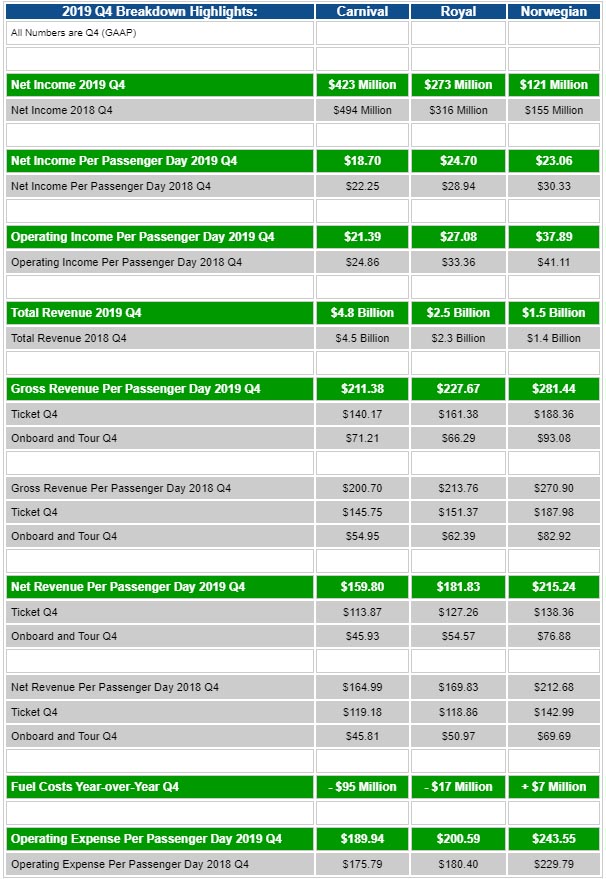
Cruise Industry News takes a look at the financial performance of the “big three” following the final quarter of 2019.

Takeaways:

While gross revenue was up for Q4 2019 for the three publicly-traded cruise companies, increased operating expenses led to reduced operating income, net income and net income per passenger day, compared to Q4 for the previous year.

Net revenue per passenger day was also down year-over-year for Carnival Corporation, up noticeably for Royal Caribbean and up slightly for Norwegian.

Gross revenue per passenger day was significantly up for all three companies, including onboard spending, with gross ticket revenue per day also up for Royal Caribbean and Norwegian, but down for Carnival.

Carnival saw the biggest difference between gross and net onboard revenue: more than $25, making it flat with last year, while Royal had nearly a $12 drop and Norwegian a little more than $10, and up from last year.

Both Carnival and Royal Caribbean saw a decrease in fuel costs year-over-year while Norwegian saw its fuel spend to go up.

Carnival cited the regulatory change preventing travel to Cuba, geopolitical events in Arabian Gulf, Hurricane Dorian, an unscheduled drydock, and multiple shipyard delays. Royal cited the Oasis drydock mishap, Cuba and Hurricane Dorian, and Norwegian also cited Cuba and Dorian.

Because of the fleet mix, Norwegian continued to generate the highest gross and net ticket and onboard spend revenue.

2019 financeCruise Industry Financial Tracking

The Cruise Industry Financial Tracking Report provides an in-depth look into the financial metrics of the leading cruise companies. Learn more.

Included: Carnival, Royal Caribbean, Norwegian, MSC, Star/Genting, Royal Olympic, P&O Princess, Regent, American Classical Voyages and Commodore.

Key metrics include revenue, operating expenses, operating income and net income, as well as those metrics on a per passenger day basis. We also look at EPS, fleets, berths and passenger cruise days.

Norwegian Cruise Line Holdings: Virus depressing bookings globally

The Norwegian Spirit has been moved from Asia to Europe.

The coronavirus Covid-19 outbreak has caused a slowdown in new bookings and increased cancellations worldwide, Norwegian Cruise Line Holdings reported to investors today.

NCLH CEO Frank Del Rio said that the impact of the virus extends beyond Asia, threatening what in early January looked to be the start of a record year for the company.

“The resiliency of our business model will be tested once again by a noncontrollable external factor,” he said. “The effect of the coronavirus outbreak on our business has been swift and severe and the continuous global headline news coverage has been substantial and relentless.”

NCLH said in an earnings release that it has cancelled 40 cruises across its three brands due to the outbreak: 10 on Oceania, six on Regent Seven Seas, and 24 on Norwegian Cruise Line (21 were on the Norwegian Spirit, which was redeployed to the Eastern Mediterranean from Asia earlier this month.

NCLH CFO Mark Kempa called the outright cancellation of cruises on Oceania and Regent Seven Seas “a significant impact for us.”

Image result for regent seven seas asia cruises

“Those are very long lead-booking itineraries with very high per diems,” he said. “Those voyages were completely sold out.”

Despite the Spirit’s extremely condensed booking window, Del Rio said the relocation of the ship provides the best opportunity to maximize its earnings and revenue potential and “demonstrates our nimbleness and ability to redeploy our assets as necessary.”

Looking ahead, Del Rio said that “given the unknown duration and severity of the outbreak, there may additional impacts that are not yet quantifiable. It is affecting the broader consumer demand environment that extends to our global deployment outside of Asia, which cannot be quantified at this time.

“The cruise industry was at the forefront of headline news for reasons that we know and that has caused near panic in the travelling public,” he added. “So, we’ve seen a meaningful decrease in new bookings. A meaningful increase in cancellations. Not just for our Asia sailings but throughout the deployment.”

Del Rio said he’s heard from travel partners and business partners that they are seeing similar trends across their portfolios.

“Business is soft, people are scared to travel,” he said. “Until we see the levelling off of new cases and the cruise industry not being the poster child for the virus, this may continue for some time.”

But he also said that “nothing is permanent.”

“Consumers do have a relatively short memory, thank god. We have seen other major events affecting the cruise industry that were quickly overcome,” Del Rio said.

Silver linings 

Del Rio also pointed to “silver linings,” including what he called the “underlying resilience of our business and potential for a reasonably timed recovery.”

The strong booked position prior to the outbreak, he said, “demonstrates the strong demand fundamentals of our business.”

He also said that in the past five days, NCLH has seen an improvement in week-over-week booking volumes and a decrease in cancellations compared with the prior three weeks.

“I don’t want to call it a turnaround trend just yet, but it is at least one data point of a possible positive change,” he said.

“We are no longer seeing a week-over-week acceleration in the declines in bookings and increases in cancellations. We’re seeing a moderation.”

Del Rio said the bookings decrease is similar to what the company experienced during similar geopolitical events and the financial crisis a decade ago. The difference with this crisis, he said, is the increase in cancellations.

“As an industry and company, we have faced and overcome challenges similar to Covid-19,” Del Rio said.  “I am confident this challenge will not be different. It usually takes eight-plus weeks from the time the news cycle peaks to when we can expect a return to normal booking patterns. It’s not a question of if, but when.”