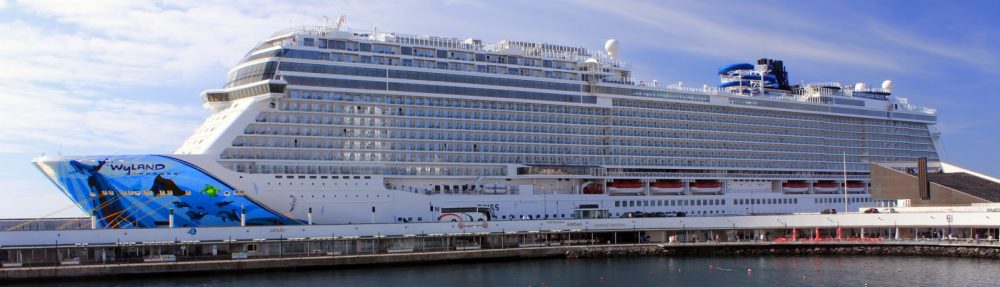

Britannia is a cruise liner constructed by Fincantieri for the British cruise line Peninsular and Oriental (P&O) Cruises. P&O Cruises is owned by Carnival Group, the world’s biggest cruise ship operator. The ship was christened in a naming ceremony held in September 2013. The estimated investment for the cruise vessel is £500m (approximately $825m).
The ship will sail on its maiden voyage from Southampton, England, to the Mediterranean in March 2015. She can accommodate a total of approximately 5,600 passengers. The inaugural itineraries include a voyage covering the Norwegian Fjords, the Canary Islands and the Baltic Sea.
The ship will be transferred to the Caribbean during winter, sailing for 15-night fly/cruise itineraries from Barbados.
Construction of Carnival’s cruise ship

The 400t keel was laid at a ceremony in May 2013 at Fincantieri’s Monfalcone shipyard. © P&O Cruises.
Carnival awarded the contract to build the new cruise ship to Fincantieri in June 2011. The first steel was cut in November 2012 and her 400t keel was laid in May 2013.
She was launched in Fincantieri’s Monfalcone shipyard in February 2014, and is scheduled to be delivered to her owner in March 2015.
Design details of the Britannia
Richmond International designed the interiors and all of the public areas including passenger cabins, restaurants and entertainment areas. An art collection worth over £1m is displayed onboard.
Britannia will measure 330m in length and 38.4m in width. The length between perpendiculars of the ship will be 306m and gross tonnage capacity will be 142,000t.
The cruise ship will feature 15 passenger decks comprising 1,819 passenger cabins, which will be categorised into suites, deluxe balcony cabins, outside and balcony cabins, inside cabins and 27 single inside cabins.
Entertainment and relaxation aboard Britannia

The most eye-catching and remarkable feature of Britannia’s three tier atrium is the Starburst chandelier at the centre.
The ship features a studio, which is a multi-purpose venue for talks, guest speakers, cookery demos, films, plays, game shows and music recitals. The ship has a theatre with an impressive LED backdrop for shows with the slickest production values.
It has four pools including the main pool, featuring pop jets and plenty of space for sun bathing, as well as the Lido Pool, the Riviera Pool, Serenity Pool and Bar at the top deck, and a children’s splash area. The top deck also features a range of services and relaxation treatments, such as the Oasis Spa and an alfresco spa terrace surrounded by private cabanas.

The three-tier Atrium featuring a Starbust chandelier. © P&O Cruises.
A separate space is also available to the guests for dance lessons, night clubs, film bars, a gym and an arena for short tennis, cricket or football games. The Live Lounge will host tribute acts, live bands and stage performances by singers during the day and at night will transform into a nightclub. Similarly, the Crystal Room hosts evening shows, such as cabaret and live music, and transforms into a dance venue at night.
Large facilities are present for children and teens, including a dedicated teens-only pool deck and the Reef children’s club featuring a night nursery and activity zone.
Restaurants aboard the cruise ship
The new cruise liner has a variety of dining options, including 13 bars and 13 restaurants and cafés.
The ship features four deck bars and three signature restaurants. The Peninsular restaurant and the Meridian restaurant do not have fixed seating or dining times, whereas the Oriental restaurant offers club dining.

“The new cruise liner has a variety of dining options, including 13 bars and 13 restaurants and cafés.”
Specialty dining venues include Lanlard Patisserie by Eric Lanlard, Sindhu by celebrity chef Atul Kochhar, the Blue Bar, the Limelight Club, the Java Café, and British and European cuisine by Marco Pierre White on special evenings.
The other ten eateries include the Glass House, serving wines by Olly Smith, and Grab & Go outlets providing sandwiches, healthy snacks, salads, grills, pizzas and more.
Another unique feature onboard the vessel is a cookery club, where guests can create their own cuisine with British celebrity chef James Martin.
Britannia’s engine and propulsion system
Britannia runs on a diesel-electric propulsion system. The vessel will be fitted with five tier II-type engines supplied by MAN Diesel & Turbo. Two of the five engines are V48/60CR-type and have a power capacity of 14V each, whereas the remaining three are of 8L48/60CR-type. The engines will have a total power capacity of 62,400kW and can cruise at a speed of 22k.
Other features of the ship include two membrane bioreactor (MBR) wastewater systems supplied by Wärtsilä Hamworthy.


 Wetravel2u's Weblog