Fuel efficiency and floating on air

By Tom Stieghorst
*InsightIt’s funny how visions of the future can be both wrong and right.

I had that thought after viewing a museum exhibit of designs by modernist Norman Bel Geddes, including one for a cruise ship.

Bel Geddes’ big idea was streamlining and in the 1930s, he turned out everything from vacuum cleaners to passenger buses with that teardrop profile meant to increase speed. His cruise liner — with room for 2,600 passengers — is a thing of beauty, although it looks as much like a submarine as a surface ship. The exhibit included side views showing how wind eddies swirled around the superstructure of the conventional ships of the time.*TomStieghorst

Today, however, it isn’t wind resistance that is the focus of cruise industry streamlining, but water resistance. And the object is no longer to be the fastest across the Atlantic, but to cut fuel costs.

That accounts for the bulbous projection at the bow of every cruise ship, an innovation that pushes water quietly aside and improves efficiency. Cruise ships in recent years have been slathered in silicon compounds or other coatings to make them shed marine slime and slip through the water more easily.

The newest streamlining idea is set to debut on the Quantum of the Seas, the first full test of an air lubrication system that uses microbubbles to provide a cushion for the ship to ride on.

Royal Caribbean Cruises Ltd. (RCCL) has tested the system in a small way on the Celebrity Reflection, but installed a full system on the Quantum as part of the ship’s technology emphasis.

The idea is to form and inject tiny air bubbles below the hull that reduce drag as the ship plows forward. Ironically for Bel Geddes, air is the instrument to provide extra cruise ship streamlining.

Other firms have tried this before, but Royal Caribbean has developed its own method of making the bubbles so that they’re small enough to be effective. It involves first heating the bubbles to shrink them, and then cooling them to prevent them from turning to steam as they hit seawater.

“We’re not only riding on air, we’re riding on air-conditioned air,” quipped RCCL Chairman Richard Fain, on a recent tour of Quantum in Germany.

The system — which only works when a ship is traveling at speed — could knock 7% to 9% off of propulsion costs, even taking into account the energy needed for heating and cooling, Fain said.
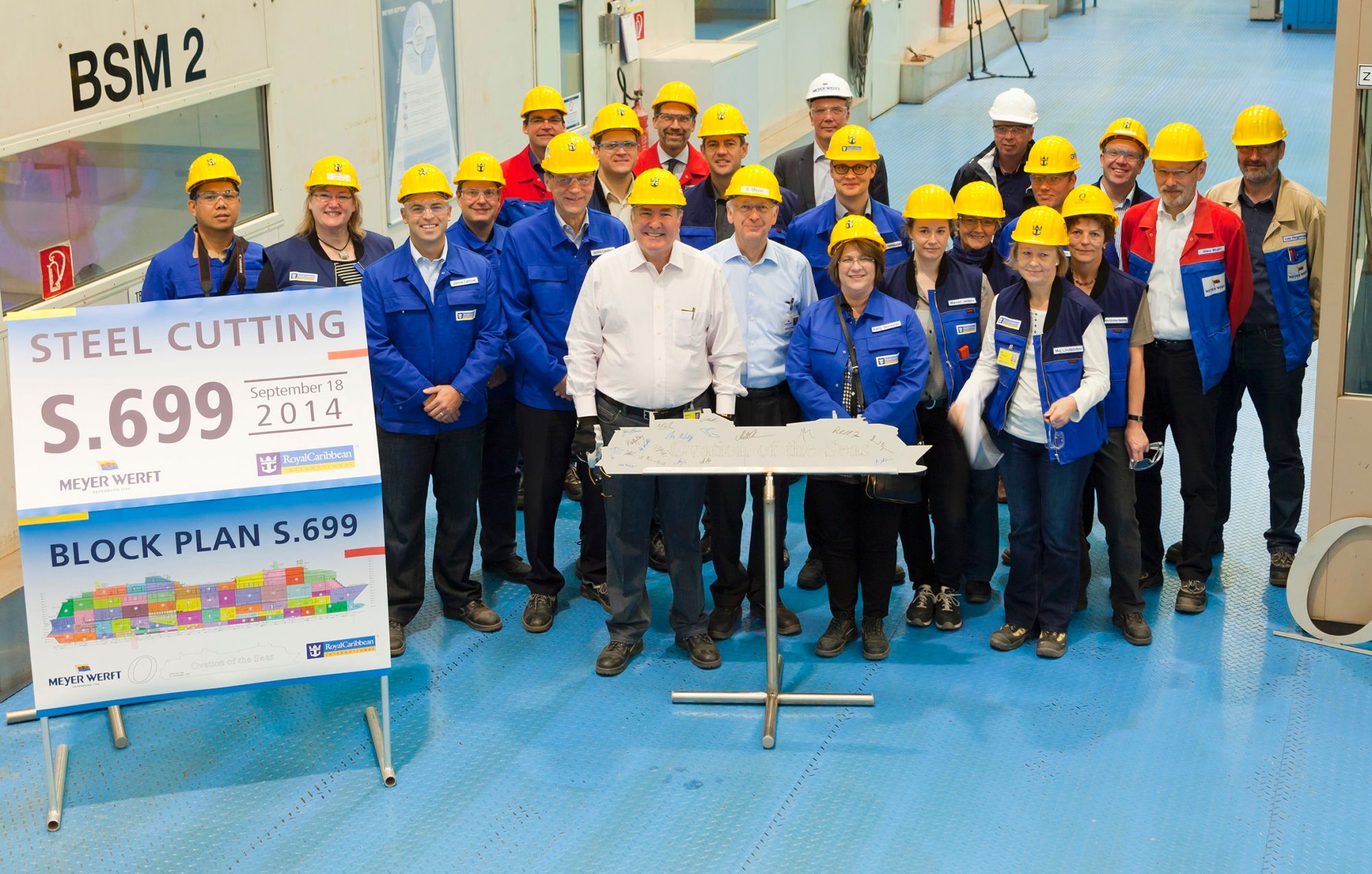
Meyer Werft: steel cut for the third Quantum cruise ship “Ovation of the Seas”

Shortly before the completion of the new Quantum of the Seas today there are another milestone for Royal Caribbean International: the steel section and thus the start of construction of the third cruise ship the new Quantum-class. 

The Smartship named Ovation of the Seas. The completion at the Meyer Werft shipyard in Papenburg is planned for autumn 2016.

Photo: Royal Caribbean International

The ships of the new Quantum class perform other groundbreaking innovations at sea a (maiden voyage Quantum of the Seas November 2014 from Cape Liberty, New Jersey, maiden voyage Anthem of the Seas in April 2015 from Southampton). The Quantum class of ship boasts a number of new additions; skydiving simulator “Ripcord by iFly’, the 90-meter-high swinging arm” North Star “, the largest indoor sports and entertainment complex at sea” SeaPlex “with bumper cars, roller-skating and much more, as well as the biggest and most versatile cabins.

The cruise ships each include 18 decks and a tonnage of 168,666 GT. With 2,090 cabins they provide space for 4,180 guests at double occupancy.

CLIA: Capacity up in developing markets

By Tom Stieghorst
CLIA’s annual report on the economic contribution of the cruise industry highlights growth in less developed cruise territories, including Asia, the Australia/Pacific region and South America.

The report said these three areas recorded 20% capacity growth in 2013 and accounted for more than half the global increase in available bed days. Europe’s capacity growth slowed from 18% in 2011 to 3.5% last year.

CLIA said the number of passengers carried in 2013 by its member lines rose 3.9%, to 17.6 million (river cruises are not included in the tally).

Bed days increased 4.8% because the average cruise was longer and capacity was higher, CLIA said.

Passenger embarkations at U.S. ports fell 1.3%, to nearly 10 million, the first time in at least four years that happened. CLIA attributed the decline primarily to redeployments to markets more distant from the U.S.

Direct spending by cruise lines, passengers and crew in the U.S. crossed the $20 billion threshold, rising 2.4% to $20.1 billion in 2013. More than 80% of that was for wages, taxes, and goods and services. Passengers and crew accounted for $3.63 billion in spending.

CLIA member cruise lines in North America showed a net increase of one ship in 2013, to 178, with a combined capacity of 338,505 berths, the study said.