Palfinger Marine has completed its first major refurbishment jobs since the start of the pandemic, according to a press release.
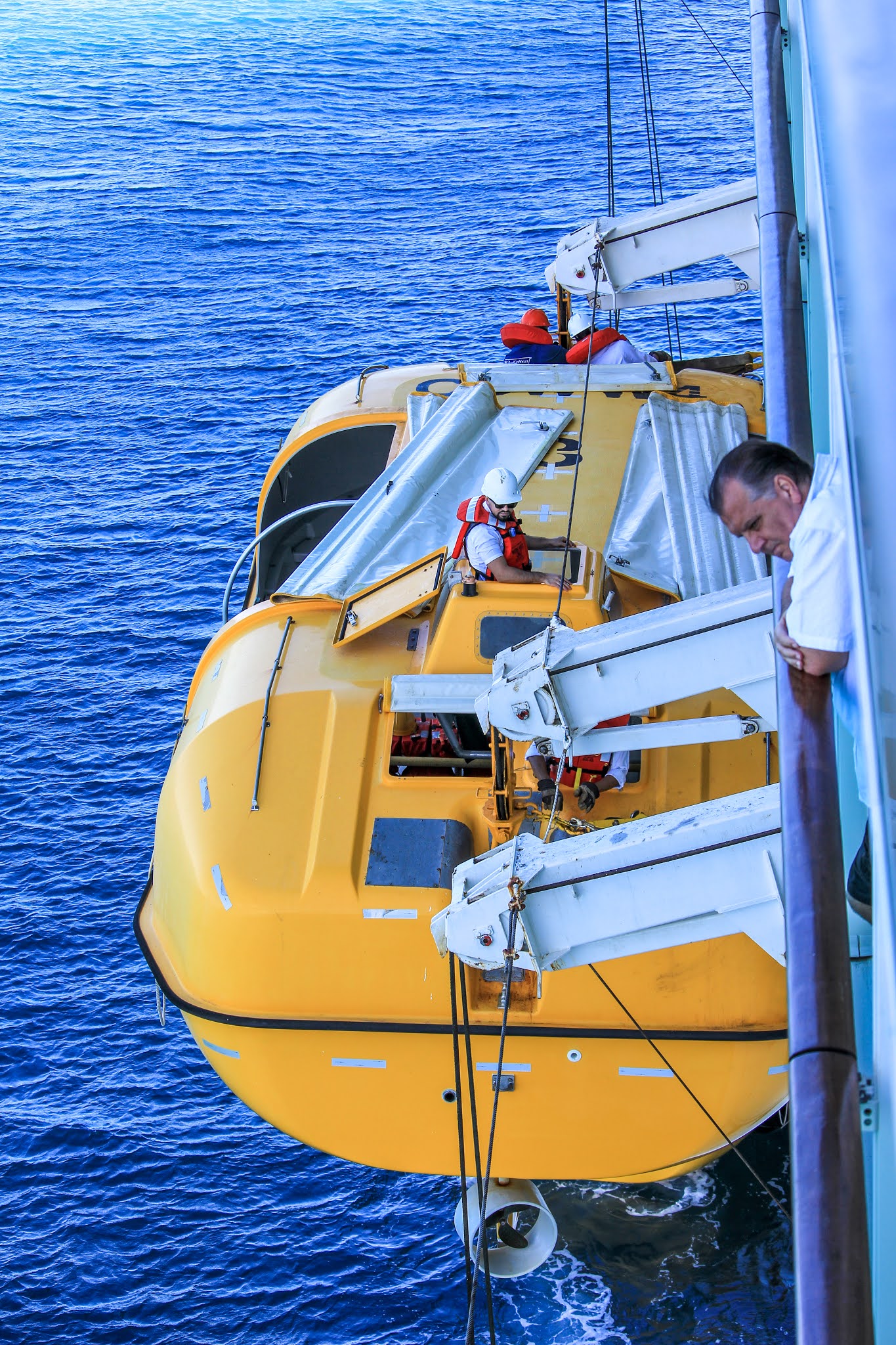
The job involved servicing 18 lifeboats and 20 winches for the Allure of the Seas from Royal Caribbean International.
To complete the job, 11 technicians from Palfenger’s U.S. service office travelled to Naventia’s shipyard in Cádiz, Spain, where they joined five LSA- and seven refinishing technicians from Palfinger Spain.
Palfinger’s Florida-based Operations Manager Josh Lozano has celebrated the resumption of major cruise operations at Palfinger.
“Slowly but surely, we were able to resume our work after the lockdown, starting with the first successful service job for the Allure of the Seas,” he said.
Together, the technicians working on the Allure refinished the canopies on 18 lifeboats – which can carry up to 370 people each – and inspected the boats and release gear.
This work included “cleaning and maintaining the release hooks as well as inspecting the boats according to MSC.402 and other regulations required by class and flag,” the company stated. The jobs took 30 days to complete.
Lozano said that they have also been performing two cruise drydocking in Italy and Singapore, utilizing the company’s corresponding local offices. Additional planned inspections were performed by the company’s UK office.
The trade association representing 95 per cent of the global ocean-going ships says its members will maintain the voluntary suspension of cruise ship operations in the U.S. through the end of the year.
Cruise Lines International Association members include brands of Carnival Corporation, Royal Caribbean and Norwegian Cruise Line, the three largest cruise ship groups. Each made their own separate announcements related to suspending U.S. cruises through the end of the year on Monday.
The voluntary suspension comes less than a week after the U.S. CDC issued framework guidance to resume cruise operations in earnest despite surging cases and recent warnings from government scientists that cruise ship travel exacerbates the spread of COVID-19. The CDC’s No Sail Order, which was first issued in March and later expanded multiple times, expired on October 31.
The framework requires cruise lines to “demonstrate adherence to testing, quarantine and isolation, and social distancing requirements to protect crew members while they build the laboratory capacity needed to test crew and future passengers.”
CLIA said today that extending the sailing suspension through the end of the year will give its members time to implement the extensive measures set out by the CDC and the guidance of outside public health experts.
The suspension has created unprecedented losses for cruise lines and beaten down cruise stocks. According to CLIA, the cruise industry generates over $53 billion in annual economic activity and supports 421,000 jobs in the United States. The cancellation of cruises since for nearly eight months has resulted in estimated losses of more than $25 billion in economic activity and over 164,000 American jobs.
The Association issued the following statement on behalf of its members:
“As we continue to plan for a gradual and highly-controlled return of cruise operations in the U.S., CLIA members are committed to implementing stringent measures to address COVID-19 safety, including 100% testing of passengers and crew, expanded onboard medical capabilities, and trial sailings, among many others. We share a common goal with the U.S. Centers for Disease Control and Prevention (CDC) to protect public health, which has been affirmed and reaffirmed consistently throughout the industry’s response to the global pandemic. As we work to operationalize a path forward, our members have agreed to extend our existing suspension of U.S. operations through December 31. This action will provide additional time to align the industry’s extensive preparation of health protocols with the implementation requirements under the CDC’s Framework for Conditional Sailing and Initial Phase COVID-19 Testing Requirements for Protection of Crew. We recognize the devastating impact that the pandemic continues to have on the 421,000 Americans whose livelihoods are connected directly to cruise operations. We will work with urgency to advance a responsible return to cruising while maintaining a focus on effective, science-based measures to protect public health.”
CLIA’s statement added:
“In the nearly eight months that cruise operations in the U.S. have been suspended, CLIA members have been diligent in the planning and development of rigorous protocols in the interest of the health and safety of passengers, crew and the communities cruise lines serve. The public health protocols that CLIA members have agreed to adopt have been informed by the recommendations of world-class experts in public health and science, as well as the experiences of CLIA member lines who have resumed sailing in Europe and other parts of the world with approval from local and regional governments.”
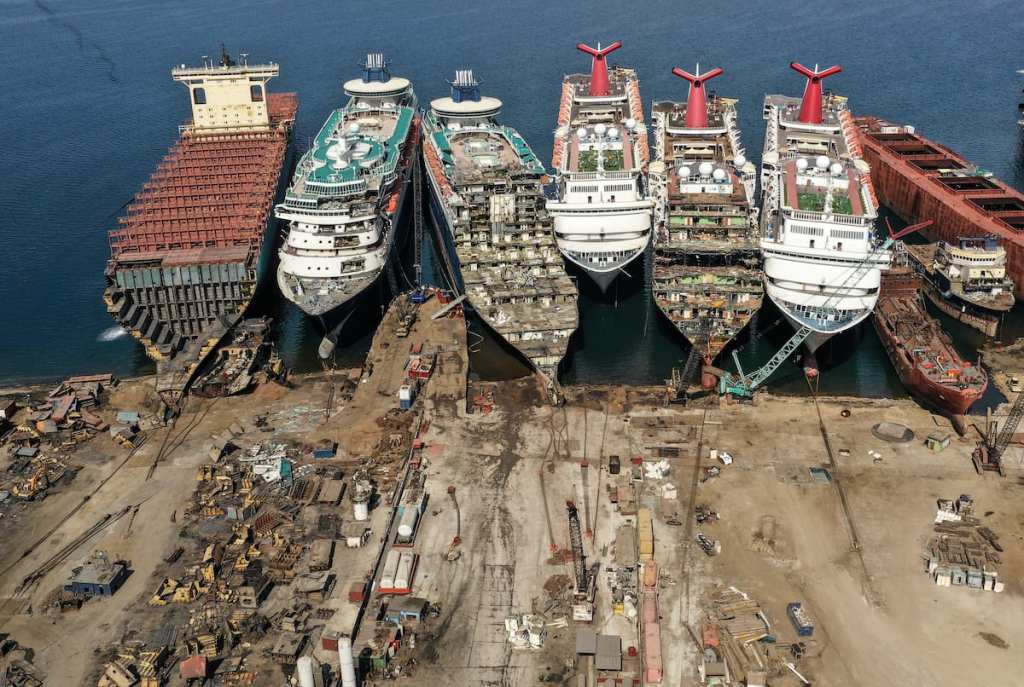
2 Royal Caribbean and 3 Carnival cruise ships can be seen, such a shame.
A drone image shows decommissioned cruise ships being dismantled at Aliaga ship-breaking yard in the Aegean port city of Izmir, western Turkey, October 2, 2020. REUTERS/Umit Bektas
Carnival Fantasy was a ship famous for its outlandish décor, all-night revelry and its size—back when 2,000 was an incredible number of passengers. The “Fun Ship” vibe it introduced in 1990 came with such whimsical spaces as an Egyptian-themed piano bar, decorated with a fake sarcophagus, and a glitzy glass-topped atrium that was the hub of the social scene.
Today the Fantasy is attracting a whole different breed of booty-seeker. In July, the 30-year-old ship sailed to the Aegean Sea, wrapping its final voyage in the shipbreaking capital of Aliaga, Turkey.
Its resting place there is a demolition yard where old cargo ships, tankers, research vessels—and now cruise ships retired during the Covid-19 pandemic—get torn apart and broken into pieces. In this case, they’re not being broken in half to get upgraded and stitched back together. Instead, circling the Fantasy’s partially deconstructed innards are buyers from all sorts of industries, looking for rock bottom deals on everything from artwork and kitchenwares to electrical wires and stainless-steel sinks.
For the cruise company, it’s an opportunity to recoup at least some value from an asset that’s currently acting as dead weight; while ships’ values decline with age, the Fantasy was originally built for about $225 million. And for the recycling companies that buy the vessel for cash and take on the hazardous task of emptying all its valuables, it’s a matter of a months-long salvage resale on steroids.
Cutting the Losses
It’s hard to gauge how exactly much money is made off of cruise ship recycling. Companies don’t immediately disclose the sale prices of the vessels after relinquishing ownership, and the resale value of their most sought-after commodity, scrap steel, fluctuates in each global market on a daily basis.
But the business is booming.
Next to Carnival Fantasy in Aliaga are two other Fantasy-class ships built in the late 1990s. And next to them are two former Royal Caribbean vessels (scrapped by Royal’s Spanish partner line Pullmantur Cruceros). The ships all had big fan bases, even as they aged. Fantasy and its sister ships started 2020 full of passengers bent on fun-in-the-sun activities in the Caribbean, Bahamas, and Mexican Riviera.
A drone image shows decommissioned cruise ships being dismantled at Aliaga ship-breaking yard in the Aegean port city of Izmir, western Turkey, October 2, 2020. REUTERS/Umit Bektas
The ships would have left the fleet in coming years even in a healthy industry; the pandemic sped up the process, with owners of idled vessels haemorrhaging cash and looking to cut their losses.
In its third-quarter filing, Carnival Corporation said it planned to sell 18 “less efficient” ships in 2020, resulting in a 12% reduction of its nine-brand fleet. “Those ships were giving us a bad drain,” Carnival CEO Arnold Donald said during a recent webinar with the Society of American Travel Writers.
Going, Going, Gone
Without much of a market for second-hand tonnage, the main worth of the ships is the steel that makes up the superstructure.
If, for instance, Carnival Fantasy has 15,000 tons of steel in its superstructure, the scrap may sell for upwards of $4.7 million based on current global market prices—though other factors also come into play, such as local prices and demand.
Decommissioned cruise ships are being dismantled at Aliaga ship-breaking yard in the Aegean port city of Izmir, western Turkey, October 2, 2020. REUTERS/Umit Bektas
Along with the risk of these market fluctuations, the buyer also takes on the uncertainty of just how much metal can be salvaged. Pre-1990s ships tend to have more steel in their hulls and underwater plating, but those built in the ’90s and after can bear lighter and stronger alloys.
Either way, steel and metal scraps will travel to a smelter to make rebar for construction projects around the world. Steel from some other dismantled ships can find its way to Turkey’s large car manufacturing industry, where it might become parts for a Toyota or a Ford.
Aluminum, copper, and stainless steel are also salvaged and resold, along with other valuable commodities that mostly remain in Turkey. The ripped out teak decks on Fantasy may end up in local shops, restaurants, and homes. Theatre scenery and lighting may find its way into show productions. Even the tackiest artwork has some value, and can end up in restaurants throughout the country.
Buyers come to the yard for everything down to the bolts and nuts. Even if a used toilet sells for a fraction of the shelf price, multiply that amount by a few thousand—given the number of cabins and public spaces on each ship—and it can add up to a substantial sum.
According to Orbay Simsek, vice president of the Aliaga-based Simsekler Ship Recycling Company, there are even markets for kitchenware, closets, and blankets.
Basically anything and everything that can be sold sells. Everything must go. Even the sarcophagus.
Eco-friendly Shipbreaking
Taking apart ships is a controversial topic, thanks to concerns over both human and environmental risks. It’s one of the most dangerous jobs in the world, according to Wouter Rozenveld, director of Sea2Cradle (SC2), an expert in green ship recycling who was hired by Carnival to oversee the safe dismantling of its ships. Each Carnival vessel may take up to nine months to break down, he says, and the blowtorch-based work comes with constant fire hazards.
Those hazards are amplified when the recyclable component pieces, like furniture, cabling, piping, and machinery inside each deck have to be carefully taken apart and separated says Ehud Bar-Lev, who oversees assessment services at maritime specialist Lloyd’s Register.
The extra steps in disassembly also increase the potential for hazardous waste spills, containing everything from oily residues to sludge, asbestos, and coolants in fridges.
To prevent those incidents, the Turkish shipbreaking yard undertakes its work in a concrete holding area that catches debris; in similar facilities throughout India and Bangladesh, the process may happen on the beach. Rather than letting toxic chemicals spew into the water, the Turkish yard collects the materials, has them catalogued by Sea2Cradle, and then hands them over to the government-run Ship Recycling Association of Turkey for proper disposal.
Carnival Corporation saw these precautions as a marketing opportunity, making a highly unusual move to publicize its efforts as “responsible recycling.” But it was the shipbreaking yard, not Carnival, that saw the biggest windfall as a result: never before has Aliaga seen five mega cruise ships in its harbour.
There may be more coming in the months ahead.
“The longer the pandemic rages on in the world, the more cruise ships will end up in scrapyards, and my guess is at an increasingly younger age,” says Manso Ng, a maritime management professor at Virginia’s Old Dominion University. “Even if a vaccine becomes available, how many of us will be comfortable jumping right back on cruise ships?”




 Wetravel2u's Weblog
