Higher Ticket Prices and Onboard Spend Primary Drivers for Royal Caribbean’s Q2

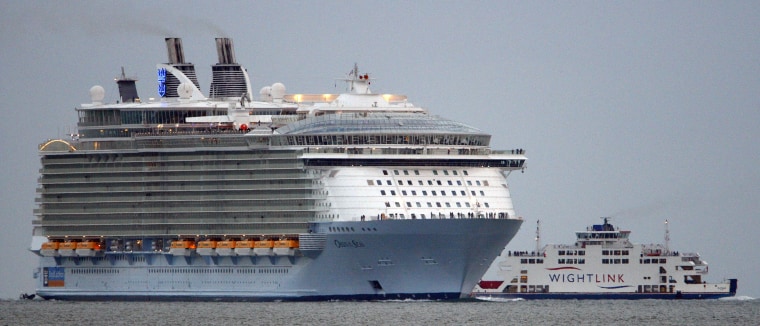
Symphony of the Seas

With capacity up 2.6 per cent, higher ticket prices and onboard revenue were the main drivers for Royal Caribbean Cruises reporting record results today in the second quarter.

Royal Caribbean reported net income of (GAAP) $466.3 million, or $2.19 per share, on revenues of $2.3 billion for its second quarter ended June 30, 2018, compared to net income of $369.5 million, or $1.71 per share, on revenues of $2.2 billion last year.

Ticket revenue per passenger day was $163.76 for the second quarter of this year, compared to $158.92 last year and the onboard spend was $65.12 compared to $61.70 per passenger last year.

Operating expenses rose moderately at $128.70 per passenger day with increases in all expense categories, from $126.30 last year.

With operating income of $456.9 million this year, up $37.2 million from $419.7 million, $9.4 million in interest and other income this year, compared to a $50.2 million in interest and other expenses last year, contributed further to boost net income to $466.3 million over $369.5 million.

The increase in per share income was also boosted by fewer outstanding shares, a result of Royal Caribbean’s share buyback program. Outstanding shares numbered 212.5 million, compared to 216.1 million for the same period last year.

Royal Caribbean reported 10,213,067 passenger cruise days this year, up from 9,950,570 passenger cruise days last year, and 1,461,055 passengers, compared to 1,433,339 in 2017.

A tale of two cruise lines

Image result for silverseas muse

Two European businessmen created two different cruise lines in the 1990s. Both have been successful in their own terms, but one formula for success has a lot more scale than the other one.

The two lines are Silversea Cruises and MSC Cruises. Silversea was formed in 1994 by building two new ships straight out of the gate for the luxury market. It was marketed primarily, if not exclusively, in North America.

MSC took a different route. Created from the leftovers of the Lauro Lines in 1995, MSC operated used, some would say very used, tonnage. Like Carnival Cruise Line, it deployed its older ships to cater to the mass market. It was marketed primarily to Europeans, with a few winter itineraries in the Caribbean.

Silversea’s first newly built ship, the Silver Cloud, was a thing of beauty. It was instantly competitive with other luxury vessels.

MSC’s first newly built ship didn’t arrive until a decade after the Silver Cloud was delivered and it was a takeover of an option that couldn’t be exercised by the Greek line Festival Cruises when it went into bankruptcy.

Since launching, Silversea has acquired a fleet of nine ships, with two more vessels on order.

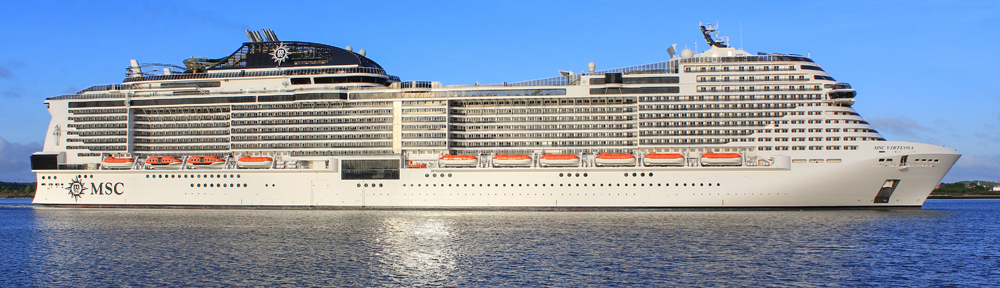
With the delivery of the MSC Seaview, MSC has 15 ships in its fleet, with another nine on order through 2026.

Image result for msc seaview christening

Last week, Silversea and Royal Caribbean announced an agreement in which Royal will get a 67% equity stake for $1 billion. Silversea gives up its autonomy as a private company in exchange for continued growth and investment in its brand.

MSC is investing in its own future with a $10.5 billion newbuild program, and its autonomy is not in doubt.

MSC took a slower, less glamorous route to success but in the end, it is the company that stands independent.

Two major differences steered MSC and Silversea towards different outcomes. The first is that MSC Cruises was a side project for MSC chairman Gianluigi Aponte, whose main business, container shipping, made it easier to secure the financing that kept MSC’s order book growing.

The second is that MSC operates in the low-price, high-profit segment of the cruise business. Catering to the mass market may not be where the glamour is, but it is where the money is. The finances of both MSC and Silversea are private, so it is perhaps unfair to say one is more profitable than the other.

Royal Caribbean announces a brand-wide withdrawal of single-use plastic straws

Image result for royal caribbean drinks

Single-use plastic straws are to be withdrawn across all 50 ships across Royal Caribbean Cruises brands by the end of the year.

The move is the first step towards a comprehensive plastics elimination across Royal Caribbean International, Celebrity Cruises, Azamara Club Cruises, Tui Cruises and Pullmantur.

A “straws upon request” policy running for more than a year will see paper straws replacing plastic versions by early next year.

Passengers will start to see Forest Stewardship Council-certified wood coffee stirrers and bamboo garnish picks as part of the company’s plastic reduction strategy.

The focus will then switch to other single-use plastics such as condiment packets, cups, and bags.

A full plastics audit is underway, with the overall plan to be completed in phases by 2020.

Chairman and chief executive Richard Fain said: “Healthy oceans are vital to the success of our company.

“For over 25 years, our Save the Waves programme has guided us to reduce, reuse, and recycle everything we can. Eliminating single-use plastics is another step in that programme.”