Royal Caribbean offers an augmented-reality view of CocoCay

Michael Bayley discusses the Perfect Day Island Collection. Photo Credit: Jamie BiesiadaNEW YORK — Royal Caribbean Cruises Ltd. (RCCL) on Wednesday night unveiled its new Perfect Day Island Collection and ship-refurbishment program at South Street Seaport here, complete with an augmented reality (AR) component so attendees could get a feel for what CocoCay, the first Perfect Day Island, will look like.

Royal Caribbean International’s Michael Bayley, president and CEO, and Mark Tamis, senior vice president of hotel operations, first introduced the changes in a room with nearly 360-degree screens displaying photos and concept art behind them.

The presentation screens opened up, revealing an augmented reality experience. Photo Credit: Jamie Biesiada
The presentation screens opened up, revealing an augmented reality experience. Photo Credit: Jamie Biesiada

Bayley said Perfect Day Islands will contain features that mix what Royal Caribbean guests have said in surveys is most important to them when spending a day on a private island: The chance to “chill,” and the opportunity for more “thrills.”

CocoCay, the line’s private Bahamian island and the first island in the collection, with features like the tallest water slide in North America, a helium balloon that rises up to 450 feet in the air, and a beach escape with daybeds, over-water cabanas and more.

“We are going to open up Perfect Day destinations literally around the world,” Bayley said.

In addition to locations in the Caribbean, Bayley said Royal Caribbean is also eyeing the Asia Pacific as a location. Each Perfect Day location may be different, he said.

Screen Time: New CocoCay comes to life (Click the image to play)

Image result for royal caribbean augmented reality

After the introduction, the screens at the front of the room opened into another space. Guests were invited to reach under their chairs where iPads were waiting. After entering some basic information, they acted as conduits for the AR experience.

Several different portals — large circles guests could walk through — were set up around the room, mimicking different parts of CocoCay, like Daredevil’s Peak, a pair of water towers with 13 slides, and Oasis Lagoon, a freshwater pool area.

An iPad ripples as the user walks toward one of several portals set up around the room. Photo Credit: Jamie Biesiada
An iPad ripples as the user walks toward one of several portals set up around the room. Photo Credit: Jamie Biesiada

As guests approached, the iPad screen would ripple, and turn into renderings of what that area of CocoCay will look like — for instance, at the Arrivals Plaza, guests were greeted by a large pirate ship to their right. As the iPad moved, the image would change, as if one was looking at CocoCay through the screen.
Royal Caribbeans Major Revitalizations

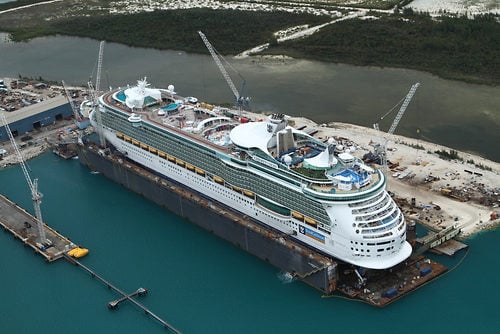
Image result for independence of the seas in dry dock
Independence of the Seas in Drydock.

Among the big out-of-water projects for Royal Caribbean Cruises, this year are revitalizations of the Adventure, Mariner and Independence of the Seas, plus the complete refurbishment and transformation of the Adonia into the Azamara Pursuit.

The company’s large-scale drydocking projects are overseen by the newbuild and innovation department, headed by up Kevin Douglas, vice president, who joined Royal in 2004 as a project manager overseeing a large-scale revitalization on the Sovereign of the Seas.

While smaller dry dockings (known as a “shave and a haircut”) are generally run by the brands, Douglas said his group comes together to plan the big changes, working closely with the operations teams to craft a program vision, whether it’s the Royal Advantage or Celebrity’s recent $400 million Edge-upgrade scheme.

With a schedule that calls for dry dockings every five years, the planning starts with a holistic look at each ship, and how they fit into the class and the brand

“The principal goal is how we improve the guest experience, offering a more meaningful product,” said Douglas. That ranges from stateroom upgrades to new restaurants and other features like the FlowRider surfing simulator. “We look at how we can add in IT and the smart ship concept, upgrading the technical experience and entertainment.”

Projects are evaluated not only on cost but in the number of containers and raw materials needed.

“We know how much material we can deal with on a daily basis, and that determines how much time we need,” Douglas said.

The technical scope of jobs is increasingly complex.

“Then we look at the stability of the ship with the increase in weight and the increase of the centre of gravity, and whether we have to add a ducktail to the stern.”

Allure of the Seas at Navantia

Another major technical project has been installing scrubbers (the company prefers to call them Advanced Emissions Purification Systems).

“They are about the size of a school bus,” Douglas noted.

Royal Caribbean has had its scrubber program going for five years, with some 20 ships outfitted with various systems from a number of suppliers with the project being overseen directly by Matti Heikkinen, vice president of newbuild.

“He and his team have done an awesome job,” added Douglas.

Under the waterline, the company has an on-going initiative to study hull coatings, with a new direction expected to be announced in early 2018.

“There is a massive benefit on fuel efficiency on drag and resistance,” Douglas said.

That project is being spearheaded by Captain Patrik Dahlgren, senior vice president of global marine operations, and Anshul Tuteja, director of energy management.

“We are looking at every type of paint, and which coatings work best in what areas,” Douglas explained. “Patrick and Anshul are looking very carefully, and we can actually track the performance of a hull coating relating to efficiency and how much fouling they are getting.

“We probably have every type of paint coating in the fleet, and are now starting to review final recommendations for future coatings.”

Royal Caribbean has also grown the scope of its drydocking work along with its shipyards, continually working to get leaner and manage bigger projects.

“Twelve years ago we were doing 12 to 16 containers a day and thought ‘wow.’ Now we are doing 50 containers a day and think nothing of it.”

And the spending is skyrocketing.

“We used to be at $800,000 per day, and now its $2.8 million; and we want to go even higher,” Douglas said.

The next hurdle may come in Asia, with a number of company ships in China. One of those ships has already been in a Chinese drydock for a repair, which Douglas said went well. SkySea also recently drydocked at a yard in China for a small refit.

Years of planning, million-dollar decisions and executing on a tight schedule, Douglas said it all came down to partnerships, whether internal, whether with the shipyards or with turnkey suppliers.

“It’s about how we do these projects in a short period of time, minimizing the risk and maximizing the planning.”

To agents’ delight, new cruise ships steaming for the West Coast

The Norwegian Bliss, shown here in a rendering, will make a June debut in Seattle.LONG BEACH, Calif. — For years, agents on the West Coast have pleaded with suppliers to put new cruise ships in ports near their clients. Now they’re getting their wish.

This year, the Norwegian Bliss will make a June debut in Seattle, the first time a new Norwegian Cruise Line ship has been stationed in the West since the Norwegian Star began sailing in Hawaii in 2001.

Next year, Carnival Cruise Line will launch its latest ship, the Carnival Panorama, in Long Beach, Calif., while Royal Caribbean International will move the Ovation of the Seas, just 2 years old, to Seattle.

Together, the three ships will add more than 12,000 new or nearly new lower berths, at least seasonally, to the West Coast market.

“It’s very exciting. There’s been a big need out here for a long time,” said Betsy Geiser, vice president at Uniglobe Travel in Irvine, Calif. “Historically, it’s been older ships and smaller ships. Carnival’s making a big improvement by bringing [the Panorama] here.”

With their proximity to the Caribbean, East Coast ports, particularly Miami and Fort Lauderdale, have long been the default homeports when a new vessel emerges from the shipyard.

In recent years, ports such as New York have also benefitted as fleets grew and lines cultivated new markets.

But in a sense, the West Coast is the cradle of the industry, said John Mast, vice president of marketing for Expedia CruiseShipCenters in Vancouver.

“It’s important to remember that Princess, with that run down to Mexico, sort of kicked off the U.S. cruise industry in many ways,” Mast said.

The California-Mexico itinerary, immortalized in “The Love Boat” television show, is still a mainstay of the market. Carnival plans to enrich Ensenada with new port activities in a bid to make Long Beach one of its biggest hubs.

“I think there’s been a renaissance going on for the West Coast, and I think that Carnival’s investment is a very strong indicator of that,” Mast said.

There are several reasons why the region is enjoying a rebirth, Mast said. One is the recent expansion of the Panama Canal. Before 2016, the cruise industry’s newest and largest ships couldn’t fit through the locks. Now that a wider channel has been opened, it is easier to move most large ships back and forth.

Also, after several years in which European cruise seasons were marred by terrorist activity, domestic ports have become more attractive long-term investments, especially in excursion-rich Alaska.

Mast said the new ships, with their go-kart tracks and Imax theatres, can help attract a younger demographic to Alaska.

“It seems kind of gimmicky to have a racetrack on the roof,” he said, “but the reality is that Alaska is a wonderful summer vacation for families. Families are a huge market. If I know kids, that will immediately get them excited, and we know that kids play a role in forming the vacation choice.”

For agents, the practical impact of having news ships on the West Coast is that they are easier and more profitable to sell.

Anita Pagliasso, president of Ticket to Travel in San Jose, Calif., said, “Cruisers are very excited about something new. It becomes lucrative because the pricing’s always higher when a brand new ship comes out, so the higher the pricing, the higher the commission. It goes hand in hand, I think.”

Pagliasso said the opportunities extended beyond West Coast agents.

“I think some of the feedback I got, even some of the agents in the Midwest, was that [clients] have gone to Florida enough, and they want something different,” she said. “This is a great opportunity for not only West Coast agents to promote these ships but other agents who have clients who have done all the cruising out of Florida and are looking for something new and exciting.”