Cruise Industry 10-Year Timeline: 50+ Million Guests, 20% Growth

Cruise Industry 10-Year Timeline: 50+ Million Guests, 20% Growth

The global cruise business is on course to grow at least 20 per cent between 2026 and 2036, with big new ships driving growth to an estimated 50 million guests, according to the 2026 Cruise Industry News Annual Report.

That is compared to just over 23 million guests 10 years ago, and an estimated 39 million this year.

The bulk of the growth is coming from the industry’s major players that have numerous new big ships on order, including Carnival Cruise Line, Royal Caribbean International, MSC Cruise, Norwegian Cruise Line and Disney Cruise Line.

Together, these five brands have a combined 34 ships on order, amounting to just over 150,000 new berths.

The most growth is coming from MSC, with 10 newbuilds set to debut. The new ships from the industry’s fastest-growing will include more World-class vessels built in France, and an entirely new class of vessel set to be constructed in Germany at Meyer Werft.

Norwegian Cruise Line is close behind with eight ships on order, adding more than 36,000 berths through 2037 as the brand continues to scale its large-ship fleet at Fincantieri in Italy.

Royal Caribbean International has six newbuilds scheduled, building on the success of its Icon-class platform with additional vessels from both Meyer Turku in Finland and Chantiers de l’Atlantique in France.

Carnival Cruise Line has five ships on order totalling nearly 30,000 berths, with new tonnage coming from both Meyer Werft and Fincantieri.

Disney Cruise Line, meanwhile, is accelerating its own expansion with five ships set to debut through 2031, more than doubling its current fleet size and extending its reach into new global markets.

The combined orderbook across all cruise lines stands at 78 ocean ships valued at approximately $80 billion, reflecting the industry’s confidence in sustained long-term demand.

MSC Poesia Enters Drydock for Major Refurbishment

MSC Poesia Enters Drydock for Major Refurbishment

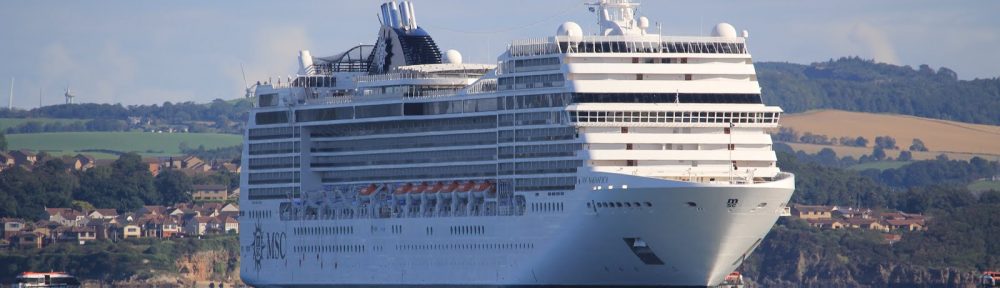
The MSC Poesia recently entered drydock at the Palumbo Shipyard in Malta to undergo a major refurbishment project.

Having completed its winter season in Northern Europe, the MSC Cruises vessel arrived at the facility on Feb. 19, 2026.

As part of a modernization effort that will see all of the Musica-class ships undergoing refits, the 2008-built vessel is now set to get new features and venues.

The project includes the addition of MSC Yacht Club, the company’s ship-within-a-ship concept that will feature 62 new suites.

Guests staying in these new staterooms will take advantage of private areas including a sun deck, a restaurant and a lounge.

The MSC Poesia is also getting two new specialty restaurants: the American-style Butcher’s Cut Steakhouse and Kaito Sushi Bar.

Other areas undergoing significant changes include the MSC Aurea Spa, which will be redesigned and modernized.

The ship’s gym will be moved to a new area, where it will offer a fresh layout and state-of-the-art equipment.

Upon completing its drydock, the MSC Poesia is set to kick off a repositioning voyage to North America ahead of MSC’s first season in Alaska.

The two-part voyage starts with a trans-Atlantic crossing to PortMiami that is set to depart from the Italian port of Civitavecchia on April 6, 2026.

The 90,000-ton ship is then scheduled to offer an 18-night cruise to the Panama Canal that sails between Florida and Seattle.

Starting in early May, the MSC Poesia offers a series of seven-night cruises to destinations in Alaska and Canada.

Sailing roundtrip from Seattle, the itineraries are highlighted by scenic cruising at Tracy Arm Fjord and Inside Passage. Ports of call set to be visited include Ketchikan, Icy Strait Point and Juneau.

Following MSC’s maiden season in the region, the vessel is scheduled to reposition to Miami for longer cruises to the Caribbean and Central America during the 2026-27 winter season.

Fincantieri and Eni Extend Cooperation for New Technologies

Fincantieri Keel Laying

Fincantieri has announced that it has extended its agreement with the Italian energy company Eni for the continued development of initiatives in decarbonization and the circular economy.

The CEOs of Eni and Fincantieri, Claudio Descalzi and Giuseppe Bono, signed a memorandum of Understanding extending the cooperation in research and development, set up by the two Italian companies in 2017, to push technological barriers into the future.

According to Fincantieri, the main focus of the extension will be the development of new and innovative initiatives. The activities will focus mainly on waste to energy processes, production and transport of alternative energy sources such as natural gas, methanol, hydrogen and fuel cells, and the development and deployment of offshore renewable technologies.

Over the past three years, Eni and Fincantieri have collaborated on several concepts of floating offshore production platforms, with a modular and so-called reversible approach, developed according to a Fincantieri patent; a floating gas to methanol concept with Eni technology; and a floating independent power plant.

Descalzi, CEO of Eni, stated: “Thanks to the developed synergies, Fincantieri and Eni will support the country’s sustainable development. This agreement fits into our long-term strategy. To build the future Eni we are combining economic and environmental sustainability, we are working on a transition by providing energy in a profitable way and, at the same time, obtaining an important reduction in the carbon footprint. Natural gas, a fossil energy source with the lowest carbon footprint, will represent an increasing component of Eni’s energy mix in the coming years: 60% in 2025, reaching 85% in 2050. In this process, Fincantieri represents a strategic partner with whom we continue to research and develop innovative technologies and systems.”

Fincantieri’s CEO Bono commented: “We believe that the success of this partnership is very good news for Italy, especially given that the cooperation explores sustainable developments. The ability of big two national industrial players to pool experiences, skills, and above all their visions for the future, is a huge strategic achievement. I am very pleased because the research path we are charting with a group such as Eni has already led to the creation of several projects, consolidating a technological lead, which has allowed our companies to obtain important achievements worldwide.”