RCCL presidents tackle over-tourism, luxury, female leadership

Editor in chief Arnie Weissmann, far left, and Royal Caribbean Cruises Ltd. CEO Richard Fain, far right, moderated a panel of RCCL presidents, seated: Mark Conroy of Silversea, Lisa Lutoff-Perlo of Celebrity and Larry PImentel of Azamara.

Editor in chief Arnie Weissmann, far left, and Royal Caribbean Cruises Ltd. CEO Richard Fain, far right, moderated a panel of RCCL presidents, seated: Mark Conroy of Silversea, Lisa Lutoff-Perlo of Celebrity and Larry PImentel of Azamara.

FORT LAUDERDALE — Cruise line presidents from Royal Caribbean Cruises Ltd. brands took on the subject of over-tourism, the evolution of luxury cruising and female leadership during a panel at CruiseWorld.

Regarding over-tourism, they said that in the general travel industry, cruise lines are a small part of the phenomenon — but a highly visible one.

“Our reality is, perception rules,” said Lisa Lutoff-Perlo, president of Celebrity Cruises. “There are these big white ships pulling in and it’s a lot of people at once.”

Larry Pimentel, president of Azamara, said that 25 years ago there were only 1.4 million outbound travellers from China; today there are 150 million. “India is also coming,” he said. “By no means is this only a cruise issue; it is an industry issue.”

And Mark Conroy, managing director of the Americas, for Silversea Cruises, said that overreacting to over-tourism could be overly damaging to some local residents in destinations such as Venice.

“Tourism is the largest employer in the world overall,” Conroy said. You can’t just shut it down. If you banned all tourism into Venice, there’d be a big unemployment problem there.”

Silversea redefining expedition cruising

Conroy said that 10 years ago when he was working for a rival company he thought that Silversea chairman Manfredi Lefebvre was crazy to bolt an expedition arm onto a luxury brand.

“I thought he’d lost his mind until I saw the per diems from the expedition business,” Conroy said.

Silversea, as a top-tier luxury brand, also brought a different concept to what was then more of a rustic product. At that time, Conroy recalled, “You had to sacrifice your lifestyle to go on an expedition.”
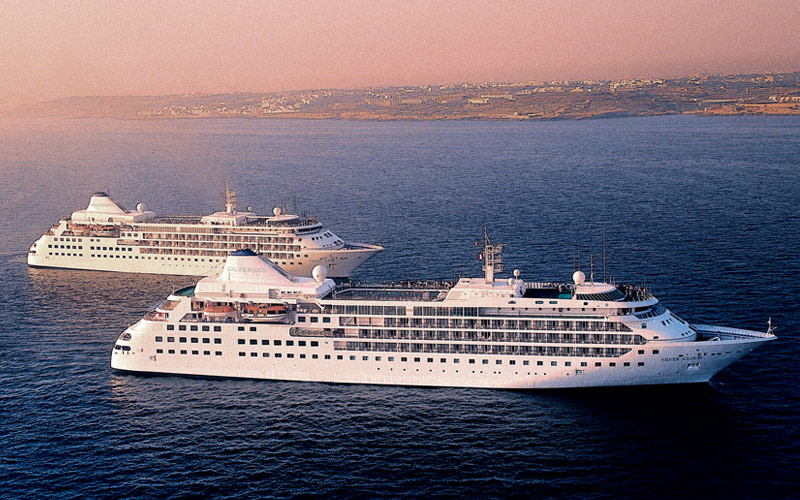
Image result for silver wind"

But when Silversea renovated its two oldest ships, the Silver Cloud and Silver Wind, it decided to transform them into expedition vessels but with the space and amenities of a luxury ship.

Conroy said that one of the unintended consequences was that the larger ship had faster speeds than most expedition ships.

“We can cross the Drake Passage [to Antarctica] in 28 hours instead of two days,” Conroy said

In defining the “luxury” appeal of his Azamara brand, Pimentel said that value plays a bigger part than in traditional luxury brands. As a department store, Azamara would compare to Nordstrom, he said.

“We’re not Saks Fifth Avenue.” As a car, we would be more like a Lexus.”

A woman in charge

The panel followed the CEO Conversation between Royal Caribbean Chairman Ltd. chairman and CEO Richard Fain and editor in chief Arnie Weissmann, and Fain returned to the stage to co-moderate the panel of presidents.

Lutoff-Perlo, who was named the president of Celebrity five years ago, and Fain asked her what was is like to be one of the few women to run a cruise line. She said at first, she took it for granted.

“When I was appointed I didn’t think about my gender at all,” she said. “But then when I was appointed, to the rest of the world apparently it is a really big deal.

“The great part is the part I can do to pay it forward” to other females in the industry, she said. 

Delightful detours on the Black Sea

The Sept. 29-to-Oct. 8 sailing aboard the Silver Spirit, the largest ship in the Silversea fleet, was originally going to be a total Black Sea cruise. But the unrest in the region caused Silversea, like other cruise lines, to eliminate calls in Ukraine (i.e., Yalta, Sevastopol and Odessa) and Sochi, Russia.

Silversea still started and ended the cruise in Istanbul, one of the great cities to explore; kept their calls on the west side of the Black Sea (as did most cruise lines); and then added in some lesser-known ports in Greece and Turkey. For me, one of the appeals was that beyond Piraeus/Athens, all of the other ports were new places to see.

The onboard experience was outstanding in every way: food, service, entertainment and the ship itself. And it turned out to be an excellent series of stops.

Here is a recap of some of the ports of call:

Athens/Piraeus: There’s no way to see all that Athens had to offer in one day.

The absolute highlight has to be the Acropolis, sitting high on the hill where the Parthenon, its most famous structure, is in full view. The massive renovation project is nearly done, making a visit ideal for everyone; there’s a bit of a climb to reach the site, but it’s not too rigorous.

Museums abound in Athens; the best one for Acropolis buffs is the Acropolis Museum, featuring a great collection, videos and outstanding views.

Organized tours included a variety of stops: Constitution Square and the Royal Palace (with the very proper changing-of-the guard ceremony), Olympic Stadium, Temple of Zeus and more. Everywhere one looks, there’s history.

And then there’s the shopping and eating mecca, the Plaka district and adjacent Ermou Street.

Experienced travelers can just jump in a taxi at the port of Piraeus and go into Athens; for two or more people, it’s cost- and time-efficient compared to cruise line transfers.

Izmir, Turkey: Izmir is Turkey’s third- largest city and its biggest seaport on the Aegean Sea. The primary shore excursions are trips to Ephesus, which has to be one of the most breathtaking ancient treasures ever to be uncovered. New areas, such as the Terrace Houses, continue to be discovered.

Having already been to Ephesus a few times, I chose to take the Izmir city orientation tour that included the Agora ruins, which are constantly undergoing discovery and rebuilding. It also went to the Archaeology Museum; the mosaic exhibit may be the best I’ve ever seen. Izmir’s waterfront goes on for miles with one restaurant after another (grilled calamari time!) on the inland side and walking paths and statuary on the water side.

Constanta/Bucharest, Romania: Constanta is the largest Romanian city on the Black Sea, but the highlight was the ship’s full-day, complimentary tour to Bucharest.

I’ve never really enjoyed three-hour bus rides (in both directions) but this was really worth it. The ride was pleasant enough with some nice scenery, and the two skilled tour guides did a terrific job.

Bucharest itself was fascinating, with stops made at key highlights: Palace of Parliament; Patriarchal Hill and Church; the open-air Village Museum; lunch featuring local cuisine and folk dancing; and photo stops or drive-bys at some of the well-preserved Eastern European-style buildings and churches.

Nesebur, Bulgaria: The last scheduled port of call was to be Nesebur, a rocky peninsula sitting on the coast. Unfortunately the waters were rough and the tendering operation had to be scrapped. Thus I did not get to see the city considered to be one of the great Unesco World Heritage Sites with its Greek and Roman ruins.

While I had planned on touring Nesebur, fellow guests had planned on seeing Pomorie, rumored to be a lovely resort city on the Black Sea. I guess I’ll have to go back.

2015 itineraries

Lines are still adjusting itineraries for 2015 due to the situation in Ukraine. Silversea, for example, will not be calling at any Black Sea ports, while Seabourn will still be calling at Constanta, Izmir and Nesebur.

Both lines will be calling at some smaller spots in Greece and Turkey, including Limnos, Thessaloniki, Volos and Santorini in Greece and Marmaris and Kusadasi (also a port call for Ephesus) in Turkey. This creates a terrific mix of port calls for experienced as well as first-time visitors to the region.

As long as the cruise begins or ends in Istanbul, a pre- or post-hotel stay is an absolute must. For those concerned about safety in the area, Istanbul is at least 500 miles away from the Syrian border; it’s not a city to be avoided because of regional issues.