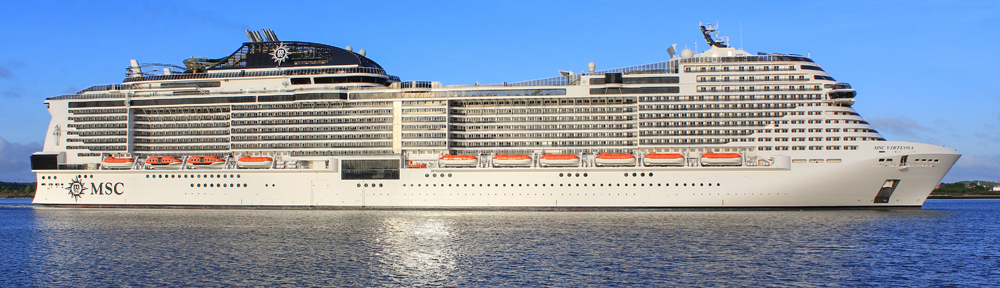

Next Gen. Cruise ship for MSC.
Until recently, expedition cruising was a quiet corner of the ocean cruise business, with occasional new tonnage added to a small fleet of spartan ships sailing to wild and majestic places.
The ships are still small, but some are not so spartan anymore, and the expedition niche in 2018 is trending bigger.
By one estimate, at least 18 new expedition vessels are ready to debut over the next 24 months.
Setting the tone was the transfer in 2017 of the original Silversea Cruises ship, the Silver Cloud, to the line’s expedition fleet after conversion to an ice-hardened vessel capable of visiting both polar regions.
In 2018, the parade of new expedition builds begins in June with Le Laperouse, the start of a new class for the luxury expedition brand Ponant, which will add three more of the 180-passenger vessels by mid-2019.
The French brand will be joined this year by Norway’s Hurtigruten, which is expecting a new prototype, the 530-passenger Roald Amundsen, in August. Soon after, Scenic Cruises will take delivery of the 228-passenger Scenic Eclipse, another expedition-style vessel.
And by year’s end, Quark Expeditions plans to take delivery of a 176-passenger ship, currently under construction in Portugal, capable of polar sailing.
The boom is underway in part because small ships for expedition cruising are easier to finance than the $1 billion behemoths now being ordered by contemporary ocean cruise brands. And there is a greater variety of shipyards able to take on the projects.
Companies like Lindblad Expeditions have gone public and are tapping into public equity to finance expansion.
Expedition cruise lines expect that many consumers who have been introduced to cruise vacations by the larger lines in recent years are now familiar with the concept and will be receptive to trying a different kind of cruising.
New technologies
In addition to a bumper crop of expedition ships, 2018 will also see the advancement of technology on larger ships designed to save time and smooth out the points of friction to make cruising more enjoyable.
The technologies go by disparate names: Royal Caribbean International calls its package Excalibur, MSC Cruises has MSC for Me and Carnival has its Ocean platform, which includes the Ocean Medallion and Ocean Compass app. Luca Pronzati, MSC’s chief business innovation officer, said MSC’s technology will provide wayfinding onboard the ships, a reservations function and a more convenient way to access and personalize an activities agenda.
“You can schedule your day in an easy way,” Pronzati said. “It’s really changing the paradigm.”
Passengers can access the information through smartphones, on their in-cabin TVs or at screens in public areas of the ship. Pronzati said that the current functionality of MSC for Me, which is available on the MSC Meraviglia and the MSC Seaside, is a foundation and that the line is working on expanded capabilities, such as a digital concierge service.
Carnival’s Ocean platform, although it debuted for a limited number of passengers on Princess Cruises’ Regal Princess in November, will be rolled out onboard five more ships by the end of 2018.
Carnival expects its phased activation of the Ocean Medallion and Ocean Compass app onboard the Regal Princess to be finished by the first quarter of 2018, with all passengers being able to use it simultaneously thereafter. The two technologies are designed to give each cruise customer a more personalized vacation. It will, for example, provide suggestions for activities, drinks and meals based on stored preferences and proximity to venues on the ship.
Royal Caribbean’s package of onboard technologies, Excalibur, is expected to be on 15% of its fleet, starting with its most-recently delivered ships, within the first few months of 2018. It will be on a majority of Royal’s 25 ships by the end of the year.
One focus of Excalibur is expedited embarkation, which Royal calls “frictionless arrival.” It will allow passengers who input information before arrival come aboard without stopping at a check-in counter. Other applications include using it to order room service, open cabin doors and connect with friends and family onboard.
One of the ships that will benefit from Excalibur is Celebrity’s new Celebrity Edge, the first in a class of four ships ordered so far that will be a prototype for the design of Celebrity’s fleet.
The innovations already announced for the ship include “infinite verandas” in which balcony space is incorporated into a cabin and the Magic Carpet, a 90-ton platform that hangs off one side of the ship and will move between four decks, including the embarkation deck, where it will serve as a shore excursion platform.
Following a December 2018 christening in Fort Lauderdale by Nobel Peace Prize laureate Malala Yousafzai, the Edge will make its first seven-day Caribbean cruise.
Celebrity plans to spend $400 million over the next six years to make the rest of its fleet look more like the Edge class.
The Cuba connection
Some of the oldest ships in the cruise industry will also be part of its newest trend in 2018: expanded cruises to Cuba. Norwegian Cruise Line has tapped the Norwegian Sun for four-day cruises to Cuba from Port Canaveral next summer. The Sun is joining Norwegian’s oldest ship, the Norwegian Sky, which does the itinerary from Miami.
Royal Caribbean is also expanding its capacity to Cuba, putting the 28-year-old Empress of the Seas in Miami for five-, seven- and eight-day trips that for the first time include Cienfuegos and Santiago de Cuba, while its second-oldest ship, the Majesty of the Seas, will provide four- and five-night Cuba itineraries from Tampa.

 Wetravel2u's Weblog