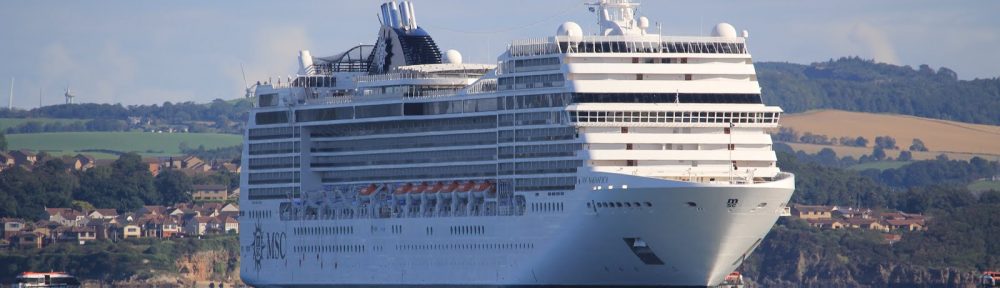
Cruise Order book Hits Record Level

Cruise lines seem to have abandoned their cautious approach to ordering new ships this summer as the cruise orderbook has achieved record level, with the sector hoping to take advantage of the mobility of its assets to tap the enormous potential in emerging markets, according London-based industry analyst Clarksons Research.

Since the start of last year, 24 firm orders for new vessels, including 15 with capacity in excess of 3,000 passenger berths, have been recorded. The order book now consists of 41 vessels with a combined berth capacity of 120,664, equivalent to 25% of the current fleet.

In the 3,000+ berth sector the orderbook is equivalent to 73% of the current fleet.

According to Clarksons, the continued focus on “mega” cruise ships is evident from the orders noted so far this year.

Namely, Royal Caribbean has ordered another Quantum-Class, 4,200 passenger ship for delivery in 2019. Elsewhere, Carnival Corporation has firmed the first four of a previously announced plan for a nine-ship order.

“These will be the largest ships contracted by Carnival at 180,000 GT, and while not as large as the Royal Caribbean Oasis-Class ships (225,000 GT), they will have a higher total passenger capacity (6,600), giving Carnival at least a claim to having the largest cruise ships afloat,” Clarksons said.

In the past 20 years, there have three distinct phases of expansion, with the orderbook exceeding 100,000 berths in early 2001, in 2007-08 and again in 2015. The two previous peaks were followed by a sharp drop as investment in new vessels was abruptly cut off by economic slowdown in the established key markets in North America and Europe.

In the short-term, Clarksons expects the performance of the cruise sector to remain closely linked to that of the major “western” economies. Last year North American and European passengers accounted for 55% and 29% of the global market of 22 million respectively; these markets will continue to exert an important influence.

However, the outlook may be shaped by developments further east. Thus far, relatively few of Asia’s rapidly growing middle class have been exposed to cruises, but the cruise lines believe they can develop significant demand growth in this region.

In 2015 the number of mainland Chinese tourists cruising is expected to pass 1 million for the first time, and according to industry sources in 2014 the number of cruises based at a Chinese ‘home port’ grew by 9% y-o-y to 366, while another 100 cruises called at a Chinese port (up 41%).

“So, the cruise sector once again seems to be in rapid expansion mode. This time, the question is whether the establishment of new Chinese brands, the deployment of vessels specifically designed for Chinese operation and further investment in Asian cruise ports could drive a more sustained phase of ship investment,” Clarksons adds.

Carnival makes higher commission levels easier to reach

Carnival Cruise Line said it will lower the number of cruises agents have to sell to reach a higher tier in its commission structure.

The move will make it easier for agents to earn more selling Carnival and reverses a move the line made three years ago in the opposite direction.

Adolfo Perez, vice president of trade sales and marketing, said the move was his top priority since being promoted to his new job in June.

“Essentially what we’re doing is reducing each of the thresholds for each of the commission levels, so anywhere from the 11% to the 15% commission level we’ve reduced the number of sailed cabins required to hit that tier,” Perez said.

For example, agents who previously had to sell 400 cabins to earn the 15% level will now have to sell 250. To earn 14%, the threshold goes from 300 to 175.

The 13% level is now reached at 125 cabins, down from 200, while the 12% level is reached at 50 cabins, down from 100.

Small or beginning agents will need to sell 40 cabins, down from 50, to boost their commission rate to 11% from the starting rate of 10%.

Agencies already earning the top rate of 16% are unaffected. Perez said he feels the structure for those commission levels is already adequate.

In a statement, Vicky Garcia, chief operating officer of Cruise Planners of Coral Springs, Fla., said Carnival’s moves to recognize the value agents bring to the bottom line is a step in the right direction for the competitive landscape.

“It is obvious the company has reprioritized travel agent relationships and this trend should continue to keep the brand top of mind for travel agents,” she said.

Fincantieri starts construction of ultra-luxury cruise ship for Carnival Corporation

The keel laying ceremony of “Seabourn Encore”, the first of two ultra-luxury cruise ships that Fincantieri will build for Seabourn, brand of Carnival Corporation, was held today at the Marghera shipyard.
“Seabourn Encore”, due to join the Seabourn’s fleet at the end of 2016, will be built according to the standards and technical solutions that make Seabourn one of the most prestigious brands in the ultra-luxury segment and will continue the fleet’s modernization that began in 2009.

The all-suite ship will be approximately 41,700 gross tons, 210 metres long and 28 metres wide and will be able to reach a cruising speed of 18.6 knots. It will carry up to just 600 guests, based on double occupancy. Every suite will feature a private veranda.

Safety will be one of this ship’s major strong points. It will be built using the very latest technologies, whose standards will exceed the requirements of the relevant legislation. Fuel consumption will be significantly reduced by optimizing the ship’s hydrodynamics.

Fincantieri has built 70 cruise ships since 1990 and other 14 ships are currently being designed or built in the Group’s yards.