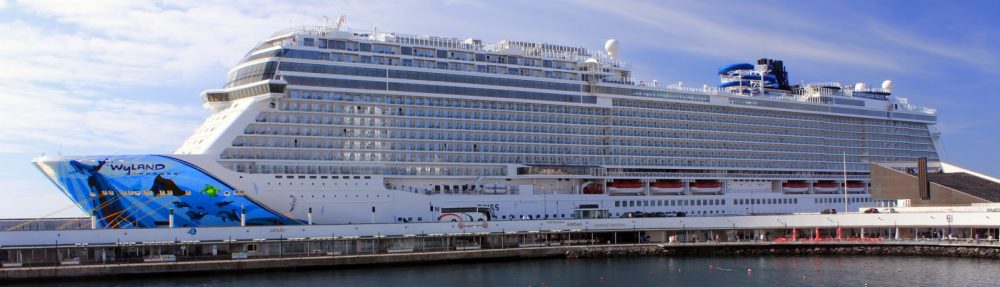
German lockdown forces cancellation of Aida cruises

German cruise brand Aida Cruises has cancelled all voyages planned between October 31 and November 30, following news of Germany’s lockdown.
The Carnival Corporation brand said in a statement: “As a result of Germany implementing far-reaching measures to contain the coronavirus pandemic, Aida Cruises today (October 29) announced it will temporarily pause its cruises for November, cancelling all voyages planned between October 31 and November 30.
“This follows the federal government of Germany’s October 28 decision to impose further restrictions on public life and travel to limit the spread of Covid-19, which Aida Cruises fully supports.
“As the leading cruise line in Germany and a part of Carnival Corporation & plc, Aida Cruises’ highest responsibility and top priorities are compliance, environmental protection and the health, safety and well-being of its guests, crew, shoreside employees, and the people and communities its ships visit – and that commitment is reflected in the line’s temporary pause in cruise operations.
“Aida Cruises recognises its decision is disappointing to its guests and appreciates guests understanding the importance of making health and safety the most important priority.”
The cruise line resumed operations in mid-October and “will closely monitor the further development of the pandemic” before starting cruises again in December onwards.
With Covid-19 cases surging across Europe, Germany’s month-long national lockdown starts on Monday (November 2) with the closure of restaurants, bars, gyms and theatres.
Meanwhile, France will be going into lockdown from Friday (October 30) with citizens allowed to leave home only for essential work or medical reasons.


Germany lifts blanket travel warning but only 11 countries ‘open’

The German government lifted its ‘blanket’ warning against international travel on October 1, but foreign office advice against all but essential travel still excludes all but 11 countries.
The Berlin government will also impose 14-day quarantine restrictions on travellers arriving from most countries from October 15, with early release from self-isolation only for those who test negative for Covid-19 after five days.


Advice against non-essential travel routinely renders travel insurance invalid except where travellers are already abroad when the advice changes.
The German travel industry vowed to campaign against the new restrictions.
However, German health minister Jens Spahn urged people to “avoid unnecessary vacations abroad”.
Speaking on German TV, Spahn said the rising Covid infection rate in Germany involved people returning from holidays and said: “We can learn from this in terms of autumn, winter and Christmas.”

German foreign ministry advice against travel due to Covid does not just cover ‘high risk’ countries but also those considered a lower risk with restrictions of their own.
The government introduced a three-tier, traffic-light system of travel advice as it ended the blanket warning.
This categorises high-risk countries as ‘red’, those with lower rates of infection but restrictions in place as ‘amber’ for ‘wait before travel’, and low risk as ‘green’ signifying a low level of infection but with advice to ‘take special care’.


The ‘red’ category currently applies to 123 countries – including Spain and Belgium – and to parts of an additional 15 countries including most of France, Croatia and Turkey excluding ‘the Turquoise Coast’, Wales and Northern Ireland.

Conway Castle in North Wales.

The ministry also advises against travel to many European cities including Vienna, Amsterdam, Geneva, Budapest, Dublin and Lisbon.
Only nine of the 26 EU member states fall wholly in the green category and two outside the EU – Tunisia and Georgia.
Germany imposed a global travel warning in March but lifted it for most European countries in June.
The government temporarily introduced free Covid tests on arrival for travellers returning from ‘high-risk’ destinations but withdrew this in September because of the pressure on testing facilities when it also reissued warnings for travel in Europe.
Germany’s response to Covid and travel has been hailed in Britain as an example to follow, but from mid-October Berlin’s approach will be similar to the regime the UK government appears to be moving towards.
In the meantime, figures suggest the German travel market has had no better summer than the UK’s.

BA’s 747 retirements ‘should bring forward aircraft scrappage scheme’

End of the BA jumbo jets: British Airways scraps ENTIRE FLEET of ...

The government must use British Airways’ retirement of its 747 fleets to bring forward aircraft scrappage scheme, says union Unite.

BA announced this morning that it is to retire its Boeing 31-strong 747 fleets as a result of the coronavirus pandemic. The move was brought forward from 2024.

Unite national officer Rhys McCarthy noted the nostalgia of the aircraft but called on the aviation industry to use the landmark to move towards cleaner aircraft.

“While the 747 jet is held in high regard, it is time for the ‘queen of the skies’ to relinquish her throne,” he said. “The entire aviation industry’s stock of older more polluting planes needs to be replaced with the next generation of cleaner and quieter aircraft built and maintained in the UK.

“Other European countries, including France, Germany, Spain and the Netherlands, have already committed to scrappage measures that will see their aviation industries invest in greener aircraft and help re-kickstart aerospace manufacturing so badly hit by the Covid-19 pandemic.

“It is now time for the UK government to do the same and put together a sector-based strategy for the long-term future of our world-leading aerospace industry, and the thousands of highly skilled jobs it supports.

“Investment in research and development is vital if zero and ultra-low emission planes are to be built. However, this must be accompanied with an immediate industry-wide scrappage scheme so that the newest planes, which emit 25 per cent less Co2, are 25 per cent more fuel-efficient and 50 per cent quieter, can replace more polluting aircraft as quickly as possible.”

This week Boris Johnson said he would ‘examine’ the idea of an aircraft scrappage scheme. Transport secretary Grant Shapps recently announced a Jet Zero Council to work towards carbon-neutral transatlantic flights.

McCarthy said: “British Airways’ retirement of the 747 should be the impetus he needs to put such a [scrappage] scheme into action.”

Alex Cruz, British Airways’ chairman and chief executive, said: “This is not how we wanted or expected to have to say goodbye to our incredible fleet of 747 aircraft. It is a heartbreaking decision to have to make. So many people, including many thousands of our colleagues past and present, have spent countless hours on and with these wonderful planes – they have been at the centre of so many memories, including my very first long-haul flight. They will always hold a special place in our hearts at British Airways.

“We have committed to making our fleet more environmentally friendly as we look to reduce the size of our business to reflect the impact of the Covid-19 pandemic on aviation.  As painful as it is, this is the most logical thing for us to propose. The retirement of the jumbo jet will be felt by many people across Britain, as well as by all of us at British Airways.  It is sadly another difficult but necessary step as we prepare for a very different future.”