I think 2016 will be very, very good for the travel business and the cruise industry in particular.
Overall, the world economic picture is improving. The Fed raising interest rates for the first time in eight years is about as bullish a signal as you could have that the economy is strong and not likely to fall back on recessionary conditions. The travel industry in particular wants that because travel is a discretionary expense; you travel when you have money in your pocket. If the government confirms what we’re seeing in our everyday business, that will help boost consumer confidence, which will lead to more business for everyone. So I’m bullish on what we’re seeing in America.
In some parts of the world, what’s hurting our industry is foreign exchange. The Canadian dollar is very weak. The euro is very weak. The pound, miraculously, has stayed very level-headed, and our business in the U.K. is growing double digits across all three brands.

In Asia, currency is not an issue. It’s all about the emerging Asian market, dominated by China, and we believe that that will continue. A survey by UBS came out that confirmed the Chinese consumer is now more engaged than ever in the cruise space as a vacation alternative. They’re learning more about what differentiates the brands. That’s very, very good news for us.
Mexico is a little weaker than it has been in the past. But as far as markets go, perhaps the biggest weakness, from a pure economic structural perspective, is South America. Brazil is the big engine there, and they’re going through their recession now. Although different operators do have some capacity there, South America is not a dominant source market for the cruise industry, so I don’t see that as a huge headwind.
We’re now a global industry in every sense of the word. We source globally, our ships travel globally, so it’s impossible to pitch a perfect game. Somewhere in the world, where we source or we travel, will have problems. Sometimes they’re economic, sometimes they’re geopolitical, sometimes they’re both, but barring a proliferation of what we saw in Paris, what we saw in San Bernardino — that’s always the elephant in the room.
We used to say that the Europeans would bounce back faster than the Americans [from terrorism] because Europeans were perhaps better prepared to deal with these shocks. But Americans, perhaps not at the same level, do realize that terrorism is a fact of life these days, and it could happen in New York City, it could happen in Paris. The shock comes, and I think it fades more quickly than it would’ve faded pre-9/11.
The cruise industry as a whole is gaining vs. other vacation alternatives. The whole world is engaged in cruising, and that’s good for everyone, good for the economies of the places that we visit, good for the shipbuilding industry, good for the major cruise lines.
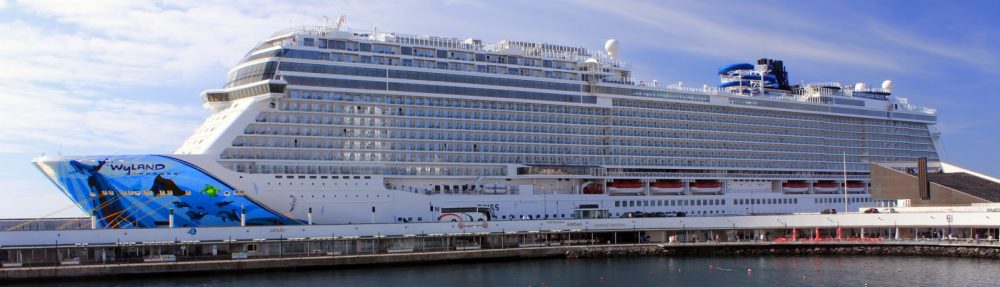
The Escape cost nearly $1 billion. You can enjoy it for under $150 a day. You can’t stay at the Dew Drop Inn in Pahokee for $150 a day.
And I think the good news is that the major cruise lines are all publicly traded and in the hands of professional managers. There is a board of directors, and there are shareholders to answer to. You have to run the business professionally, and I think that if you speak to my colleagues, they will tell you that what we all want is measured growth. The industry is growing, but we don’t want overcapacity. We don’t think overcapacity is around the corner anytime soon, and I think that the limitation in the shipbuilding side of the equation is sort of the regulator for that. The industry can well handle the six to eight ships that the shipbuilding industry can deliver annually.
We’ve publicly stated that 2016 will be a record year, a breakout year for Norwegian Cruise Line Holdings. We expect to have more revenue, more passengers booked, higher occupancies and higher pricing than we did this time last year. The Caribbean is particularly strong, Alaska is particularly strong, Europe has been trending very well. Right now, it’s looking very good, and the commentary that I’ve heard from my colleagues in the industry mirrors what we’re seeing at Norwegian: strong worldwide demand, which is allowing prices to rise. That’s good news for our travel agent partners because they’ll earn higher commissions, and the consumer is still getting one heck of a value. The [Norwegian] Escape is a ship that cost nearly a billion dollars, there’s everything on her that you can possibly want on any vacation, and you can enjoy all of that for under $150 a day, per person. You can’t stay at the Dew Drop Inn in Pahokee for $150 a day.
On the Norwegian side, 2016 will be a year of execution, another year where we’ll elevate the customer experience. I’ve said many times that Norwegian is not the bottom dweller. It’s at the highest level of the contemporary space, and we intend to dominate that space, not only with our new ships like the Escape, Getaway, Breakaway and Epic but also by keeping the legacy fleet in tip-top condition. You’ll learn more about our plans about that early in the coming year. We’ll have a major announcement to make. And, of course, we’re getting ready for two new destinations: China, with the Norwegian ship that comes out midyear 2017, and I believe that at some time in 2016 an American cruise ship will sail into Havana harbor. That’ll be historic for both countries and the cruise industry. The last time Cuba was open to Americans, the cruise industry as we know it today didn’t exist.
And we’re excited about the two additions to the Oceania and Regent fleets. We’ve got the Sirena coming online in April, the fourth of our R-class vessels. She’s undergoing a top-to-bottom refurbishment, which will instantly bring her up to the Oceania standard. And she’s selling very, very well.
And then there is the Explorer, the first vessel launched by Regent since 2003. She will be, without question, the most luxurious cruise ship ever built. Her public rooms are magnificent. Her suites and staterooms are the largest at sea. The balcony isn’t just a place to peep your head out and catch some wind but actually to go out and enjoy the sea. The cuisine, how do I articulate how good it is? I can look you in the eye and tell you that there is no restaurant in Miami — and I’ve not been to any restaurant in New York — that has the kind of quality and variety of styles that you’re going to find aboard the Explorer. We have an exciting inaugural planned, and I’ll tell you this: It is the antithesis of Pitbull [the godfather of the Escape]. I’ll let your mind wander as to who that might be.

She is selling like we’ve never seen anything before, with per diems in excess of $1,000. The $10,000-a-night owner suite is sold out for all the sailings that we have published. There’s a waiting list on every single one of those departures. People recognize this is the best of the best of the world, and there’s plenty of money floating out there, and they all want in.
And I get to be the first one who ever sleeps on that bed and enjoys that suite.


 Wetravel2u's Weblog