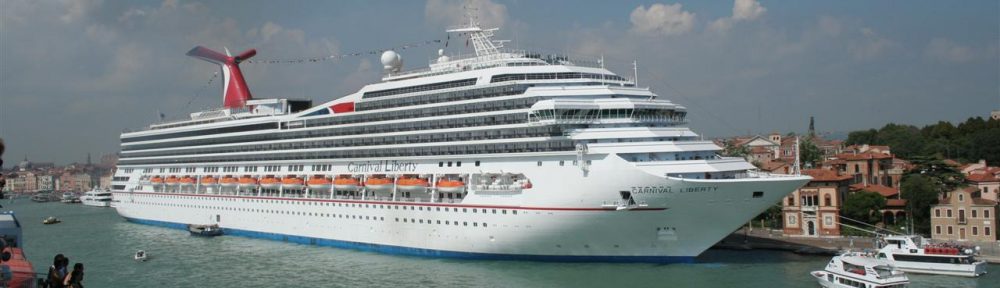
Lines await effect of plan to slash Venice cruise ship traffic

Lines await effect of plan to slash Venice cruise ship traffic

By Tom Stieghorst

Italy’s decision to constrain cruise ship growth in Venice will likely change the way some cruise passengers enter and leave the city as it is phased in over the next few years.

Prime Minister Enrico Letta approved plans to limit or shut down cruise ship traffic in parts of the Venice lagoon.

His order is at least a partial victory for the No Grandi Navi (No Big Ships) movement that sprang up in Venice as megaships began to visit the city.

And it is a setback, at least for now, for cruise lines.

“This would certainly be a disappointing outcome from our perspective,” Carnival Corp. said in a statement, which went on to assert that “the cruise industry is an important economic driver for Venice and other communities around the world.”

The ruling does not ban cruise ships from docking in Venice, but it places restrictions on how many ships can transit the Guidecca Canal, which takes passengers past the city’s iconic St. Mark’s Plaza.

Starting in January, it requires a 20% reduction in the passage of ships larger than 40,000 gross tons. It limits the number of large ships that can dock at the city’s main cruise terminal, Venezia Terminal Passeggeri, to five per day, according to European press reports.

By November 2014, ships over 96,000 gross tons would no longer be permitted in the Guidecca canal.

In its statement, Carnival said that while no changes are currently being planned, “we will evaluate the ruling and see how it impacts our business in the long run.”

Royal Caribbean Cruises Ltd. also responded to the ruling, saying that it is reviewing its deployments for 2013 and 2014 to be sure they comply with the new regulations.

“We recognize visiting Venice during their cruise is a highlight of our guests’ vacation,” Royal stated. “We expect to continue with our scheduled port calls to Venice for our 2013 and 2014 itineraries.”

Last year, 661 cruise ships bearing 1.7 million passengers called at Venezia Terminal Passeggeri. No breakdown of ship size was immediately available.

For the industry, Venice has become a vital turnaround port, uniquely serving both western and eastern Mediterranean itineraries.

For the city, that means extra revenue. Cruise ship passengers and crews spend $255 million a year in Venice, according to a 2013 Cruise Market Watch study, ranking it eighth among world cruise ports and third in Europe, behind Barcelona and Rome (Civitavecchia).

Practically, the decision will first affect deployment decisions for 2015. Neither Carnival nor Royal has announced its 2015 itineraries. The squeeze would be most acute in the summer months when ships tend to migrate to the Med.

One solution is to develop a new channel to Venezia Terminal Passeggeri for large ships that bypasses the most historic part of Venice. Letta’s office said the order restricting ship size also authorized development of such a channel.

However, that would end the romantic entrance to the city past St. Mark’s Plaza, which is treasured by many cruise passengers.

Cruise lines digest plans to limit Venice visits

Cruise lines digest plans to limit Venice visits

By Phil Davies

Cruise lines digest plans to limit Venice visitsGlobal cruise lines are digesting the implications of plans to limited the number of large ships allowed to pass through the centre of Venice.

The Italian government announced its intention to impose limitations from January with a 20% cut, while cruise ships of more than 96,000 tonnes will be banned from the centre of the historic city from November 2014.

Prime Minister Enrico Letta’s office also announced plans to open up a new canal to the city to allow big vessels to enter the city by an alternative route.

The Cruise Lines International Association (Clia) yesterday attempted to view the decision in a positive light despite the likely impact on member lines which see Venice as a highlight of many Mediterranean itineraries.

Clia said it viewed the announcement from Rome as a “positive on-going commitment of the representatives of the Italian institutions to find a sustainable and long-term solution for the city of Venice. This goal is shared by the cruise industry”.

However, the organisation added: “We are in the process of determining the impact of the decision, and any estimation or evaluation at this time is premature.

“Venice is consistently rated as the number one European cruise destination for our industry and we look forward to further strengthening our role as a key contributor to the economic vitality of Venice.”

Environmentalists have long protested against giant cruise ships passing through Venice, arguing that they damage the city’s fragile lagoon.

Venice to limit cruise ship numbers from January

Venice to limit cruise ship numbers from January


Protesters line the the bank of the Giudecca Canal during a demonstration to block a cruise ship
Last month protesters tried to stop a ship from docking in the city’s port

The Italian government has announced it will begin to limit the number of large cruise ships that pass through Venice.

Environmentalists have protested against the ships in recent years, saying they damage the city’s fragile lagoon.

From January 2014, the number of cruise ships allowed through Venice will be cut by 20%.

Ships of more than 96,000 tonnes will be banned from the centre of the city from November next year.

Prime Minister Enrico Letta’s office also announced plans to open up a new canal route to the city – thereby allowing big vessels to enter the city by a kind of back door, the BBC’s Alan Johnston reports from Rome.

The measures were announced after a meeting between Mr Letta, the mayor of Venice and other local politicians on Tuesday.

A spokesman for those who have protested against the ships told Italian media that the measures constitute a first step and that their campaign will go on.

Concerns over big ships sailing too close to shorelines have increased since the Costa Concordia cruise liner ran aground off a Tuscan island in January 2012, killing 32 people.

Those who oppose the ships argue that they are grotesquely out of keeping with the beautiful old city and that they disgorge unsustainable numbers of visitors into the squares and alleyways, our correspondent reports.

But there is also a powerful lobby in Venice that favours the cruise ship trade and welcomes the economic benefits it brings, he adds.