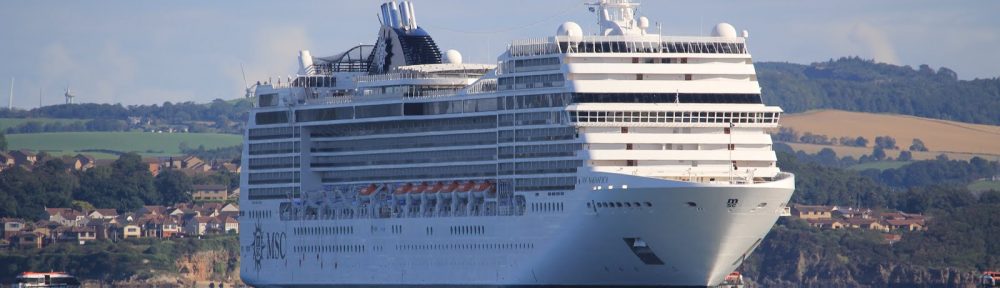
“About to sail on the magnificent #regalprincess WYWH” — @mickyarison, Nov. 5, Twitter,l
 For many, the resulting Instagram/Twitter/Facebook post was finished off with the hashtag #regalprincess.
At a table on the atrium’s first deck were two passengers with laptops out. One was Sara Dunaj, Princess Cruises’ social media manager. The other was Simon Duvall, also known as@simontravels and the host of #CruiseChat, a weekly Twitter chat about cruising.
“The Regal Princess hashtag,” he said, “is about to blow up tomorrow.”
A few years ago, with the advent of live Web streaming, consumers and agents could witness in real time the special events surrounding a ship launch: the entertainment, the CEO and captain making speeches, the bottle-breaking and the streamers flying.
But today, launching a new ship is a social media conversation, begun years before the vessel actually hits the open seas. A cruise line will begin using a hashtag — #regalprincess or #quantumoftheseas, to name the two most recently christened ships — and then seed social media with posts about the construction progress, itineraries and onboard innovations. Bloggers and social media influencers, not to mention the traditional news and trade media and everyday cruise fans, will pick up on the posts and rebroadcast them to their own friends and followers.
The result, cruise executives say, is a boon in terms of marketing for the ship and the brand. The resulting pins or posts, meanwhile, are marketing that will live on as cruisers contemplate a cruise on the #carnivalbreeze or #norwegiangetaway.
“I think at this point, social is … one of the most important elements of marketing a new ship launch,” said Gordon Ho, Princess’ chief marketing officer. “So in terms of magnitude, we spend so much time thinking about how our ship launch and marketing activities are going to be social.”
“Heading to NY to rejoin #norwegianbreakaway. Anything you haven’t seen yet that you’d like a picture of?” — @nclandy, May 6, 2013, Twitter
 Social media “has become a critical aspect of telling a story of a new ship to consumers, to trade,” said Andy Stuart, Norwegian Cruise Line’s executive vice president of global sales and passenger services. “It’s expected. And it’s an opportunity to engage with a much broader audience in different ways and across different platforms.”
Norwegian took advantage of the siren call of social media in a big way when it debuted the Norwegian Breakaway in New York in May 2013. The line opened up the WiFi networks so they were complimentary to guests, and it invited nontraditional media to the ceremony — “people only telling the story through social media,” Stuart said.
A week after the ceremony, Norwegian and its communications partner, MTN, said that the line had set a “new record” for social media usage at sea during the inaugural events in New York from May 8 to 12.
“The result generated more than 429,755 Facebook visits over the five-day period, and Instagram registered more than 56,862 visits and 1,715 pictures uploaded with the hashtag #NorwegianBreakaway,” the companies said. “Guests utilized Twitter onboard, and as a result, Norwegian received a record number of mentions and retweets about the content shared from Norwegian Breakaway.”
Duvall said he considered the Breakaway to have been the first big-ship launch to embrace the social media and blogger community by inviting social media influencers onboard and promoting the #norwegianbreakaway hashtag.
“Oasis and Allure of the Seas were the beginning,” he said. “It wasn’t such a critical piece of it back then. It was the beginning of the trend.”
A suddenly dominant tool
 If the Oasis of the Seas and Allure of the Seas, in 2009 and 2010 respectively, were the beginning of the trend, there were several subsequent ship launches, such as from Celebrity or Disney, that showed up on major platforms like Twitter, Facebook, Instagram, YouTube and Pinterest. On the rivers, attendees at the multiship inaugural for Viking Cruises tapped out observations on their phones using the term #vikingchristening.
In June 2012 for the Carnival Breeze launch, Carnival Cruise Lines teamed up with cruise newbie and former “American Idol” contestant Janell Wheeler, who documented a trip to see the ship fresh from the yard on Facebook, Twitter, Pinterest and YouTube.
Flash forward to November 2014: Media interested in attending the Quantum of the Seas’ inaugural cruises in New York last weekend were asked to provide their Twitter handles as part of the preregistration process.
“Our #FiatAtSea campaign is one way we generated buzz to launch #MSCDivina”–@KenMuskat #CSM2014 #cruisemkt” — MSCCruisesUSA, March 11, Twitter
For its introduction of the MSC Divina to the U.S. market last fall, the MSC Cruises team saw big results from a social media campaign: It loaded a bright red Fiat 500 onto the Divina and tracked the car and the ship as they made their way from Italy to Florida.
Every day, the ship’s photographer took a picture of the port — Malta, St. Thomas — then sent the pictures out on MSC’s Facebook page and on Twitter with the hashtag #fiatatsea. When the Divina entered Miami, it was escorted by a fleet of specially equipped Fiat 500 watercraft cars, with the hashtag emblazoned on the side, that appeared to drive on the water’s surface — a photo perfect for sharing.
“We got so many people talking about us,” said Ken Muskat, executive vice president of sales, public relations and guest services for MSC in the U.S.
Five bloggers were invited the day before the Divina’s arrival. The day of the inaugural there was a social media meet-up onboard with a stream of live tweets that ended in fireworks (the fireworks photos went viral, Muskat said). Free WiFi was provided for agents and other guests onboard to share their thoughts and photos.
 From Nov. 12 through 23, 2013, the period surrounding the ship’s arrival, MSC said the hashtag #mscdivina generated 5,585 tweets and 1.5 million impressions on Twitter. Overall that month, the likes and followers of the line’s Facebook and Twitter pages grew 10%.
With an inaugural cruise a brand can only carry as many press, agents and guests as the berths can hold. But Muskat said social outreach is a way to build buzz and reach a global audience in real time. Muskat, a self-proclaimed Twitter addict, said the platform enables him to have a personal relationship with agents.
“And then there’s the crew,” he added. “They were the first ones tweeting.”
“The Love Boat cast is naming #RegalPrincess today! RT if you’re dreaming of ‘love, exciting and new!'” — @princesscruises, Nov. 6, Twitter
Last week, as the Regal Princess was counting down to its naming ceremony with the cast of “The Love Boat” and VIP celebrities from the show, the tweets and Instagram posts started flying fast and furious, right down to the posts about getting ready to board and pictures of the ship in Port Everglades.
Selfies with “The Love Boat” cast. Photos of the cabins. The atrium. The spa. The ceremony itself, followed by the fireworks.
Once the ship left port on a short preview cruise, the tweets and photos switched to the sail-away and a day trip to Princess Cays. More food, onboard entertainment, then regretful goodbyes — an entire cruise to be lived vicariously through social media.
One of Princess’ social media goals, Ho said, was to create “stories that are sharable;” for example, the cast of “The Love Boat,” who together named the Regal Princess, or the line’s new Chocolate Journeys program with chocolatier Norman Love.
“Inherently, chocolate is something that can be shared abundantly,” he said.
(I recalled my brief trip to the Regal Princess: Crew had passed out a complimentary cabernet-and-chocolate pairing, and I had instantly — automatically? — snapped a picture of my wine glass and chocolate and shared it via Twitter.)
A versatile social toolbox
 Each platform offers a slightly different tool.
“On Facebook, we’ve been focusing on imagery, because it’s such an image-driven thing these days,” Princess’ Dunaj said. “On Twitter, we’re able to do a lot more live activity, so that’s where we’re doing the live tweeting of the event.” Instagram, of course, is “entirely visual,” and the line created a series of videos to drive buzz for the Regal on YouTube.
A hashtag’s activity can be measured by several metrics, including impressions, which means, roughly, the number of times a tweet with a hashtag could have been seen by a person with a Twitter account. Princess Cruises, for example, has 73,300 followers on Twitter, so each time @princesscruises tweets something, that tweet garners 73,300 impressions. On a busy hashtag, it doesn’t take long for the impressions number to reach into the millions.
Princess said last week that using analytics that enabled it to search for “#regalprincess,” “Regal Princess” or “The Love Boat,” from Nov. 4 through Nov. 11 it recorded more than 83 million Twitter impressions. More than 850 photos were hashtagged #regalprincess.
Companies are measuring social media returns on a more long-term basis — not just one hashtag but several iterations, and not just the hashtags but also what the tweets say.
This enables them not only to respond quickly to a problem or “like” a compliment but also to tailor and refine content to what users want to see.
“I’ll be on it on the 18th! YAY!” — Chris Voegele, Nov. 7, Facebook
“Only a few more days of anticipation, Chris! How excited are you to join us onboard?” — Royal Caribbean International
The Quantum of the Seas has been billed as the most highly anticipated new ship of the year, so it’s not surprising to see a flood of information showing up as a constant stream on the social media “dashboard” on Royal’s public relations site.
“It’s been four years since we launched a new ship, and the whole online landscape has changed,” said Tracy Quan, Royal Caribbean’s associate vice president of global corporate communications.
“Right from the very beginning, we knew we had to do it differently than just doing traditional launches; we knew we had to leverage all the social channels out there.”
Royal, which has also refined the art of the “reveal” — i.e., producing a splashy event to draw attention to new facilities or programs onboard — incorporated social media. For example, company President Adam Goldstein co-hosted a Google Hangout to coincide with the reveal of its Dynamic Dining program (aka #dynamicdining on #quantumoftheseas).
 For travel agents, in addition to being able to repost, repin or retweet Royal’s public posts, Royal said there have been daily Quantum-related posts on the Facebook page of Vicki Freed, the senior vice president of sales and trade support and service, and Freed conducted a Facebook chat with travel partners earlier this month.
It also houses social media sample copy and images on its LoyalToYouAlways.com trade site for agents to share with clients. A Facebook campaign for the trade is forthcoming.
The line has refined some of its early strategies from the Oasis and Allure debut. For example, on the Quantum debut it’s partnering with “experience advisors” outside of the travel industry to extend its reach, such as Michael Schwartz of the Michael’s Genuine gastropub on culinary (4,000-plus Instagram followers, to use one statistic), former NFL linebacker Dhani Jones on sports and fitness (75,000 followers on Twitter) and HGTV personality Genevieve Gorder on cabin decor (70,000 likes on Facebook).
“It’s not about who we know; it’s about who they know, who they reach,” Quan said. “So they can just amplify. … In our bid to always try to expand our audience reach, we want to be able to speak to new-to-cruisers.”
It has also continued to post making-the-ship videos to YouTube, but the company has been publishing shorter videos, which Quan said was more in line with viewer preferences today.
On Royal Caribbean International’s YouTube channel, a video about the robotic bartender in the Quantum’s Bionic Bar had been viewed nearly 10,000 times as of last week; a video titled “All New Technology Onboard Smartship Quantum of the Seas” posted in August has been viewed more than 42,000 times.
Quan said the videos serve two purposes: to satisfy media and consumers who are hungry for new content and also to serve as story ideas.
 “If we talk about the behind-the-scenes on the making of the Bionic Bar, we get media who wouldn’t typically cover us, like the tech media, approaching it,” she said. “How did we come up with the concept? How did we come up with the development?”
And of course, during the ship launch this weekend the line threw down the barriers to the wireless network to enable all who sailed onboard to Facebook, Instagram, tweet, Vine and pin to their hearts’ content.
Halo effect
Stewart Chiron, aka the Cruise Guy (@cruiseguy) and the owner of Leisure Pros, was one of the social media aficionados fresh off the #regalprincess who last week was readying for #quantumoftheseas.
“Social media is so vitally important to businesses today to get your messages out and communicate with people,” he said. The Quantum, he said, “is going to have a halo effect. It is going to be able to showcase what cruising is all about.”
J.D. Andrews, a travel videographer and photographer who goes by @earthxplorer, said that when he’s onboard, he “constantly” posts on Twitter, Instagram and Facebook with his phone (and shares more “professional” photography on his website, earthxplorer.com, when he gets home). He doesn’t have a minimum or maximum number of posts or a concrete plan. “The only ‘plan’ I’ve ever had is to share my adventure, the things that I find fun and interesting,” he wrote in an email.
Andrews, who said he had been using social media since 2007, said he loved the interaction with followers: “they can ask me questions in the moment, and if I don’t know it’s easy enough to find them the answer.”
He said he thought that change has come to the cruise industry. “It seems that, finally, each cruise line has come to their own ‘tipping point,’ either by necessity or trying to keep up with their competition, and it’s about time. It’s the only way to post what your company is doing, assist in customer service and share the exciting world of travel directly to your consumer.
“And it’s free.”


 Discounts do more than harm revenue, said Adam Snitzer, president of Peak Revenue Performance, a Miami Beach consulting firm that specializes in revenue management.
 A two-category upgrade, a popular value-add in Carnival Cruise Lines promotions, has a perceived value of whatever the difference in brochure cost is between the two cabins.
 However, Crooks said it’s important that the offers not become too complex. He said promotions that are not combinable with other offers are especially frustrating to agents and consumers.
 Called the All-Inclusive, the product bundles Norwegian’s Ultimate Dining and Ultimate Beverage packages with Internet minutes, plus a bevy of other items not included in the cruise fare.
 To hold the line on rate, Regent added a selection of free shore excursions to prime the demand pump. Regent and sister line Oceania Cruises have continued to refine the model since then.
 At Carnival, upgrades such as Seuss at Sea or the Carnival Live concert series have added value that helped its business recovery from negative publicity surrounding the Carnival Triumph engine room fire in 2013, Rein said.
 Wetravel2u's Weblog