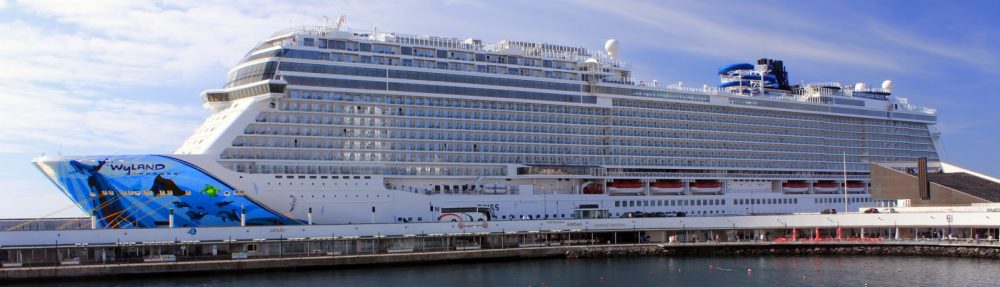
MSC Cruises’ new ship and second powered by liquefied natural gas, the MSC Euribia has completed a four-day set of sea trials in the Atlantic Ocean, according to a statement.
The trial involved checking the performance of the ship’s engines, fuel consumption and safety systems, and speed and stopping distances.
Following the completion of sea trials, the ship set course for Chantiers de l’Atlantique’s shipyard in Saint-Nazaire, France before being delivered to MSC Cruises in May.
MSC Euribia’s official christening ceremony is scheduled for June 8 and will take place in Copenhagen, Denmark before its inaugural season in Northern Europe sailing from its homeport in Kiel, Germany.
Shortly after the christening, starting from June 10, the MSC Euribia will offer seven-night sailings from Kiel to Copenhagen and the Norwegian fjords with calls in Geiranger, Ålesund, and Flam.
The MSC Euribia will sail Northern Europe for the winter 2023-24 season offering seven-night sailings from Hamburg to Rotterdam, The Netherlands; Zeebrugge, Belgium; Le Havre, France and Southampton in the UK.
MSC World Europa, demonstrates the company’s strategy to decarbonise by cutting greenhouse gas emissions.
This ship was delivered from the Chantiers de l’Atlantique’s shipyard in Saint-Nazaire 24 October, with the latest power and propulsion technology on board.
MSC Cruise Management (UK) head of electrical engineering Steven Frey said this ship is powered by LNG and has a solid oxide fuel cell (SOFC) to run as a pilot project.
“We are working to get to zero emissions from multiple fronts, including digitalisation, workshops and partnerships, hybrid propulsion solutions, shore charging and new technologies, such as SOFC,” said Mr Frey. “We are starting a demonstration of a 500-kW SOFC on a ship, and we want to scale this technology up to 20 MW.”
Using power from shore during port stays is an important method for MSC to reduce ship emissions.
“All of our newbuilds are ready for shore power and we are retrofitting the existing fleet,” said Mr Frey. “Around 50% of our ships will be ready by 2023 and 65% by the end of next year. We have also signed a memorandum of understanding with Cruise Baltic to use shore power in 32 ports from 2024 when it is available.”
He said smaller cruise vessels need around 4.5 MW of power and MSC’s largest ships to need more than 10 MW from shore power to shut down engines.
Mr Frey said a combination of shore power and technology to reduce energy consumption and fuel usage is needed to cut cruise ship emissions.
“We are looking at ways to decarbonise by reducing energy consumption on the ships, by adding LED lighting and heat recovery, reducing hotel loads and using alternative fuels,” he said.
“We have a dedicated department dealing with energy efficiency and developing solutions for tracking data from our vessels, so we have a clear view of consumption,” Mr Frey added.
On the subject of fuels, MSC has already turned to LNG to cut pollutants and will consider other sources of energy.
“We are considering hydrogen as a fuel of the future and are using LNG now. MSC World Europa uses LNG fuel and has the SOFC pilot project. Other ships could run a fuel cell and LNG,” said Mr Frey.
MSC Cruises’ latest ship, MSC World Europa, demonstrates the company’s strategy to decarbonise by cutting greenhouse gas emissions
This ship was delivered from the Chantiers de l’Atlantique’s shipyard in Saint-Nazaire on 24 October, with the latest power and propulsion technology on board.
MSC Cruise Management (UK) head of electrical engineering Steven Frey said this ship is powered by LNG and has a solid oxide fuel cell (SOFC) to run as a pilot project.
“We are working to get to zero emissions from multiple fronts, including digitalisation, workshops and partnerships, hybrid propulsion solutions, shore charging and new technologies, such as SOFC,” said Mr Frey. “We are starting a demonstration of a 500-kW SOFC on a ship, and we want to scale this technology up to 20 MW.”
Using power from shore during port stays is an important method for MSC to reduce ship emissions.
“All of our newbuilds are ready for shore power and we are retrofitting the existing fleet,” said Mr Frey. “Around 50% of our ships will be ready by 2023 and 65% by the end of next year. We have also signed a memorandum of understanding with Cruise Baltic to use shore power in 32 ports from 2024 when it is available.”
He said smaller cruise vessels need around 4.5 MW of power and MSC’s largest ships to need more than 10 MW from shore power to shut down engines.
Mr Frey said a combination of shore power and technology to reduce energy consumption and fuel usage is needed to cut cruise ship emissions.
“We are looking at ways to decarbonise by reducing energy consumption on the ships, by adding LED lighting and heat recovery, reducing hotel loads and using alternative fuels,” he said.
“We have a dedicated department dealing with energy efficiency and developing solutions for tracking data from our vessels, so we have a clear view of consumption,” Mr Frey added.
On the subject of fuels, MSC has already turned to LNG to cut pollutants and will consider other sources of energy.
“We are considering hydrogen as a fuel of the future and are using LNG now. MSC World Europa uses LNG fuel and has the SOFC pilot project. Other ships could run a fuel cell and LNG,” said Mr Frey.