The Carnival Miracle is currently undergoing a routine drydock in Astoria, Portland. As part of the ship’s regular maintenance schedule, the shipyard stay was confirmed by Carnival Cruise Line in May.
In addition to regular upkeeping and class work, the Spirit-Class vessel is set to receive Carnival’s new blue, red and white livery.
Created to celebrate the company’s 50th anniversary, the new hull look was inspired by officers’ uniforms and features a navy-blue bow along with red and white accents running the entire length of the ship.
After completing the drydock, the Miracle is set to resume its cruise program on the West Coast on November 17.
On the date, the 88,500-ton vessel sails from Long Beach on a short cruise to the Mexican Riviera. The five-night itinerary includes full-day visits to Cabo San Lucas and Ensenada before returning to Carnival’s cruise terminal in the Los Angeles area.
During the 2022-2023 winter season, the 2,124-passenger ship is also set to offer two-week cruises to Hawaii, as well as additional three- to six-night itineraries to the Mexican Riviera and Baja California.
Closing out Carnival’s Spirit Class, the Carnival Miracle originally entered service in 2004.
Designed with a multi-deck atrium, a glass-enclosed pool deck and a large number of cabins with private balconies, the ship underwent a major refurbishment in 2015.
At the time, it received all of Carnival’s Fun Ship 2.0 upgrades, including the Alchemy Bar, the RedFrog Rum Bar and the Cherry on Top candy store.
Other features of the vessel include the Punchliner Comedy Club, a Serenity adults-only retreat, a classic American-style steakhouse, a nine-hole miniature golf course, a 14,500-square-foot health and wellness centre, and more.
In addition to the Miracle, six Carnival ships have completed scheduled drydocks in 2022, including the Carnival Luminosa
Meyer Turku has always been at the forefront of new technologies, Tim Meyer, CEO, said to Cruise Industry News, noting that the yard built the first LNG-fueled passenger vessel, the Viking Grace and that its sister yard in Papenburg delivered the first LNG-fueled cruise ship.
“It is important to understand that every time we build a prototype, we set very ambitious targets for GHG emissions and fuel consumption so that the new ship becomes more efficient. That becomes part of our building contract with most customers and, of course, by reducing the fuel consumption, we also lower our customers’ operating costs.
“Over the years, we have been introducing new technologies in our newbuilds, such as, for example, podded propulsion; air lubrication to reduce the hull’s resistance in the water; advanced wastewater treatment, ballast water treatment, and more, which eventually have become building standards for the cruise industry.
“Now, we are focusing on HVAC, which is a large energy consumer,” Meyer continued. “It is not necessary to cool down all the public rooms all the time, when there are no people present, for example, or staterooms when people leave.
“There is also the ventilation and exhaust from the galleys that used to run around the clock. We are now optimizing this, so it is only running when there is cooking going on.”
In addition, Meyer Turku is looking to develop a carbon-neutral cruise ship concept by 2025, working with suppliers, universities and research organizations, as well as the state of Finland.
“This is a very important effort and will be key to our success going forward,” Meyer said. “On one hand you have the ship itself, on the other hand, you have the shipyard, and then we have our network and supply chain that can be optimized.
“A cruise ship is like a small city; you have everything from water production to wastewater treatment and so on. The goal is to have all these systems working together as efficiently as possible, and with AI (artificial intelligence) we will be able to do just that.
“Another pillar is our people, so we are also focused on creating new competencies within the yard, looking at how we are working and developing new ideas for methods and procedures.”
As a shipbuilder, Meyer said the company can literally build anything. However, the key is that it must make sense.
“When you have a ship such as the Viking Grace running between Stockholm and Turku, then it makes sense to operate on LNG, as long as you have a fixed route. But if you have a cruise ship sailing all over the world that may not work if LNG cannot be bunkered. So, you have to adapt the product.
“The big question is what fuels will be available and where they will be available,” Meyer continued.
“Another factor that plays in is the energy density of marine fuels. Diesel oil has the most energy per litre; methanol has only half as much, LNG a little less than methanol; liquefied ammonia, liquid organic hydrogen carriers and liquefied hydrogen even less.”
Thus, future fuels could impact the design and general arrangement of future ships, tank space and bunkering frequency.
“What do zero emissions mean,” Meyer asked rhetorically. “Does it mean no exhaust only or does it also mean no sound and no vibrations? What is important for us is to look at different aspects, not only the cruise ships themselves but also the supply chain. Germany, for example, is studying how to make steel production more sustainable. As a shipyard, we cannot do all of this but work as partners with our suppliers.
“We have to look at the whole picture, and if you compare to what people do on land, let’s say they drive their car, heat their homes, prepare food, go to the theatre and so forth. If you add all that up on a per capita basis, I think cruise ships will come out quite well.”
Contrary to land-based hotels and resorts, there is no waste of energy on a cruise ship, according to Meyer, who said that is a challenge the shipbuilder has been tackling for years and continues to look for new solutions.
Icon of the Seas will have Royal Caribbean International’s “biggest-ever focus” on families, as the line looks to increase its share of the new-to-cruise market.
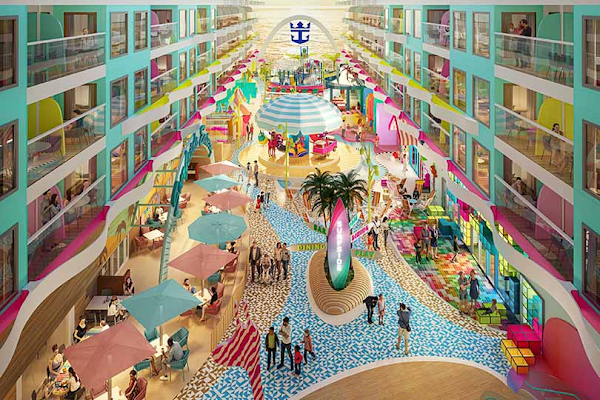
Icon launches in January 2024, and across the 28 stateroom categories, more than 80% of rooms sleep more than two people. The ship will feature the new Surfside neighbourhood, which is dedicated to families with young children. This is a key target audience for the line, which already carries between 200 and 600 children under six years old on each cruise.
Speaking in Miami to unveil the design of the ship, the line’s president and chief executive Michael Bayley said: “On Icon our focus on family is probably the highest level it’s ever been. We’re going more and more towards delivering phenomenal vacations to families.”
Bayley said the new-to-cruise market was a “sweet spot” for Royal Caribbean, and that in 2019 the line carried more than one million people on their first cruise. He said offering short taster cruises is key, as clients then graduate to seven-night sailings.
From October 2023 Allure of the Seas will offer three- and four-day cruises from Port Canaveral. He added: “We think that once we get that message out to young families [about the facilities onboard], we’ll see a lot more new-to-cruise coming onboard Icon.”
Bayley said the brand’s family demographic is “vast from a marketing perspective”, adding: “Everyone is in a family, so we want to make sure that families have a fantastic vacation with Royal Caribbean. On Icon, whether you’re a grumpy old man or an innocent young kid, everyone can do their own thing and be super happy all day.”
The icon will offer the three-storey Ultimate Family Townhouse, which has access to the new family-focused Surfside neighbourhood
He acknowledged that while school-age children were at school for the majority of the year, families with pre-schoolers can holiday throughout the year. “That market is quite powerful. A young family is a big market, and we think it’s an under-served market and we think that Icon, especially with Surfside, is going to really deliver on that.”
He stressed that the ship caters for multigenerational families, highlighting the new neighbourhoods and features, including adults-only areas and the largest waterpark at sea.
The Royal Caribbean team in Miami has spent more than one million working hours on the design process for Icon, in addition to time spent by external experts. It worked with 10 futurists to understand what consumers of the future would expect from holidays.
Bayley said: “Icon is the culmination of everything we’ve learnt in more than 50 years. We push the boundaries of what’s possible and what’s expected. This is the work of thousands of industry experts from around the world.”
New family cabins include the 285-square-foot Family Infinite Balcony, which sleeps six and borrows the Infinite Balcony concept from sister line Celebrity Cruises. It includes a bunk bed alcove for children at the rear of the cabin, with a secret den, a separate space for adults and a 50-square-foot balcony.
The new Surfside neighbourhood houses the Ultimate Family Townhouse, which takes the brand’s existing Ultimate Family Suite concept and spreads it across three storeys, with 1,772-square-foot of internal space, alongside two balconies. Sleeping eight, it includes a slide, Lego wall, video games, movie theatre, karaoke and backyard that leads straight into Surfside.
The Family Infinite Balcony stateroom includes an area for children at the rear