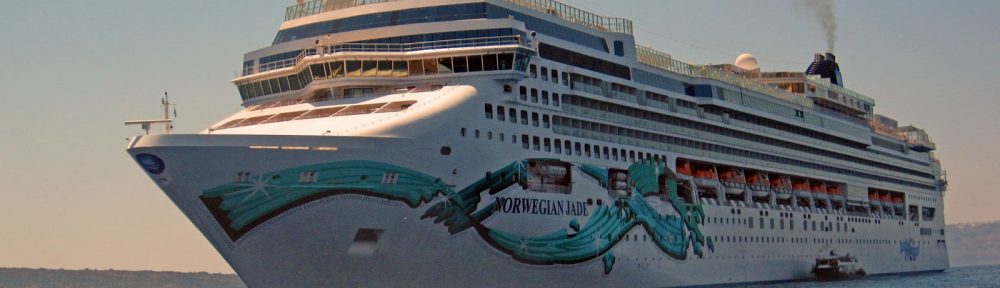
Everything we know about the virtual balcony

If there’s one feature of Royal Caribbean’s next-generation cruise ship that is just starting construction, Quantum of the Seas, that is capturing people’s imagination the most, it’s likely the virtual balconies.  These 80-inch LED screens attached to a wall are promising to deliver an innovative take on the inside cabin.

Understandably, there’s a lot of intrigue regarding this new kind of cabin and people want to know what it is exactly and what to expect.  We don’t know everything quite yet, but here’s a listing of all the information on virtual balconies that we do know in one place.
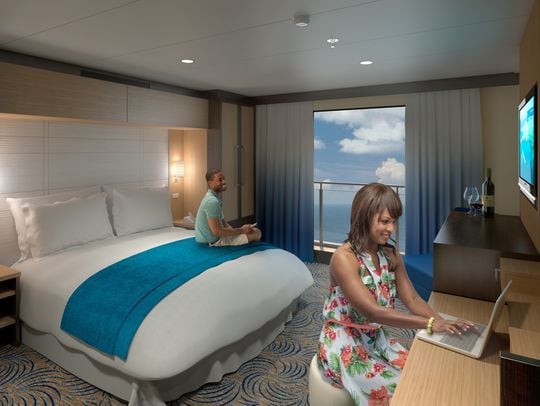
What is a virtual balcony?

The virtual balconies will be 80-inch LED projection screen that stretches from floor to ceiling.  They will offer digital real-time views of the ocean and destinations visible from the ship’s exterior.

It will be displayed in high-resolution color on a giant 80-inch LED screen on the wall of an otherwise windowless stateroom.  It will work at sea and in port.

Will virtual balconies cost extra?

When they were announced, Royal Caribbean CEO Adam Goldstein said there will not be a specific surcharge for interior cabins with virtual balconies, but added that he hopes they will bring higher yields.
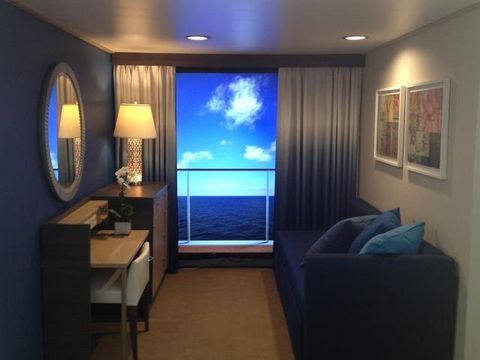
How many inside cabins on Quantum of the Seas will have virtual balconies?

There will be 373 inside cabins on Quantum of the Seas that will offer the virtual balcony feature.

Will any ships other than Quantum of the Seas have virtual balconies?

It’s a safe bet sister ship Anthem of the Seas will have virtual balconies along with the unnamed third Quantum-class cruise ship Royal Caribbean has on order.

In addition to those ships, Navigator of the Seas will receive virtual balconies as part of a previously planned refurbishment.  Navigator of the Seas will go for its refurbishment in December 2013. It is scheduled to sail from Galveston when the upgrades are complete.  Royal Caribbean will use Navigator of the Seas as the “testing ground” for this brand new innovation.

In addition to Navigator of the Seas, virtual balconies will be included as part of scheduled refurbishments for Voyager, Adventure and Explorer of the Seas.  Those ships are set to undergo the revitalization process in 2014-15.
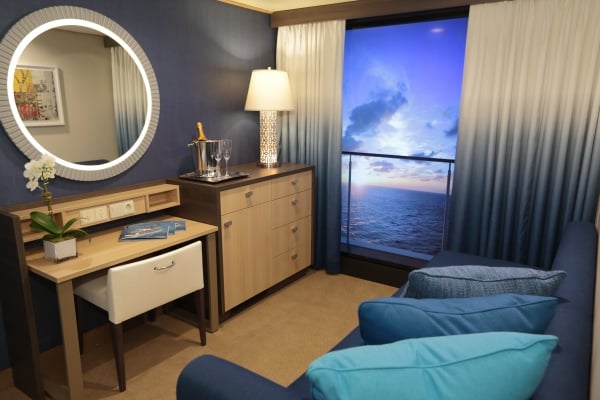
Will the virtual balcony projection be on all the time?

No, you may turn the virtual balcony feature on or off at your convenience.

Where did Royal Caribbean come up with the idea for the virtual balconies?

According to Royal Caribbean Chairman Richard Fain, they got the idea from Disney Cruise Line’s virtual portholes that debuted on their ships a few years ago.

“We actually had looked at the idea, and we didn’t think that the technology and the receptivity from the public was there,” he says. Disney “proved that the public does value something like this.”

virtual balcony projection video

Comment: Cruise industry must take China’s rise on board

Comment: Cruise industry must take China's rise on boardFollowing the announcement of the deployment of Royal Caribbean’s newest ship year-round from Shanghai next year, David Selby assesses the significance of the decision and the impact on established markets

China is vast – it has a population over 20 times that of the UK and is the world’s second largest country by land mass.

Between 2007 and 2011, its economy grew at the rate of Canada, France, Germany, Italy, Japan, the United Kingdom and the United States combined – and while we dither in the UK about where the next commercial airport capacity will be situated, around two-thirds of the world’s airports are being built in China, with 55 planned between 2013 and 2015!

Shanghai is China’s biggest city, with a population of over 22 million, according to the last National Population Census in 2010. While a significant number of residents still have insufficient income or interest in cruising, it was perhaps only a matter of time before a major international cruise line would announce year-round deployment from the city, as Royal Caribbean has done.

The fact that it is its newest and “shiniest” ship, Quantum of the Seas, does make it interesting. It goes against the traditional idea of growing “new to cruise” markets typically using older tonnage, and keeping the key markets fresh with the newest innovation hardware.

During last week’s announcement, Adam Goldstein, Royal Caribbean’s president and chief operating officer, said: “Every trend we are seeing in China tells us we can achieve real long-term competitive advantage and appealing returns on our investments in this fast-growing market by accelerating our presence there. We will have to be nimble, but the ability to move fast is one of our strengths.”

I agree! It comes from having – in my view – the strongest single international cruise brand in the world.

Meanwhile, analysis commissioned last year by the Asia Cruise Association predicts a market size in Asia by 2020 of 3.8m, of which China will be 1.7m – just below what the UK is today. Cruises are typically of short duration and to serve 3.8m cruisers on 5 night voyages, the region will need the equivalent of eighteen 3,000 berth ships sailing in the region year round. It is unlikely to stop there.

Where will they come from, and what of traditional core markets?

Well, Royal Caribbean points out that the ports of Florida (with ships sailing to the Caribbean – the most popular cruising destination), will be operating with record levels, while from New York passengers will have the chance to cruise on ships not previously deployed from there.

In the UK of course, we look forward to seeing Anthem of the Seas – Quantum’s sister-ship – sailing from Southampton after she is launched next year. Longer term however, we could see a general shift away from current core markets unless there is an acceleration of new-build activity.

For the remainder of this year, apart from Quantum, there are just three ships over 2000 berths being launched worldwide – for Princess, Costa and Tui in Germany. Next year there are five, in 2016 there are six and in 2017 there are so far just three. While this may increase, it is barely enough to cover the Asian growth over the next six years.

Therefore, the challenge is on for the industry in traditional markets to keep the product and marketing fresh, to drive value and deliver exceptional levels of customer service – and the same goes for the destinations the ships visit.

Looking even further ahead – once the Chinese have tried cruising at a local level, they will without doubt be cruising further afield and coming to Europe.

So while we sort out the runway problem, it would be a good idea to sort out the UK Visa situation at the same time.

Quantum’s China deployment reflects a new economic reality

By Tom Stieghorst
Shanghai, future homeport for QuantumThe decision to make Shanghai the home for Royal Caribbean’s Quantum of the Seas has immediate implications for U.S. travel agents who had been looking forward to selling the ship’s originally scheduled cruises from South Florida and New Jersey.

The Shanghai deployment is the clearest sign yet that the U.S. and Europe will have to compete for the future attention of a cruise industry they’ve grown accustomed to thinking of as their own.

“We were in a two-theaters-of-operation mode for the last 20 years,” said Adam Goldstein, president of Royal’s parent company, Royal Caribbean Cruises Ltd. “Now, its North America, Europe and Asia-Pacific.”

In addition to China, Australia is getting strong support from North American cruise companies.

Lisa Lutoff-Perlo, Royal Caribbean’s senior vice president for operations, said the plan had always been an Asia deployment for one of its upcoming ships.

“We have clearly accelerated that with the decision to send Quantum to Asia,” she said.

In its announcement, Royal Caribbean said Quantum would sail year-round from Shanghai on three- to eight-day cruises to Korea and Japan.

Details about the itineraries will be available in a month or two, said Christopher Allen, Royal Caribbean’s assistant vice president of global deployment and itinerary planning.

Goldstein said the Chinese market has evolved from being in research-and-development mode to one that is contributing to the company’s profitability.

He said that even without the ability to sail to Japan from China, due to political tensions between the two countries, 2013 was a profitable year for China-sourced business.

Royal Caribbean has been sailing the Voyager of the Seas and Mariner of the Seas from China. Although the addition of the 4,200-passenger Quantum will increase Royal Caribbean’s capacity in the market by 66%, Goldstein said he’s confident it will sell.

“This year, there’s more of a desire by [Chinese] travel agents and tour operators to go to Japan,” he said.

China has grown at a blistering pace, as has its outbound tourism, Goldstein said. “The Chinese have a very strong belief that they have emerged as an economic powerhouse,” he said, adding that the feeling they should be at the forefront of every industry comes along with that.

Goldstein said that the tourist experience in Singapore, Hong Kong, Macau and Shanghai is world-class, so the positioning of a top-of-the-line ship there is seen as only natural.

Although he has said several times that Caribbean countries need to take heed of the global competition for ship calls, Goldstein said the Quantum announcement was less a reflection on the Caribbean market than a sign of the new world economic order.

Quantum of the Seas under constructionThat order might not be good news for U.S. travel agents, who typically profited from the power of a line’s newest ship to fill fast and command premium prices.

U.S. agents, particularly those in South Florida, benefited from that effect when Royal Caribbean introduced its last new Oasis-class vessels, the Oasis of the Seas and Allure of the Seas, based in Fort Lauderdale.

The move of the Quantum to Asia means a new lineup of Royal Caribbean ships in important East Coast ports.

After the Quantum leaves New Jersey in May 2015, it will be succeeded by the Liberty of the Seas until November.

The Anthem of the Seas, which will debut in the summer of 2015 doing European cruises from Southampton, England, will then take up the New Jersey routes to Bermuda and the Caribbean.

Vicki Freed, senior vice president of sales, trade support and service, said she had already heard from some agents in the Northeast U.S. who want to have clients sail on all three New Jersey-based ships in one year.

“They feel like they’re getting the trifecta,” Freed said.

But Fort Lauderdale, which had announced itself as the winter home of the Anthem, will have to make do with the Navigator of the Seas, along with its monopoly on the Oasis-class ships.

Royal Caribbean officials took pains to say that New York, South Florida and China are all important markets. As Royal Caribbean becomes more global in its deployment, the key will be to strike the proper balance, said Lutoff-Perlo.

“North America is always at the forefront of everything we think about because it is such an important market for us now. Always has been and always will be,” Lutoff-Perlo said.

One area that has lagged in Royal Caribbean’s deployment is the U.S. West Coast, particularly Los Angeles. Freed said that the line hoped to be back one day, but noted that itinerary options were somewhat limited.

Allen added: “I think that that’s a market we will continue to review and continue to look at the opportunities, and when the time is right we’ll be excited to come back to the West Coast.”

The decision to move the Quantum to China shed new light on the announcement of “Dynamic Dining,” which eliminates the main dining room on the Quantum for five smaller, alternate dining venues, a style more in tune with Asian preferences.

Lutoff-Perlo said that during a 50-day repositioning cruise from New Jersey to Shanghai in 2015, workers would modify the retail, gaming and galley areas of the ship to adjust for Chinese tastes.

She said that a press conference in Shanghai to announce the Quantum’s commitment to China was heavily attended and lasted a long time.

“The world is changing. How our ships are sourced is changing,” Lutoff-Perlo said. “The fact that these ships are popular all over the world is much different now than it has been in the past.”