All the sea’s a stage

By Tom Stieghorst
When Micky Arison began working on cruise ships in the 1970s, name-brand entertainment was scarce.

“We had a limbo dancer, a hostess and a singer,” the Carnival Corp. chairman recalled in a recent promotional video.

A Holland America Line show produced by RWS Associates.Four decades later, the limbo dancer has been replaced by far more recognizable talent. Olivia Newton-John, Chicago and LeAnn Rimes are among the names appearing on Carnival Cruise Lines ships this summer.

Each week, dozens of musicians, dancers, magicians, comics and other professional entertainers sail on each of Carnival Cruise Lines’ 24 ships. The biggest cruise lines operate facilities on land to train performers for shows at sea.

Even some luxury lines are employing cutting-edge video technology and aerialists of the type used in Las Vegas shows, striving to make their vessels as alluring as possible.

“Things have changed quite a bit,” Arison said.

Cruise entertainment is being reshaped by a combination of technology, changing consumer tastes, competition, growing ship size and a revolution in the way dining works on ships. (To see more examples of what cruise lines are doing in the entertainment department, click here or on any of the photos for a slideshow of images.)

Those improvements have enabled cruise lines to experiment with moving some entertainment from the cost side of their ledgers to the revenue side, with several on the cusp of charging guests for what was once free.

“For the first time, we’re seeing entertainment as driving revenue to the vessels,” said Nick Weir, vice president of entertainment for Royal Caribbean International.

Carnival started charging between $20 to $40 this year for seats at its Carnival Live concerts, and Weir hinted that Royal is exploring ways to follow suit on its ships.

Entertainment has changed in part because of the more flexible dining that has evolved on cruise ships over the past 10 years. Andy Stuart, executive vice president of global sales at Norwegian Cruise Line, said a passenger’s choice of shows used to be defined by early or late seating.

“It was dinner and a show,” Stuart said, when evening meals were limited to the main dining room.

But Norwegian had to rethink entertainment after it ditched the two-shift dining format in favor of its Freestyle Dining.

Now one of the hottest tickets on Norwegian’s newer ships is a theater that combines dinner and a show. The Illusionarium on the Norwegian Getaway and Cirque Dreams on the Norwegian Breakaway provide hour-long specialty shows with dinner for $29.99.

Blue Man Group in performance on the Norwegian Epic.Burn the Floor, a 45-minute pop ballroom dance show, is also staged in the middle of one of Norwegian’s main dining rooms.

In the main theater, Norwegian offers a licensed version of Broadway’s “Legally Blonde,” among other shows. It also pioneered the at-sea presentation of Blue Man Group, a Las Vegas mainstay.

“Everyone loves Blue Man Group,” said Norwegian CEO Kevin Sheehan. “But it is a little bit different than the traditional cruises with the old-fashioned Broadway shows, where everybody’s running around dancing and singing like they’ve been doing for 40 years on these ships.”

Other lines have also retired the flesh-and-feathers shows of yesteryear.

Out with the old

At Holland America Line, one of the big entertainment hits has been Dancing With the Stars at Sea, a program of dance lessons and theme cruises modeled on an audience-driven TV show.

Shows like “Dancing With the Stars” and “American Idol” are changing audience expectations, said Lisa Lehr, executive director of entertainment development at New York-based RWS Associates, which produced six shows last year for Holland America.

“Your large-ensemble, everybody sings/ dances sort of showgirl-esque entertainment has seen its day,” Lehr said. “We’re definitely moving away from that.”

In addition to shows that make audiences the judges, cruise lines are breaking down the walls between entertainers and the audience.

80s Pop To The Max in the main theater on the Carnival Freedom.In a new main theater musical on Carnival, “88 Keys: The Rock N’ Roll Piano Show,” the piano-bar performer on the ship does a 30-minute warm-up, bringing his fans to the show.

Before another show, “Heart of Soul,” the cruise director has winners of a romantic-dedications contest read their entries. Prizes are awarded and flowers are given ahead of the show.

Performers gradually take the stage at the start of the show from seats in the audience.

Carnival is one of many cruise lines to deploy new technologies in entertainment. One game changer has been the adoption of video walls; the large, mobile scenery panels, which use LED screens, have made stage backgrounds far more interesting and versatile.

“That opens a world of storytelling,” Lehr said. “We’re able to create the Princess Forest. We’re able to take you to the Queen of Hearts tea party, and the Mad Hatter tea party, without having to bring on large set pieces that there’s nowhere to store on a cruise ship.”

On the Carnival Freedom, a performance of “Heart of Soul” starts with an LED-panel depiction of a wooden dock building itself, plank by plank, into a lake. Later in the show, the screens depict fireflies in a forest. Changing skylines seamlessly turn the Golden Gate Bridge into the Brooklyn Bridge. Vegetation grows, Jack-and-the-Beanstalk style, and the stars, moon and mountains form the backdrop for a rendition of “This Will Be (An Everlasting Love).”

LED panels debuted on cruise ships several years ago and are now found on most major cruise lines, as well as in Las Vegas and on touring Broadway shows and at big rock concerts.

And now 3-D

The next big thing in scenery on ships will be the 3-D projection system developed for Royal Caribbean’s Quantum of the Seas.

A rendering of the Two70 aft lounge on the Quantum of the Seas.Weir said the Vistarama system of 18 projectors offers a higher-definition image than LED panels. The projectors will throw scenes on the three-story, 270-degree wrap-around windows in the ship’s aft lounge as a background for performances in the evening.

On the Quantum’s main stage, guests will hear a performance on a theater-sized harp and a wall of drums, as well as see a woman whose costume can be played like a violin.

At 167,800 gross tons, the Quantum is typical of a new generation of ships that can accommodate two or more dynamic performance venues. Bigger ships also mean more crew quarters, so performers don’t have to staff the ship’s library or kids club in their off hours.

“There was a time when every berth had to work an enormous amount for it to be valid,” Weir said. “That’s not the case when you’ve got a city the size of Oasis of the Seas.”

Better performers are one result, he said.

With 104 shows being presented on Royal Caribbean and Celebrity Cruises in any given week, the need to recruit and retain performers has increased. Royal has outgrown its training space in Hollywood, Fla., and is building a $20 million rehearsal theater at Florida International University.

The 130,000-square-foot theater is about half built, Weir said, adding that it’s expected to open in January. Norwegian Cruise Line opened a 46,000-square-foot studio in Tampa in January. Carnival trains performers in Miami; Princess Cruises rehearses in Los Angeles.

RWS is also hoping to attract more cruise ship work by building a 31,000-square-foot space in Long Island City in New York City. It wants to capitalize on its background and experience producing corporate events, theme park shows and mall entertainment as well as its connections to talent.

Performers in training at Norwegian Creative Studios in Tampa.“The beauty of us being in New York City is we’re really on the pulse of what’s new and exciting happening in entertainment today,” Lehr said. “We’re really able to hand-pick those creative minds and creative talents to bring cutting-edge and innovative programming.”

Although main-stage musicals have always been the foundation of cruise entertainment, today’s bigger ships allow for a greater number of small acts in more parts of the ship.

Royal Caribbean, for example, has retooled the atriums on some of its ships as evening performance spaces for aerialists.

At Carnival, the trend is shorter shows with smaller casts, complemented by more musical groups in the atrium, casino, bars and lounges, as well as comedy at the line’s Punchliner Club.

Jim Berra, chief marketing officer at Carnival, said guests expressed frustration when they couldn’t see both the main stage show and a Punchliner show in one evening.

“They don’t want to have to trade off,” he said. “So what we’re trying to do is distribute more entertainment throughout the ship.”

Skip Lyons, cruise director on the Carnival Freedom, said that when he started working on Carnival ships 18 years ago, there was a 10-piece pit band for production shows.

Today only three ships retain the 10-piece band. The other 21 use recorded music in the main theater.

A Carnival Live performance by REO Speedwagon.“The band might not be in the show, but while the show is on, we can be entertaining guests elsewhere on the ship because the band is now playing around the ship,” Lyons said.

In the 1990s, he recalled, Carnival ships had two production shows during a seven-week cruise that employed a cast of 16 made up of two singers, two acrobatic adage performers and 12 dancers.

Today, on most ships, Carnival does four shows a week with a cast of eight — four dancers who also sing and four singers who also dance, Lyons said. Show lengths are typically 35 to 40 minutes, down from an hour or more in the past.

Earlier this year, Carnival upgraded its house band as part of the new Carnival Live program, which brings well-known acts onboard for in-port shows in Nassau, Cancun and California’s Catalina Island.

The shows are typically staged on weekdays when celebrity performers such as Jennifer Hudson or Trace Adkins are often idle.

Carnival’s Berra said the concept has been a success, with many shows sold out.

“It’s a great opportunity for [the cruise lines] to increase their earnings,” he said.

The initial series of 49 concerts concludes Dec. 15 in Nassau with a show by rock band REO Speedwagon. Berra said details of a second season will be announced this fall.

Thinking bigger in smaller venues

Smaller ships pose a challenge because they don’t have as many venues for entertainment. But ships on the larger end of the luxury scale are mounting shows that mimic their bigger brethren.

Crystal Serenity is home to iLuminate.At Crystal Cruises, the 1,070-passenger Crystal Serenity is home to iLuminate, in which performers are costumed in wired suits that show only the outlines of lights in a darkened theater.

The concept, pioneered on the TV show “America’s Got Talent,” creates some startling effects, such as a robot that appears to juggle several of its own heads. On Broadway, tickets start at $68.

Regent Seven Seas Cruises recently retooled the two-story theater on the Seven Seas Mariner to accommodate LED-panel walls and more aerial performers in a new, Cirque du Soleil-style production.

“In the finale of our shows we may have six of our 12 performers flying in the air at once,” said Michael Day, vice president of entertainment at Regent and sister line Oceania Cruises. “That’s something you don’t see on many ships, even ships much, much larger than our ships.”

Regent uses Jean Ann Ryan Productions for its shows, a veteran company that created cruise versions of Broadway shows when Norwegian first introduced that kind of entertainment in the 1980s.

While charging for marquee talent like performers in Carnival Live might be the wave of the future, for now it is an unusual revenue model. Most cruise entertainment remains free ­– and a bargain, cruise executives say.

Sheehan pointed to Blue Man Group as an example.

“When you think about it, it’s an $80 or $90 show in Vegas, and people can watch it for free as part of their cruise fare,” he said.

Another example is the upcoming production of the musical “Mamma Mia” on Quantum; it will be the first full-length Broadway musical staged at sea, complete with an intermission.

Weir tells a story of seeing a three-generation family group of 15 in the front row of a production of “Saturday Night Fever” on the Liberty of the Seas. “I remember thinking, ’15 people at a Broadway show — that’s a $3,000 night out, and yet at Royal it’s on the house.'”

Whether free or paid, top entertainment helps keep cruises competitive with mass-market destinations like Las Vegas and Orlando. But Weir said the goal going forward is to set trends, not merely match them.

“We’re on the map now,” he said. “We’re like an entertainment leader. No single entertainment operation under one roof is doing what we’re doing: ice shows, aqua shows, Broadway shows, and now we’re going to be doing multimedia shows. And we do it all in-house.”

The bottom line, Weir said, is that “we’ve become valid, and we’ve become huge.”
Meyer Werft combines forces with STX Finland – and confirms my ship 5 and 6

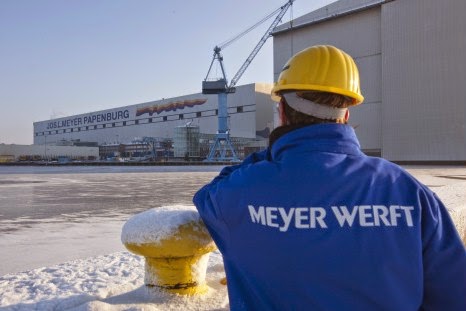
The Meyer Werft is combining forces with STX Finland: After numerous talks on closer cooperation with the cruise shipyard STX Finland in Turku now a stake in Papenburg shipbuilders agreed.
With its 70% share the Meyer Werft takes over the operational management of the Finnish shipyard. In Finland, currently about 1300 directly employed people work at the cruise ship Mein Schiff 4 for the German shipping company TUI Cruises.
The Hamburg shipping company TUI Cruises, a joint venture between TUI and Royal Caribbean Cruises Ltd.. (RCCL), now announced two more ships of this class also has to be ordered (My ship 5 & 6) in Turku. STX Finland is a proven specialist for cruise ships and a shipyard with very high technological know-how.
Positive effects are given by a higher flexibility to the customers.
Even with a future even stronger, common approach in the area of ​​research and development in the cruise market, and mutual learning among the workflows positive synergies are possible. “We are strengthening all sites equally.Positive effects are given by a higher flexibility to the customers.
Even with a future even stronger common approach in the area of ​​research and development in the cruise market, and mutual learning among the workflows positive synergies are possible. A staff reduction in Lower Saxony, Mecklenburg-Western Pomerania or in Finland are not an issue, “says CEO Dr. Jan Meyer.
With the Land a contract to secure sites in Papenburg is even being discussed. This makes it very clear that it is not about a shift from capacity, but to a significant strengthening of the bundled competence in the European cruise industry. The acquisition is currently subject to confirmation by the participating financial institutions as well as the approval of the Federal Cartel Office.

Guide to finding deals and booking a trip

Cruising 101: Guide to finding deals and booking a trip

Ready to take the plunge and book a cruise? Here’s a guide to the many booking options, from going directly to a cruise line by phone or online to using a cruise-focused travel agent. We offer tips on finding a good agent, how to find the best deals, how to choose a line and ship, how far in advance to plan a cruise, and the pros and cons of waiting until the last minute to book. We also explain such terms as a “guarantee cabin” and “Wave Season.”

How to book

There are many ways to book a cruise: direct from a cruise line; through an online or bricks-and-mortar travel agent; or through a third-party website like Expedia.com.

Using a travel agent

Most people book their cruise with a travel agent, especially first-time cruisers. There are good reasons for this:

  • Expertise. First, buying a cruise is a specialized purchase that requires a greater degree of understanding than other travel bookings. A good travel agent will offer expertise and experience, and most importantly, match your personality to the right cruise product. For example, agents can steer you and your kids away from a luxury line that caters to adults, or prevent your romantic getaway from being highjacked by a ship full of spring-break college kids.
  • No charge. Travel agents, especially those who specialize in cruises, do not charge for their services because they are paid a commission by the cruise line. (That can be both good and bad. If a travel seller seems unusually pushy about one line over another, it may be because he or she gets more commission from that line.)
  • Access to deals. Travel agents often have access to specials deals and savings, and can offer their clients perks and extras in the form of onboard credit, a free transfer to the airport, a complimentary meal in an onboard specialty restaurant or pre-paid gratuities. Furthermore, a good agent can cut through the clutter of deals out there, and let you know that a Caribbean cruise in early September looks like a great deal, but that’s because it’s hurricane season.
  • Cabin advice. Travel agents will also orient you to the dozens of cabin types some ships have. The world’s largest cruise ship, the 5,400-passenger Oasis of the Seas, has 37 cabin categories, including industry firsts, such as inside cabins with balconies.
  • Troubleshooting. Finally, an agent will be your advocate if something goes wrong. While 99% of the time you won’t need to call your agent once the ship sets sail, unforeseen problems do occur (usually weather related). An agent often has some muscle with the cruise lines, which might be able to help get you home in a tough situation, and they will help you change your ticket if they see a snowstorm is coming.

Finding an agent

Finding a “good” travel agent, however, can be challenging. For one, there are literally hundreds of websites that sell cruises. Many people who book with an online cruise seller are not always aware that they are, in fact, buying from a travel agent. Follow these tips:

  • Use word of mouth. If you know someone who had a good experience, ask for a referral.
  • Look for their affiliations. Travel sellers can become accredited cruise specialists through the Cruise Lines International Association (CLIA). Those agents can achieve up to three levels: Accredited (ACC), Master (MCC) and Elite (ECC). That means they have completed a training program on various cruise products and are required to sail and inspect a certain number of ships. They must also make a certain number of annual cruise sales, demonstrating their experience in working with customers and selling travel. To find a CLIA-certified agent near you, go to the Cruise Expert Locator at cruising.org and input your zip code.

Travel agents can also become certified “experts” by the various cruise lines. For example, if you are interested in Royal Caribbean cruises, they have a list of travel agents specialized in their product here:royalcaribbean.com/customersupport/travelagentLocate.do. Other lines do the same.

Look, also, for the initials CTC after an agent’s name. They stand for Certified Travel Counselor, which means the Travel Institute has certified they have at least five years of full-time industry experience and have completed certain tests and programs. Another resource is the American Society of Travel Agents (asta.org), the world’s largest travel-agent association.

  • Check their specialties. Once you’ve identified an agent, find out what cruise lines he or she is expert in: If you are interested in an adventure trip to Antarctica, find someone who specializes in that rather than mass-market cruising to the Caribbean.

Also, find out if that agent has been on the ships and brands you are interested in. Experienced cruise specialists often sample ships so they can advise clients with first-hand knowledge.

Booking direct

If you are a savvy cruiser who knows exactly what you want, or if you have the time to do a lot of research, booking direct might be for you.

Almost every cruise line has a direct booking option on its website or by calling its reservations center.

Picking a cruise

Matching your personality and tastes to the right cruise line and ship is imperative. To the inexperienced eye, all cruise ships might look the same. But there are major differences between the lines and even the ships within the same line.

  • Lines. Norwegian Cruise Line bills itself as a “freestyle” cruise line in terms of dining, and was the first to veer from the traditional two-set dining times. While most cruise lines now offer a variety of restaurants, NCL’s newest ship doesn’t even have a main dining room, a cruise ship staple.

Royal Caribbean targets an active crowd with its rock climbing walls, surfing simulators, boxing rings, and an onboard zipline.

Carnival Cruise Lines has never stopped calling its vessels, “the Fun Ships,” and that is what they aim to offer guests.

MORE: How to pick the perfect cruise

Then there are the niche brands: Azamara Club Cruises keeps its ships in port late to allow passengers to explore the nightlife in places like St. Tropez. Cunard Line tries to give its passengers the feel of being on an early 20th-century ocean liner. Much of the Celebrity Cruises experience is centered around food and wine, while Holland America passengers enjoy a wide range of lecturers and enrichment classes.

The upscale lines also offer different experiences — from the laid-back, yacht-like vibe of the 50-cabin Seadream Yacht Club vessels to the ultra-luxury pampering of a Seabourn ship, to the sails blowing in the wind on a Windstar Cruises vessel, there really is a product for everyone.

  • Ships. First of all, size matters. The larger the ship, the more there will be to do onboard including restaurants, entertainment, and daily activities. For families, it usually means there will be activities targeted to all age groups.

In terms of itinerary, generally the bigger the ship, the bigger and busier the ports it will go to. Only the smallest of ships can call at tiny islands, but 12 huge cruise ships at once can — and do — call in Cozumel, Mexico.

Another rule of thumb is that the smaller the ship, the higher the price tag. Small cruise ships are usually in the luxury or adventure segment of the market. They offer the highest crew-to-passenger ratios and some of the largest suites at sea.

PHOTOS: The seven most spectacular new suites at sea
MORE: Cruise entertainment, dining options increase, diversify

Many small ship lines are “all-inclusive” meaning that depending on the line, beverages like specialty coffees, soft drinks and alcohol will be included in the fare, as will some of the classes and activities you would be charged for on a larger ship.

One luxury cruise line, Regent Seven Seas Cruises, even includes a selection of complimentary shore excursions.

Smaller ships are more intimate and you will probably get to know people after a few days, while on the largest ships, you might never cross paths with the same people twice.

Small ships usually have a more mature crowd and have very little for children to do. Nightlife and the casino are often afterthoughts.

While there won’t be nearly as many places to eat as on the biggest cruise ships, the cuisine on small ships is often the finest at sea.

Next, think about what ship features are important to you — is it the “wow factors” like a zipline, surfing simulators, and bowling allies? Or are you more interested in the most extensive spa or the most roaring nightlife and casino at sea?

Do you want to try a different cuisine every night, or have the most spaces for your kids to run around?

Do you like your entertainment to be Broadway-like or cabaret style?

Lines become known for certain amenities, but those features are often found only on their newest ships. Norwegian’s “freestyle” dining experience, for example, isn’t as freestyle on its oldest ships, which don’t have as many choices as its newest ones do.

If you love Princess Cruises’ adults-only Sanctuary area or its Movies Under the Stars jumbo pool screen, be advised these amenities are not found on all of the line’s older vessels.

The newest vessels with the most newfangled amenities will always command major premiums. But if you’re willing to cruise on a vessel only a couple years older, the price will drop significantly.

At the same time, cruise lines invest millions of dollars into those old ships, and often give them the most popular amenities from the newest ones. For example, Celebrity Cruises is refurbishing many of its older ships with the best features from its newest Solstice-class vessels.

Cabin selection

There can be up to 37 different kinds of cabins on each ship. The smaller the ship the fewer the choices, but even suites on a smaller, luxury ship will have different sizes and configurations.

  • Categories. Most cabins fall into three categories: inside, outside, and balcony.

Inside cabins are the ship’s smallest and most basic. They can generally fit up to four people by utilizing bunk beds.

Outside cabins, or oceanview, have seaside windows and come in different sizes and layouts depending on their location.

Balcony cabins have attached private balconies. A standard balcony cabin will usually have a table and two chairs on it, while larger suites will have loungers.

The most expensive cabins are the suites. The most luxurious ones have large dining rooms and bars and several bedrooms. Located on the ship’s corners, they may have wrap-around balconies with private hot tubs. Oceania Cruises used big-name designers from Ralph Lauren Home for the top suites on its newest ship, the Marina, while the Oasis-class vessels have duplex loft suites with two-story windows looking out to sea.

  • Location. Cabin location is also important, especially if you are prone to seasickness. Rooms located in the middle of the vessel and lower down tend to experience the least amount of motion.

Also, keep in mind that on the largest ships the distance from one end to the other is quite far. Think about whether you want to be near the elevators, the fitness center, the lido-deck buffet, children’s play areas, etc.

If you are traveling with your family, ask about adjoining cabins. Most vessels have cabins that join via an interior door making two cabins feel like a mini-suite. While older ships have fewer of these, the newest ships that cater more to families have introduced more adjoining cabin possibilities.

When to buy

Most cruise ships sell from the inside out and outside in; the most expensive suites and least expensive inside cabins sell out first, leaving the standard balcony cabins as the last to go.

If you are particular about a certain cabin, a certain date, and a particular itinerary, you should book early. The cruise lines encourage this and usually offer early-booking incentives. Certain lines are better at giving the early buyer the best deal, while others tend to dump inventory at the last minute. Generally, what’s left the month before departure is not going to be the best cabin on the best itinerary.

Travel agents typically advise booking at least six months out for the best cabins during peak travel time. Cruises on small ships to unusual destinations like Antarctica can sell out over a year in advance.

Further, there is more demand on the mass-market ships when school is out. And you’ll pay a premium to cruise over the holidays and during spring break.

Off-peak sailings are often the best deals, and if you can handle being on a ship for many days at sea, repositioning cruises — when cruise lines relocate their ships from one region of the world to another to start a new season, such as a crossing from Europe to the Caribbean in the fall, and back again in late spring — are often among the best deals at sea.

Finally, consider the cost of air. Even if you can get a last-minute deal on a cruise, last-minute airfare to the port could be much higher.

Wave season

One of the best times of year for deals is during Wave Season, the period between January and March that has traditionally been the industry’s hottest selling period.

The combination of winter-weary consumers and cruise lines’ desire to move inventory early — so they can raise prices later — means that this is when the cruise lines make high-value offers like free upgrades, onboard credit, and free airfare. But shop around. Even among different travel agents you will find different perks based on the volume they do with certain lines.

Booking last minute

If you aren’t picky and just want a cheap getaway, it might be worth waiting for a last-minute deal. But they can be unpredictable. Weather, oil prices, consumer confidence, world events and employment reports can all impact the price of a cruise.

To find a combination of a good last-minute price and desirable cabins, time your cruise search for when people can cancel their reservations without penalty (usually between 60 to 90 days before departure). These cancelled cabins might go for reduced rates at the last minute.

Guaranteed cabins

If you don’t care about your cabin location, you can get a good deal by taking the “guaranteed cabin” option. Rather than be assigned a specific cabin number, you will get a guaranteed cabin type — oceanview, inside, balcony — but you won’t know where it is until you board the ship. This can save you hundreds of dollars, but you may end up at the bottom, rear of the vessel.