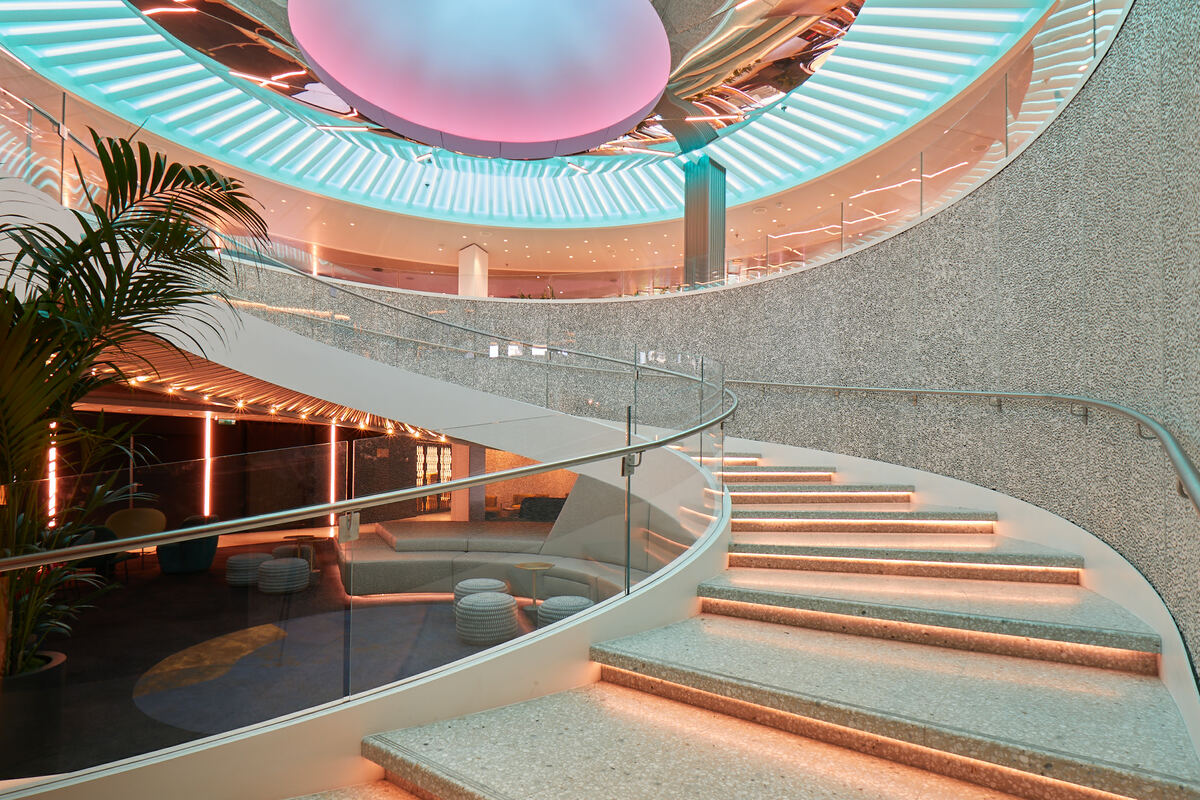
The theme of ‘modern romance of sailing’ lies behind the interior design of the ship (pictured, the Roundabout. Credit: Virgin Voyages)
He adds “The distribution of space has been developed by Virgin and Fincantieri to optimise passenger spaces and technical areas. Thanks to this fine-tuning of spaces, passengers can experience different restaurants connected to one single galley group, and a lot of entertainment options. More than 90% of passenger cabins are facing the sea, while high attention to the crew resulted in about 60% of cabins being single accommodation.
“One of the concepts that led the design of the ship has been organising layouts and using space and technology to boost passenger interaction, whether in a disco, relaxing in a lounge or even in front of the wake of the vessel. The ship is designed to provide a modern customer experience by taking advantage of the widespread wifi connection to provide on-demand services to the passengers everywhere. The passenger cabins feature an automation system which allows cabin functions to be controlled by a dedicated tablet or by an app installed on the passenger’s mobile phone.”
Mr Torrente says one of the most innovative venues is the multipurpose theatre called the Red Room, which features an innovative retractable motorised seating system which enables it to have either a traditional theatre layout or a plain, large dance floor for parties or other social events. Such flexibility will allow the biggest space on the ship to be used more than just a couple of hours a day with traditional shows. Mr Torrente expands “The novel design of the whole system required us to define the standard necessary to reach safe design and operation. Risk-based design was therefore developed starting with a hazard identification study carried out in collaboration with Lloyd’s Register, Virgin Voyages and the system manufacturer.”
Just above the sea level on deck seven is an outside lounge facing the wake, which is “very elegant and wide”, says Mr Torrente. “The layout of the area and the elegant furniture enable passengers to look at the sea and relax. At the after end of deck 16 is another outside relaxing area featuring a suspended lounge, where the traditional steel deck has been replaced by a large wire net where passengers can safely lie down hanging over the sea. For this innovative feature a risk-based design was developed, to define design criteria to provide safe experience and for using this special attraction.”
Indeed, this feature is part of the theme of the ‘modern romance of sailing’, which lies behind the interior design of the ship. Virgin Voyages senior vice president of design and customer experience Dee Cooper tells our sister publication Passenger Ship Interior & Refurbishment Review “What we tried to do was to have design nods and touches that embrace the sea and the adventure of sailing.” As well as the catamaran net Ms Cooper singles out using dichroic glass.
She explains that the glass is like a “prism that cuts light but makes it more purple or pink depending on the time of day. The glass plays up to the amazing views, big skies and sunsets of the sea and builds the environment of being in these different lights”.
The glass is present in the main entrance atrium, in cabins and suites and in “little touches” throughout the ship.
The theme ‘modern romance of sailing’ also binds together the interior designs used. The company’s ‘creative collection’ comprises interior designers, artists and architects including Roman and Williams, Tom Dixon Design Research Studio, Concrete Amsterdam, Softroom of London and more.
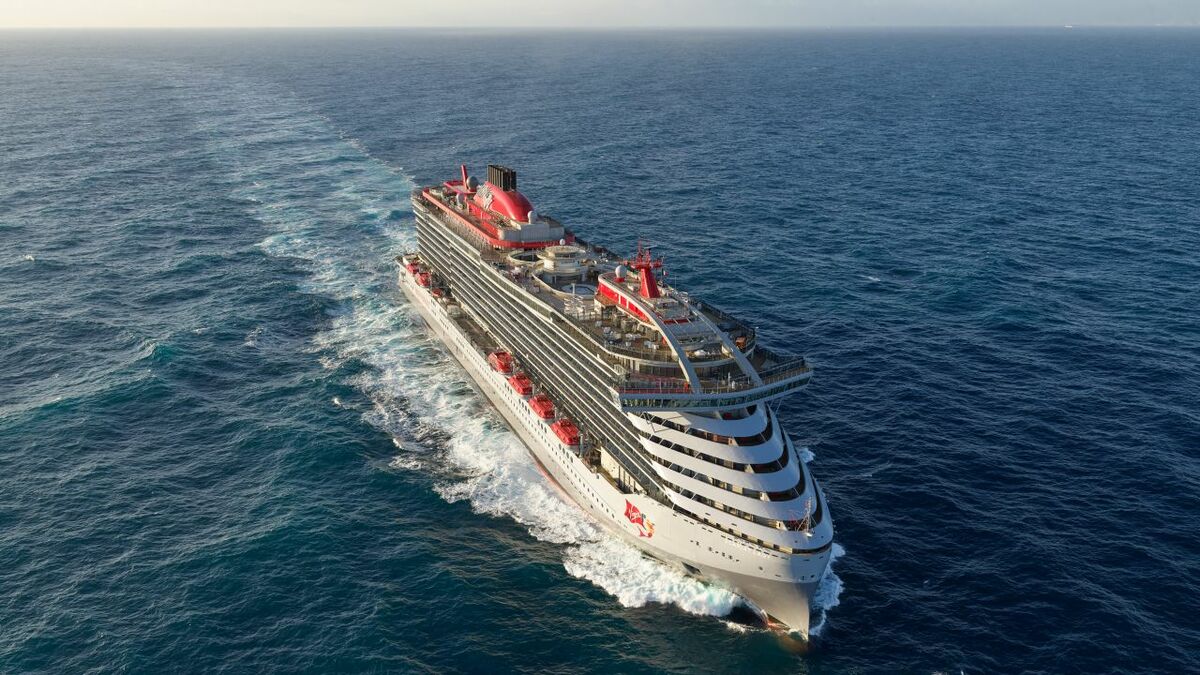
Mr Torrente tells Passenger Ship Technology “The most evident innovative characteristic is the design of the vessel, made to make passengers feel they are sailing on a fashionable ship rather than on a traditional cruise ship. Great attention has been paid to the outside shape of the ship. The vertical bow, the continuous front surface that joins hull and superstructure and the yacht-style funnel were design inputs to create something distinctive. The shipbuilder had to match the aesthetical ambition of the shipowner’s architects with structural design and manufacturing constraints. Special attention was given to the quality of workmanship to reach the very special final result.”
‘Great attention’ to environment
Explaining the energy-efficient features, he says “Virgin Voyages is a cruise company characterised by a great attention to environmental impact.”
The Climeon heat power system mentioned previously, fitted onto a cruise ship for the first time, is one of the major energy efficiency features. Another is Scanship’s advanced wastewater purification system.
Mr Torrente adds the ship “makes extensive use of LED lighting, state-of-the-art air conditioning and ventilation systems and demand-based galley ventilation with UV treatment of grease-laden air”.
Halton supplied the ventilation solutions for the galleys and restaurants. Virgin Voyages chose the Halton MARVEL system for all the galleys on board the Scarlet Lady. The Halton MARVEL system, ventilation exhaust and supply air volumes are adjusted according to need, says Halton. The system detects the mode of cooking appliances and optimises the exhaust airflow on each hood inside the galleys. At the same time, the system ensures comfortable conditions for galley personnel by effectively removing the heat and smoke from the cooking process.
Scarlet Lady features more than 20 food venues. In Geonbae, the ship’s Korean BBQ restaurant, people can cook their own food on flameless grills built into the table. This concept on board required a one-of-a-kind solution to catch and extract the convection plume and fumes from the cooking process. Geonbae will have 30 units of the Halton Jet Extraction System installed above the tables.
“These units have been designed specifically for show-cooking areas, and this particular JES model was tailored according to Virgin Voyages’ needs and their visual concept. Tailoring and co-design required several mock-ups at the Halton factory in Germany,” says Halton Marine sales manager Tapani Peltola.
Virgin Voyages senior vice president of hotel operations Frank Weber says “Halton not only provides top quality products and state-of-the-art technologies, but their team of experts allowed us to challenge the status quo and develop an industry-leading custom solution, which will allow us to bring our lively Geonbae restaurant to life while also helping us achieve our goal to incorporate smart technologies across the ship that help us limit our environmental impact.”
Another ventilation solution on board the Scarlet Lady is the Halton mobile cooking station called Halton MobiChef, which is an autonomous cooking station for electric appliances, free from any ventilation ducts.
“MobiChef is perfect for show cooking especially in public areas where it is not possible to have a ventilation duct to extract smells, grease and impurities created by the cooking process. The unit is easy to move from one place to another, it is easy to start up with a plug and play function, and looks great,” says Mr Peltola.
Moving on to the hull, Mr Torrente says “An extensive optimisation job has been carried out on the hull and the propulsion, with a final configuration capable of reaching a performance well beyond expectations. In fact, during sea trials the ship showed better than contractual performances in terms of power demand to achieve the service speed. Additionally, the vessel reached a very comfortable seakeeping attitude.”
Ship numbers two and three are contracted as sister ships to Scarlet Lady, however ship number four will undergo modifications to comply with the new Panama Canal.

 Wetravel2u's Weblog