Two TUI Cruises ships are currently operating on bio-LNG, according to a statement shared on social media.
The company said that the Mein Schiff Relax and the Mein Schiff Flow are running entirely on renewable LNG during their summer seasons in Europe.
TUI noted that this greener fuel is based on biomethane, which can significantly reduce greenhouse gas emissions compared to fossil fuels.
“Thanks to the use of bio-LNG alone, we were already able to save around 26,000 tons of CO2 by July 2026 and are expected to reach around 50,000 tons by the end of the year,” the company stated.
In addition to burning cleaner fuels, TUI highlighted other initiatives aimed at improving sustainability, including the use of shorepower.
Various ships were retrofitted with connections over the past few years, including the Mein Schiff 1, the Mein Schiff 2 and the Mein Schiff 5.
Ships also use sustainable textiles and operate under the watch of dedicated environmental officers, who are said to work to keep operations as green as possible.
The company reduced the use of plastic onboard and shifted its shore excursions program to focus on environmentally friendly tours.
The Mein Schiff Relax is currently offering itineraries departing from Germany to destinations in the Baltic and Scandinavia.
After debuting earlier this year, the Mein Schiff Flow is spending its maiden season in the Western Mediterranean with cruises to Spain, Italy, France, Morocco and Portugal.
Built by Fincantieri, the 4,000-passenger vessels introduced a new design to the fleet, becoming the company’s largest ships at 161,000 tons.
TUI is now working with Fincantieri on two additional LNG-powered vessels, which are scheduled to debut in 2031 and 2032.
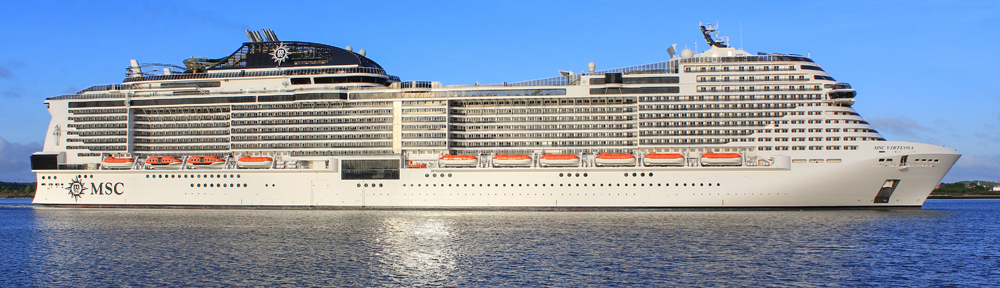
MSC Cruises, Fincantieri and Snam have announced the signing of a Memorandum of Understanding to jointly determine the conditions for the design and construction of what would become the world’s first oceangoing hydrogen-powered cruise ship.
According to a press release, MSC Group, Fincantieri and Snam have joined forces to initially carry out a study that will assess the feasibility of designing and building “the world’s first ocean-going cruise ship powered by hydrogen.” MSC Group said that the ship would allow zero-emissions operations in certain areas and the development of the related hydrogen bunkering infrastructure.
Green hydrogen can be produced without fossil fuels, using renewable energy to split water in a process called electrolysis and can therefore be emissions-free on a full lifecycle basis, MSC said. It can be used to generate electrical power through a fuel cell, emitting only water vapour and heat. This type of ‘green’ hydrogen holds great potential to contribute to the decarbonization of the shipping industry, including cruising, whether in its pure form or as a hydrogen-derived fuel.
“As a company that has long made environmental sustainability its focus, we want to put ourselves at the forefront of the energy revolution for our sector and hydrogen can greatly contribute to this. However, today production levels remain low and hydrogen fuel is still far from being available at scale. With this project, we’re taking the lead to bring this promising technology to our fleet and the industry while sending the strongest possible signal to the market about how seriously we take our environmental commitments. As we advance with the development of the maritime technology required, we will also see that energy providers take note and ramp up production to unlock this and that governments and the public sector step in to provide the necessary support for a project that is critical to the decarbonization of cruising and shipping,” said MSC Group’s Executive Chairman of the Cruise Division, Pierfrancesco Vago.
The CEO of shipbuilding group Fincantieri, Giuseppe Bono, said that “every opportunity for new solutions and technologies is a source of growth for us.”
“This one allows us to offer our customers the best of innovation to help minimize the environmental impact,” he noted.
The CEO of international energy infrastructure operator Snam, Marco Alverà, said that the company was “strongly committed” to concrete initiatives for sustainable heavy transport – on the road, rail and by the sea – promoting the use of renewable gases such hydrogen and bio LNG.
“This agreement for us is part of a wider strategy to leverage on our experience, competencies and technologies in green gases and energy efficiency in order to contribute to the full decarbonization of the shipping value chain, including ports and logistics, which will be increasingly crucial in our economies,” Alverà explained.
“Hydrogen could be a key enabler in achieving the target of net-zero emissions in shipping, accounting for approximately 3 per cent of global CO2 emissions, as well as in all the hard to abate sectors,” he added.
As per the terms of the Memorandum of Understanding, during the next 12 months, the three companies will study key factors related to the development of oceangoing hydrogen-powered cruise ships.
These include arranging ship spaces to accommodate H2 technologies and fuel cells, technical parameters of onboard systems, calculating the potential greenhouse gas emissions savings, and technical and economic analysis of hydrogen supply and infrastructure.
MSC Cruises said that it was committed to achieving net carbon neutral operations by 2050.
“To accomplish this objective, the company is working in partnership with a wide range of shipyards, suppliers, manufacturers and other organizations as well as investing in different upcoming technologies and solutions for its fleet,” MSC Group wrote. “The implementation of the cooperation above described will possibly be an object of future binding agreements to be discussed by the parties in relation thereto.”


 Wetravel2u's Weblog