MSC Expands Cruise Shore Power Plan to More Ports

MSC Euribia is 100% green-powered, the industry’s first.

MSC Group has unveiled what it said was the next phase of its shore power plan for both MSC Cruises and Explora Journeys.

At least 15 new ports between 2024 and 2026 will be added to the existing use for its vessels to plug into shoreside electricity grids to further demonstrate its commitment to, and continued progress towards, decarbonization, as well as reducing emissions from its fleet of ships while berthed in ports, the company said.

The new 2024-26 shore power plan includes at least five Italian ports; Barcelona and Valencia in Spain; Stavanger and Norfjordied, Norway; Miami, USA; Copenhagen, Denmark; Marseille, France; Rotterdam, the Netherlands; Valletta, Malta and Stockholm, Sweden.

The company intends for its ships, both MSC Cruises and Explora Journeys, to fully utilise shore power facilities at all other ports where it operates throughout Europe and the rest of the world when they are made available.

MSC Cruises ships have since February 2023 successfully used shore power at the ports of Southampton, UK and Kristiansand, Norway and later this summer the company will test the facilities at the Norwegian port of Haugesund. Other European trials this year are planned for a range of MSC Cruises’ ships at Bergen and Alesund in Norway and Warnemunde in Germany.

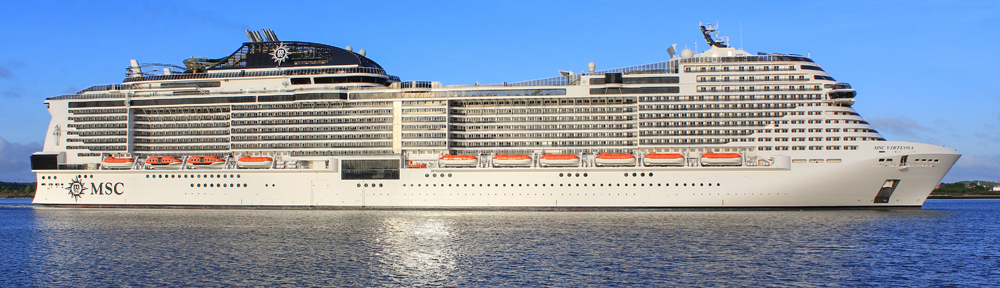
MSC Virtuosa taking shorepower in Alesund, Norway, photo credit Spacejunkie2(Flickr)

MSC Cruises will also use shore power in the German ports of Hamburg this winter and at Kiel in the summer of 2024.

MSC Cruises last year signed a memorandum of understanding with Cruise Baltic for shore power in the Baltic Sea area. Cruise Baltic has 32 ports and destinations in its region that are committed to increasing the number of shore power facilities, the company said.

Shore power capability has been fitted on all MSC Cruises’ new ships as standard since 2017 and together with retrofits completed on other vessels, 67 per cent of MSC Cruises’ total capacity is equipped with the technology. More ships will be retrofitted as the ports on their sailing itineraries make shore power available.

All Explora Journeys’ ships will also feature shore power capabilities. Explora I, the first ship in the new brand’s fleet, will first come into service on July 17 this year.

Linden Coppell, VP of Sustainability & ESG, MSC Cruises, said, “Shore power is an essential factor on our journey towards net zero greenhouse gas (GHG) operations. All of our newbuilds since 2017 are equipped with the ability to plug into local power grids and we are rolling out retrofits on the other vessels in our fleet.

“Our shore power plan actively demonstrates our ambition and that we are fully committed to reducing emissions from our ships, including while in ports,” she said.

“We have invested heavily in hybrid exhaust gas cleaning systems to substantially reduce local air quality emissions and we now need more ports across Europe and beyond to introduce shore power as quickly as possible. By making significant reductions to emissions in ports, we are fulfilling our responsibility to the docks and coastal communities that our ships visit and serve.

“Together with the use of LNG fuel, improving energy efficiency, utilizing innovative wastewater treatment and waste recycling, we are making positive strides in playing our part to address climate change and protect ocean biodiversity.”

Norwegian Sets New Targets Towards Zero Emissions

Norwegian Cruise Line Holdings launched an updated climate action strategy with short- and near-term greenhouse gas targets towards achieving net zero by 2050, according to a press release.

“We are proud to further refine and strengthen our climate action strategy and commitments including by setting milestone GHG intensity reduction targets which will guide us on our ambitious pursuit of net zero by 2050,” said Harry Sommer, president and chief executive officer-elect of Norwegian Cruise Line Holdings.

“Every aspect of our business from shoreside to shipboard is responsible for doing their part to design, deliver and demonstrate results for decarbonization and our Board of Directors has reinforced this expectation by establishing shared accountability and tying incentives for our entire management team to this critical effort. We also recently took an important step forward on our pursuit of net zero by announcing the modification of two of our future Prima Class newbuilds to accommodate the use of green methanol in the future.”

The key components of the new targets include reducing greenhouse gas emissions intensity by 10 per cent by 2026 and 25 per cent by 2030. These include emissions from the company’s fleet islands and facilities as well as fuel- and energy-related activities. The new targets serve to support NCLH’s existing strategy for achieving net zero by 2050. 

“We are also activating and mobilizing our full network of team members, ports and destinations, suppliers and partners, and guests to act now and join us on this transformative journey, further amplifying the efforts we could achieve on our own,” added Sommer.

The updated climate action strategy is centred around efficiency, innovation and collaboration. The company continues to invest in systems and technologies aimed at optimizing efficiency, such as HVAC system upgrades and waste heat recovery systems. NCLH is also working on long-term solutions including technologies that help support the ability to operate using green fuels.

The company has already completed tests of biofuel on several ships, using a blend of about 30 per cent biofuel and 70 marine gas. Long term, NCLH is also planning on using green methanol which would result in a drastic reduction in emissions and up to 95 per cent reduction in CO2 and has announced Prima ships five and six will be methanol ready.

Achieving net zero will require collaboration across the company’s network of stakeholders.

“We are encouraged to see the significant progress and momentum across sectors to decarbonize, but fundamental challenges continue to exist for the cruise industry to fully decarbonize by 2050,” said Jessica John, vice president of ESG, Investor Relations and Corporate Communications of Norwegian Cruise Line Holdings Ltd.

“Rather than waiting for these challenges to dissolve, our strategy is about acting now to implement solutions for efficiency today, innovate for future solutions and collaborate with our stakeholders along the way. Underpinning this strategy is good governance and effective risk management as we work to advance our climate action efforts and build our Company’s resilience.”

Ports of Auckland Challenged on Shore Power Plan

The Carnival Spirit is based year-round in Australia (photo: Clyde Dickens)

Ports of Auckland (POAL) has announced that it has decided to adopt the recommendation of a recent study to plan for shore power, which it said will have an estimated cost of some $18.3 million and the potential to reduce greenhouse gas emissions by 31 percent.

Commenting on POAL’s decision, however, CLIA Australasia’s managing director Joel Katz stated that a key strategy of the major cruise lines in meeting the IMO requirements is the adoption of exhaust gas cleaning system technology to achieve emission reductions. But, with the advancements in cleaner fuels and emissions abatement systems, he said, the usefulness of shore power will likely decline over time, and it should not be assumed that the next generation of cruise ships will be designed and built as shore power enabled, he said.

Katz added that it was worth noting that the Ports of Auckland said it will carry out further work on shore power, including a detailed cost estimate, a cost-benefit analysis and an investigation of funding options so there is still a lot discussion to be had with industry.

According to the POAL, cruise ships were selected for the study as the cruise industry has been proactive at addressing environmental issues over the past decade and these vessels are more frequently fitted with the onboard infrastructure required. This, combined with high individual electricity demand while at berth (compared to other vessel types), is expected to increase utilization and deliver the highest emission reduction return.

The study looked at the feasibility of a wide range of emission reduction technologies, including shore power (grid supplied, local generation including renewables, hybrid); fuel switching (methanol, LNG, low sulfur diesel); land/barge based exhaust capture systems; and ship based scrubbers.

Viable solutions were assessed against a range of social and environmental attributes in addition to the whole of life cost. This holistic approach was adopted to provide a balanced assessment of the alternatives, with consideration of the stakeholder values.

The report recommended two options: To implement shore power at one cruise berth in the next five years; and/or fuel switching to 0.1% sulfur fuel.

The report or the recommendation did not address the issue, however, that very few of the ships currently sailing year-round or seasonally from Australia are equipped to plug in.

The Carnival Spirit and Legend, for example, are not shore power enabled, according to Carnival Australia.