Royal Caribbean Group and its portfolio of cruise brands will launch 11 new ships between 2023 and 2026, culminating in the third Icon Class ship in 2026 being delivered from Meyer Turku to Royal Caribbean International, and a newbuild for TUI Cruises from Fincantieri, according to the cruise ship orderbook.
In the near term, Jason Liberty, president and CEO, said that the business would grow capacity by 10 per cent in 2024, 5 per cent in 2025 and 6 per cent in 2026.
“I think the first thing to point out is, that’s not just one brand in one market, in one destination,” he said. “So this reflects our three wholly owned brands and how they’re going to grow in their different segments and also for these ships to be in other parts of the world.
“If you look at the orderbook, as you get into ’27 and ’28, it’s lighter orderbook. We believe that at Royal Caribbean that the addressable market is underpenetrated, especially in all the different markets in which we operate. We work very hard to create global brands that attract guests from all over the world and build revenue management systems to effectively harvest that quality demand. And we think that apparatus more than supports our expected supply growth over the coming years.”
Royal Caribbean Group announced it has signed a maritime declaration with the Finnish government, represented by the Ministry of Economic Affairs and Employment (MEAE) and Meyer Turku Oy, to chart the way forward for innovative and sustainable shipbuilding in Finland.
According to a press release, the commitment is set to advance innovation, strengthen competitiveness and bolster the maritime industry’s ecosystem.
“Our partners in Finland have helped us deliver some of the world’s most impressive and sustainable ships of their time, including our newest ship debuting in January 2024, Icon of the Seas,” said Jason Liberty, president and CEO of Royal Caribbean Group. “This new partnership sets the stage for future innovations and allows us and the maritime industry to continue pursuing sustainability at the highest level.”
The declaration announces the following actions:
Preparing a roadmap for the production of climate-neutral ships in Finland. The roadmap is part of the maritime industry’s green transition.
Strengthening the innovation of Meyer Turku, Royal Caribbean Group and the maritime industry.
Supporting networking to curb economic challenges, develop new solutions and secure the long-term viability of the maritime industry.
Assembling a digital demonstration of a climate-neutral ship as part of the sustainable maritime industry development program of the Ministry of Labor and Economy.
Piloting and testing new innovations and technologies on Royal Caribbean Group ships.
This partnership also advances Royal Caribbean Group’s Destination Net Zero strategy to decarbonize its operations by 2050 and it is near- and medium-term targets, including reducing carbon intensity by double digits by 2025 compared to 2019 and the introduction of a net-zero cruise ship by 2035.
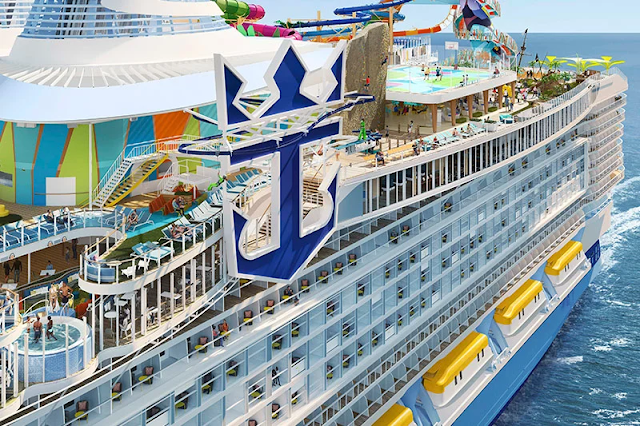
The declaration comes on the heels of another major milestone for Royal Caribbean. On Friday, Dec. 9, the revolutionary, new vacation, Icon of the Seas, reached its next phase of construction ahead of its iconic January 2024 debut. The new ship floated on water for the first time since the assembly began nine months ago at Meyer Turku shipyard in Turku, Finland. The icon will join the company’s Royal Caribbean International cruise line and its lineup of industry-leading ships, becoming the brand’s most sustainable ship to date and the crown jewel of shipbuilding in the Finnish maritime industry.
“The Finnish maritime ecosystem is built on the innovativeness, expertise and skills of the thousands of leading shipbuilders at Meyer Turku, and Icon of the Seas is the latest example of what can be built here in Finland,” said Mika Lintilä, Finland’s Ministry of Economic Affairs. “This new declaration will secure a future in which the maritime industry continues to make strides in our decarbonization goals and economic growth priorities for years to come.”
The company also has agreements with the shipyard to build the unnamed second and third ships in the Icon Class for its Royal Caribbean International brand, and Mein Schiff 7, which is currently under construction for the company’s TUI Cruises brand.
“While expertise and interdisciplinary collaboration will always be key to the success of shipbuilding, we recognize the need to continuously evolve and create strategies to reduce carbon emissions toward net zero,” said Tim Meyer, CEO, of Meyer Turku Oy. “This commitment will set us up, as an industry, to innovate and adapt in how we design, build and operate ships. This challenge presents significant opportunities for the Finnish maritime industry to take the lead globally and bring to market new technologies and products.”
“I can’t tell you how exciting this day has been, finally giving our UK travel partners the opportunity to see our new Excel-class ship,” said Carnival president Christine Duffy.
“Carnival Celebration is the ultimate 50th birthday gift and is a key part of a very unique and exciting period of growth for us.”
The celebration has since departed on a 14-day transatlantic sailing to Miami where the line will host its naming ceremony with godmother, US model and actress Cassidy Gifford.
Today, the second ship in Australia will be added as Carnival Luminosa begins guest operations in Brisbane, and next year, the third Excel-class ship Carnival Jubilee will debut from Galveston.


 Wetravel2u's Weblog