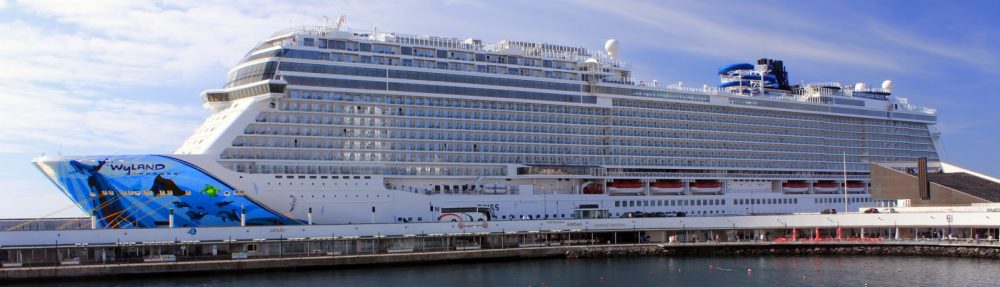
Royal Caribbean International and Norwegian Cruise Line are taking different business approaches when it comes to Caribbean deployment.
Caribbean itineraries will make up roughly 65 per cent of Royal Caribbean’s deployment this year, compared to approximately 33 per cent for Norwegian Cruise Line, according to the 2023 Cruise Industry News Annual Report.
Next year those numbers should climb for Royal Caribbean, which will put the Icon of the Seas in the year-round Caribbean market, sailing week-long cruises from Miami in January. That will be followed by the Utopia of the Seas, which will sail short voyages year-round from Port Canaveral, with the Miami-based cruise line betting big on the Caribbean cruise market, including the short cruise business.
“Utopia will be the first Oasis-class ship that will be entirely focused on short cruises in the Caribbean, supporting our strategy of competing with land-based vacation alternatives and driving new-to-cruise customers into our vacation ecosystem as we seek to close the value gap,” said Jason Liberty, president and CEO of Royal Caribbean Group, on the company’s second-quarter earnings call in July.
Norwegian Cruise Line has taken the opposite approach.
Norwegian’s short cruise portfolio, which account for 25 per cent of its deployment in 2019, will make up just seven per cent of cruises in 2023, according to the company’s second-quarter earnings presentation.
It also means Caribbean deployment is down some nine per cent this year when compared to 2023.
“We strategically shifted our deployment to longer, more immersive itineraries at the Norwegian Cruise Line brand and increased our concentration of premium destinations while reducing our Caribbean deployment,” said Harry Sommer, president and CEO of Norwegian Cruise Line Holdings, speaking on the company’s second-quarter earnings call.
“This was designed to attract a higher quality guest and maximize our competitive position.”
CFO Mark Kempa noted: “This is really about yield and EBITDA where we believe being in more premium itineraries that are booked further in advance, giving us a much longer booking curve and a more stable and predictable demand profile, which allows us to manage demand, manage our marketing a little bit more effectively and not rely so much on close-in, unstable and unpredictable demand is really key to our success.”
Royal Caribbean Group is pleased with the increased demand for European itineraries, resulting in a better-than-expected yield performance.
“While the Caribbean remains a standout performer this year, we were particularly pleased with the strength and quality of cruising [Ph] demand for European itineraries. This acceleration of demand for Europe contributed to the better-than-expected yield performance for the quarter,” said Chief Executive Officer Jason Liberty, speaking on the company’s second-quarter earnings call.
Liberty added that volumes from European consumers looking to book their summer vacations have accelerated, leading to double-digit yield growth expectations for this year compared to 2019.
“Europe sailings account for 17 per cent of our full-year capacity and 35 per cent in the third quarter. The acceleration in demand is increasing our revenue expectations for Europe sailings,“ said Chief Financial Officer Naftali Holtz.
“The better-than-expected performance has mostly been driven by our European customers, which underscores our nimble and global sourcing model,” he added.
Commenting on the somewhat surprising takeaway regarding the European market, Liberty explained that Europeans’ willingness to spend was very competitive with the North American consumer. Still, the difference is that they were delayed in activating their vacation.
“We expected Europe to be a little bit lighter versus 2019, in terms of load factor and it came roaring back,” continued Liberty.
Royal Caribbean Group today reported second-quarter Earnings per Share of $1.70 and Adjusted Earnings per Share of $1.82.
These results were significantly better than the company’s guidance due to more robust pricing on closer-in demand and further strength in onboard revenue, the company said in a statement.
As a result of the accelerating demand environment for its vacation experiences, the company is increasing its 2023 Adjusted Earnings per Share guidance by 33% to $6.00 – $6.20.
“Our brands continue to fire on all cylinders, resulting in record yields and second-quarter earnings significantly exceeding our expectations,” said Jason Liberty, president and CEO, of Royal Caribbean Group. “Demand for cruising and our brands is exceptionally strong and we have seen another step change in booking volumes and pricing, leading us to now expect double-digit net yield growth for the full year. We also expect to achieve record Adjusted EBITDA per APCD and Return on Invested Capital this year and are well on our way toward achieving our Trifecta goals.”
Key Highlights
Strong ticket pricing from both North America and Europe itineraries, combined with strength in onboard revenue, led to better-than-expected revenues in the second quarter and a significant increase in the company’s full-year outlook for revenue and earnings.
Second Quarter 2023:
Gross Margin Yields increased 13.1% As-Reported, and Net Yields increased 12.9% in Constant-Currency (12.6% As-Reported), both compared to the second quarter of 2019.
Gross Cruise Costs per Available Passenger Cruise Day (“APCD”) increased by 10.9% As-Reported, and Net Cruise Costs (“NCC”), excluding Fuel, per APCD increased by 9.0% in Constant-Currency (8.6% As-Reported), both compared to the second quarter of 2019. The favourable timing of operating expenses was offset by the increase in stock compensation expense due to the rise in share price and expected financial performance.
Total revenues were a record $3.5 billion, Net Income was $458.8 million or $1.70 per share, Adjusted Net Income was $491.7 million or $1.82 per share, Adjusted EBITDA was a record $1.2 billion and Operating Cash Flow was $1.4 billion.
Full Year 2023 Outlook:
Net Yields are expected to increase 11.5% to 12.0% in Constant-Currency and As-Reported, compared to 2019.
NCC, excluding Fuel, per APCD is expected to be up approximately 7.0% in Constant-Currency (6.7% As-Reported), compared to 2019. The increase in costs, relative to previous guidance, is driven by an increase in stock compensation expense due to the rise in share price and expected financial performance.
Adjusted Earnings per Share for the entire year are expected to be in the range of $6.00 to $6.20 per share.
Third Quarter 2023 Outlook:
Net Yields are expected to increase 13.5% to 14.0% in Constant-Currency (14.0% to 14.5% As-Reported), compared to the third quarter of 2019.
NCC, excluding Fuel, per APCD is expected to increase by approximately 11.2% in Constant-Currency and As-Reported, compared to the third quarter of 2019. Approximately half of the cost increase compared to 2019 is related to structural costs, a timing shift of operating expenses from the second quarter, and an increase in stock compensation expense.
Adjusted Earnings per Share for the third quarter are expected to be in the range of $3.38 to $3.48 per share.
Second Quarter 2023
The company reported Net Income for the second quarter of $458.8 million or $1.70 per share compared to Net Loss of $(0.5) billion or $(2.05) per share for the same period in the prior year. The company also reported an Adjusted Net Income of $491.7 million or $1.82 per share for the second quarter compared to an Adjusted Net Loss of $(0.5) billion or $(2.08) per share for the same period in the prior year.
Second-quarter revenue significantly exceeded the company’s guidance due to higher pricing and higher shipboard revenue across the company’s key itineraries, including the Caribbean and Europe. The load factor for the second quarter was 105%.
Gross Cruise Costs per APCD increased by 10.9% As-Reported, compared to 2019. NCC, excluding Fuel, per APCD increased by 8.6% As-Reported and 9.0% in constant currency, compared to 2019. Favourable timing of operating expenses drove NCC lower, however, it was offset entirely by an increase in stock compensation expense-related costs due to the significant rise in share price and expected financial performance.
Update on Bookings
Booking volumes in the second quarter remained significantly higher than in the corresponding period in 2019 and at record pricing levels. Demand for 2023 sailings has significantly exceeded expectations and bookings for 2024 sailings are up significantly versus all prior years at record prices. Demand from the North American consumer has remained incredibly strong throughout the year, and booking volumes from European consumers who are booking European cruises this summer have accelerated.
The further increase in yield expectations for the year is the result of higher pricing and onboard revenue expectations for key itineraries, particularly in North America and Europe. Consumer spending onboard, as well as pre-cruise purchases, continue to significantly exceed 2019 levels driven by greater participation at higher prices.
As of June 30, 2023, the Group’s customer deposit balance was at a record-high $5.7 billion.