Former Braemar Sails from Scotland Ahead of Villa Vie Debut

The former Braemar has sailed from Scotland ahead of debuting for Villa Vie Residences.

After spending almost four years docked in Rosyth, the 1993-built vessel left the port under its own power on Tuesday morning.

Set to be renamed Villa Vie Odyssey, the cruise ship is now on its way to the Harland & Wolff Shipyard in Belfast, Northern Ireland, where it is expected to arrive on April 25.

At drydock, the 924-guest vessel is scheduled to undergo significant technical work, including the reactivation of systems, class inspections, general maintenance and more.

The Villa Vie Odyssey will also receive a new livery, as well as new public areas and features. Among the new additions are a culinary centre and a pickleball court.

According to Villa Vie Residences, the vessel will also be enhanced with a state-of-the-art business centre, an upgraded pool deck, a new observation deck and refurbished staterooms.

All 480 cabins are set to undergo upgrades to ensure “the utmost comfort and style,” the company said.

Following the refit, the Odyssey is scheduled to sail to Southampton to embark on its maiden voyage for the new operator.

After leaving Fred. Olsen Cruise Lines’ fleet in late 2022, the former Braemar was acquired by Villa Vie Residences earlier this year.

Building on a residential ship concept, the startup brand plans to offer a continuous cruise that will circumnavigate the globe every three-and-a-half years.

Passengers can buy their own “villas” onboard the ship, becoming owners of one of the ship’s cabins.

For its first world voyage, the Odyssey is scheduled to visit all seven continents, sailing to over 425 destinations in 147 countries. The itinerary also allows guests to explore 13 of the 14 Wonders of the World, Villa Vie said.

Built in Spain in the early 1990s, the former Braemar also sailed for Cunard Line, Crown Cruise Line, Norwegian Cruise Line and others.

New Norwegian Aqua Floats Out At Fincantieri

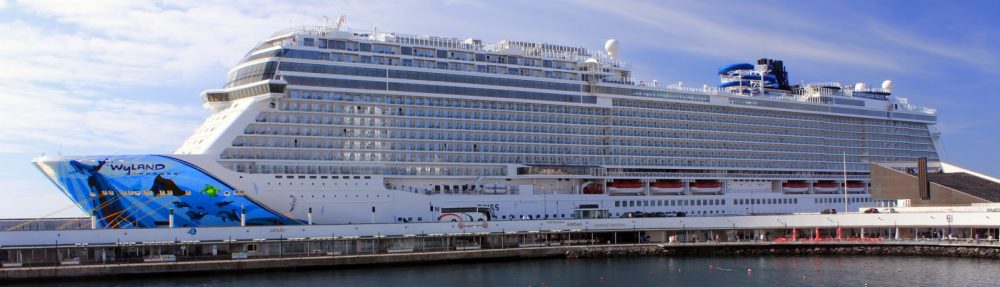
Norwegian Cruise Line and its partners at Fincantieri celebrated the float out of the Norwegian Aqua from the drydock at the shipyard in Marghera (Venice), Italy.

This marks the completion of the external work on the ship ahead of its April 2025 debut.

As per maritime tradition, two ceremonial coins were welded into the Norwegian Aqua, which historically symbolized an offering to gods and goddesses of the sea in exchange for good luck and safe passage. The ceremony was followed by a blessing by a local chaplain and celebratory champagne breaking across the ship’s hull.

“We are excited to celebrate another milestone with our partners at Fincantieri, who are integral to the Prima Class journey and supporting us in evolving the amazing experience we design and deliver for our guests,” said David J. Herrera, president of Norwegian Cruise Line. “Building upon the guest-favourite features of the award-winning vessels of this class, the 10 per cent increase in space provides us with more flexibility to deliver more offerings and more beautifully designed venues for our guests to relax and explore on board Norwegian Aqua.”

At 156,300 gross tons and a length that spans 1,056 feet, the Norwegian Aqua will be 10 per cent larger than the first two Prima Class ships. The ship will also offer luxurious accommodations in The Haven by Norwegian®, including the line’s first-ever Three-Bedroom Duplex Haven Suites.  

 “We are excited to mark this significant moment with Norwegian Cruise Line as we witness the float out of Norwegian Aqua, which represents a new chapter in our long-lasting partnership,” said Luigi Matarazzo, general manager of the Fincantieri Merchant Ships Division. “We are proud to be part of this transformative journey in which innovation, a cornerstone of our industrial plan, is one of our key points, as we strive to push boundaries and elevate industry standards.”

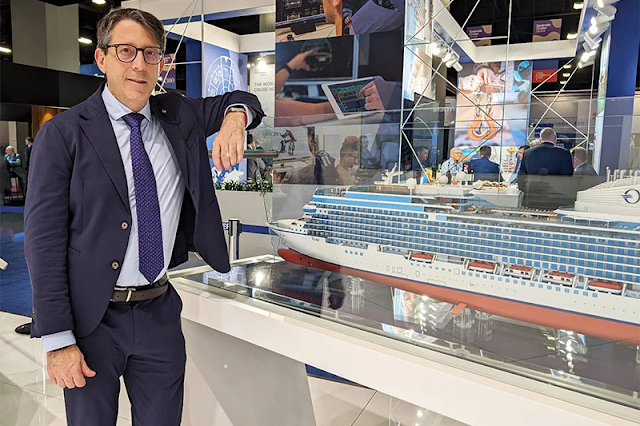
Fincantieri: ‘Covering All Brands’ with Eye on Future Fuels

Coming off a big newbuild order from Norwegian Cruise Line Holdings, Daniele Fanara, director of new building and after-sales at Fincantieri, is positive about the future.

“We are serving all segments of the market, from small luxury vessels to mega-size vessels to upper premium,” said Fanara, speaking to Cruise Industry News. “This covers all the brands in the cruise industry.”

Fanara said Fincantieri was very proud to be working with a variety of operators and being able to serve each of them in a tailored customized way.

“We have cross-fertilization with our technology, including the capacity to design the vessel,” he added.

NCLH Order

The new Norwegian Cruise Line Holdings order for eight ships includes orders for all three company brands, with new classes of ships for each of them. Norwegian, Oceania and Regent will all get new bigger ships, with orders for the Norwegian brand stretching to 2036.

“We are proud of the trust that Norwegian gave us to develop such an important program,” said Fanara.

Looking at future technologies, Fanara said the ships were being developed.

“Our attention is focused on three main fuels,” he said. “One is LNG, one is methanol, and one is hydrogen. Hydrogen is the most innovative one. We are developing new ideas on how and when we can implement hydrogen onboard the vessels.”

New ships for Oceania and Regent are being developed to be methanol-ready.

“Today there is no real answer on the fuel of the future,” Fanara continued. “It’s a matter of availability. What’s important from our side is that we are always studying the latest technology available. We are also exploring CO2 capture technology.”

Fanara said among the alternative fuels, LNG was notable in the fact it was being used today.

“Ships are sailing on LNG. The other technology is in a different phase of development. We need to monitor them so we are ready to implement them if necessary,” he explained.

Questions are coming in from cruise lines on alternative fuel practicalities, Fanara said, but with the most questions on hydrogen.

“It is the most innovative, it is the most unknown.”

Industry

Fanara called the cruise industry resilient.

“Soon after Covid, the speed at which the industry recovered and came back to strong booking and revenue levels is incredible,” he said.

Fanara expects other orders to follow, citing market demand and the value gap between cruise- and land-based vacations.

Shipbuilding Costs

Costs are up to build ships.

“A greener vessel is for sure more expensive to build,” Fanara noted. “But is the value of this additional cost worth it for the industry?

“The owners can say the ships are more expensive. We had Covid, we had wars and the result of this has been inflation. If you mix inflation and the technology transition, the result is not less expensive ships.”