For cruise lines, weddings mean varying locales, regulations

A bridal couple aboard the MSC Divina.
In 1998, Princess Cruises introduced weddings at sea to the cruise industry, with the captain tying the knot aboard the Grand Princess. Since then, weddings aboard cruise ships have become an industry unto themselves, with cruise lines offering three types of legal weddings, plus symbolic ceremonies.

And last year, Celebrity Cruises introduced civil unions at sea for same-sex couples.

Weddings at sea are actually the least common of the three cruise-related ceremonies, according to wedding expert Barbara Whitehill, managing director of Imagine Weddings and Events and the Wedding Experience. Whitehill’s company runs the wedding programs for Carnival Cruise Line, Celebrity Cruises, MSC Cruises, Crystal Cruises and Costa Cruises. She has also handled the wedding programs of Royal Caribbean International, Norwegian Cruise Line and Princess.

“Everybody does weddings when the ship is in the embarkation port or in one of the destinations or shore-side in the destination,” she said.

Cruise wedding products vary by cruise line.

For example, Celebrity, Cunard, Royal Caribbean and Princess do legal weddings at sea. But Carnival, which does about 2,600 weddings annually, does weddings only in ports or destinations. Seabourn does no weddings at all.

Some cruise lines do both symbolic ceremonies and weddings at sea, while other lines do only symbolic ceremonies at sea.

Weddings conducted in the port of embarkation or at a port of call on a ship’s itinerary are conducted under the auspices of local laws, while weddings at sea are conducted according to the laws of the country under which the ship is registered. Typically cruise ships are flagged by the Bahamas or Bermuda, but they can be flagged by other countries, as well.

Celebrity is registered in Malta, which legalized same-sex civil unions on April 14.

All this means that couples can get married in a variety of exotic locales that, depending on the cruise line and the itinerary, can range from the beach to glaciers.

Couples can get married in European castles, on a gondola in Venice or in a white-topped villa overlooking the Aegean. But there are limits and little standardization.

“It completely varies,” Whitehill said.

Couples on international itineraries can get married at sea as long as they’re on a cruise line that offers weddings at sea and the ship is in international waters.

While some countries and ports are easier than others, Whitehill said the experience varies not just from country to country but from port to port.
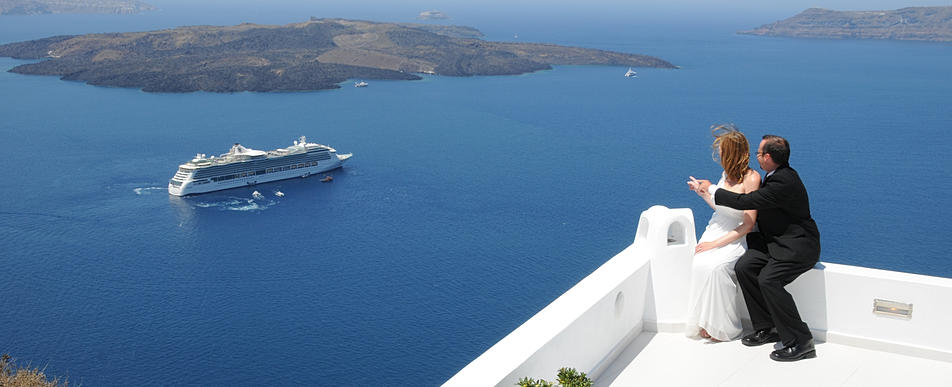
For example, Santorini weddings can only be on land, not on the ship. That is because the mayor of Santorini performs the wedding and he only does them on land. Some destinations require couples to spend a certain amount of time in the destination before the wedding and do paperwork on site, while others do not.

Laws vary from island to island in the Caribbean. As islands realized the potential of destination wedding products, many changed their laws to capitalize on the trend. Some islands revamped their laws so they’re the same for locals and visitors; others created laws to accommodate tourists that don’t apply to locals, Whitehill said.

Even symbolic ceremonies can vary from destination to destination. For example, in Grand Cayman, a same-sex couple can have a symbolic ceremony onboard the ship but not on shore.

Getting married in a U.S. port of embarkation offers the advantage of including guests who are not going to go on the cruise. They can attend the ceremony, then disembark before the ship sails.

In states in which same-sex marriage is legal, same-sex couples can be legally married onboard the ship in port under the laws of that state.

Get away from it all? Cruise passengers want MORE…….

Get away from it all? Cruise passengers want MORE intrusion from the outside world with free wifi the innovation they’d most like to see on ships (…it can cost £20 an hour)

  • Poll of 1,000 passengers found demand for internet access was top
  • But logging on can prove costly…and the signal can struggle at sea
  • Experts say younger travellers like to share holidays on social media 

With their on-board entertainment and air of relaxed seclusion, cruise liners seem the ideal place to get away from it all.

But it appears that what holidaymakers really want is more intrusion from the outside world.

Almost nine in ten passengers said free wifi and email access is the innovation they would most like to see on cruise ships, a poll found.

Get connected: nine in ten passengers said free wifi and email access is the innovation they would most like to see on cruise ships

Get connected: nine in ten passengers said free wifi and email access is the innovation they would most like to see on cruise ships

With many now including smartphones and tablets in their luggage, travellers increasingly expect to be able to browse the internet even when far from land. And while many liners try to accommodate their demands with wifi hotspots, logging on can prove costly at up to £20 an hour.

There are also problems with repeated signal interruptions and slow service. ‘This is a particularly prevalent issue for younger families,’ said Sukie Rapal of Cruise.co.uk, which carried out the poll of 1,000 passengers.

‘Teenagers use their devices to stay in touch with friends on social media, access mobile applications and play games – meaning cruisers are susceptible to receiving a very unexpected cost at the end of their trip.’

The demand for better internet access is partly down to the falling average age of passengers, which the survey found has dropped from 60 to 55 years in the last decade.

‘With a 195 per cent rise in the number of searches for cruises on mobile devices this Christmas, it’s apparent that cruisers have become more tech savvy,’ she added.

‘Cruisers need to do their research to find the most reasonable rates for wifi use, because if they fail to do so, it could end up costing them more than the holiday itself.’

Get away from it all? No thanks: Many travellers increasingly expect to be able to browse the internet even when far from land

Get away from it all? No thanks: Many travellers increasingly expect to be able to browse the internet even when far from land

The poll also showed that world class entertainment came high up on cruisers’ wishlists, while around a fifth said their biggest demand was flat screen televisions in their cabins.

The least desired innovation was robot barmen, which have already been installed on a Royal Caribbean ship. Just one per cent said they were interested in seeing these on board.

The most popular ocean destination for this year is the Far East, while Europe’s Danube is the preferred river trip.

The new Venice? Huge cruise ships could invade Thames in two years as new passenger terminal planned for Greenwich

  • It is hoped the new terminal would open in 2017 at Enderby Wharf
  • Ships up to 820ft long would stop near the Old Royal Naval College 
  • River Thames isn’t deep enough to accommodate world’s largest ships 
  • New plans will be submitted within weeks to Greenwich council

London could soon become a popular destination for large cruise ships if plans for a new passenger terminal in Greenwich move forward.

It is hoped that the mooring at Enderby Wharf would open in 2017 and become the capital’s first new terminal since the closure of the Royal Docks in 1981.

The hub would allow ships up to 820ft long to stop near popular tourist attractions such as the Old Royal Naval College and Cutty Sark, The Times reported.

Smaller cruise ships can dock alongside HMS Belfast after sailing past Tower Bridge's raised bascules

New plans from Westcourt Real Estate are to be submitted to Greenwich council within weeks and show that the mooring would be used for the start and finish of cruises, the newspaper reported.

Westcourt has not revealed the cost of the new terminal, and lead architect Jonathan Manser said a previous design failed to meet the requirements.