Demand for Weddings at would be there, say Travel Agents

Agents believe there would be demand for cruise ship weddings should the law be changed to broaden the range of venues where weddings can take place.

Couples in England and Wales could soon be free to tie the knot onboard cruise ships under new recommendations to reform wedding law put forward by the Law Commission.
The commission has branded the current legislation “confusing, out-of-date and restrictive”, and stressed it is preventing people from getting married in “more meaningful” settings.

Asked by the government to review the law, the commission on Tuesday (18 July) recommended focusing regulation on the officiant responsible for the wedding rather than the venue.

“This reform would open up a wider range of locations for couples to get married,” said the commission. “Permitted venues would include gardens, beaches, forests, parks, village halls and cruise ships.”

Bolsover Cruise Club sales manager Helen Moore told TTG that demand for weddings at sea was “definitely there”. “It offers an affordable alternative to land-based ceremonies, and all the stress of the planning and logistics is taken care of,” she said.

“Family and friends can embark on the ship together, but don’t need to be in each other’s pockets throughout the duration of the cruise. For the bride and groom, there is the option to book a suite on board to make their trip extra special.”

Moore added: “There’s no more romantic setting than being at sea, and the honeymoon is also taken care of at the same time.”

Travel Counsellor Emma Otter, who has already booked a couple to get married on Princess Cruises’ Sky Princess next year, described the possibility of being able to tie the knot at sea as an “exciting addition” to the cruise.

“Couples may have considered a wedding abroad but the flying or the addition of elderly relatives may have stopped them,” she said. “A cruise ship wedding would mean nobody is excluded, especially those that can’t or don’t want to fly.”

Otter added the reforms, should they go ahead, would likely introduce cruising to wedding guests who may never have cruised before, which she said would come as a “boost” to the industry.

Norwegian Cruise Line offers weddings at sea

Photo not taken on a NCL Ship.

For cruise lines, weddings mean varying locales, regulations

A bridal couple aboard the MSC Divina.
In 1998, Princess Cruises introduced weddings at sea to the cruise industry, with the captain tying the knot aboard the Grand Princess. Since then, weddings aboard cruise ships have become an industry unto themselves, with cruise lines offering three types of legal weddings, plus symbolic ceremonies.

And last year, Celebrity Cruises introduced civil unions at sea for same-sex couples.

Weddings at sea are actually the least common of the three cruise-related ceremonies, according to wedding expert Barbara Whitehill, managing director of Imagine Weddings and Events and the Wedding Experience. Whitehill’s company runs the wedding programs for Carnival Cruise Line, Celebrity Cruises, MSC Cruises, Crystal Cruises and Costa Cruises. She has also handled the wedding programs of Royal Caribbean International, Norwegian Cruise Line and Princess.

“Everybody does weddings when the ship is in the embarkation port or in one of the destinations or shore-side in the destination,” she said.

Cruise wedding products vary by cruise line.

For example, Celebrity, Cunard, Royal Caribbean and Princess do legal weddings at sea. But Carnival, which does about 2,600 weddings annually, does weddings only in ports or destinations. Seabourn does no weddings at all.

Some cruise lines do both symbolic ceremonies and weddings at sea, while other lines do only symbolic ceremonies at sea.

Weddings conducted in the port of embarkation or at a port of call on a ship’s itinerary are conducted under the auspices of local laws, while weddings at sea are conducted according to the laws of the country under which the ship is registered. Typically cruise ships are flagged by the Bahamas or Bermuda, but they can be flagged by other countries, as well.

Celebrity is registered in Malta, which legalized same-sex civil unions on April 14.

All this means that couples can get married in a variety of exotic locales that, depending on the cruise line and the itinerary, can range from the beach to glaciers.

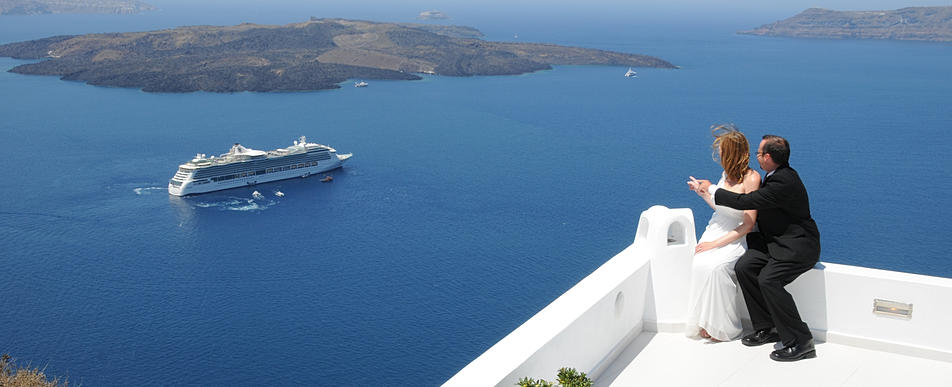
Couples can get married in European castles, on a gondola in Venice or in a white-topped villa overlooking the Aegean. But there are limits and little standardization.

“It completely varies,” Whitehill said.

Couples on international itineraries can get married at sea as long as they’re on a cruise line that offers weddings at sea and the ship is in international waters.

While some countries and ports are easier than others, Whitehill said the experience varies not just from country to country but from port to port.

For example, Santorini weddings can only be on land, not on the ship. That is because the mayor of Santorini performs the wedding and he only does them on land. Some destinations require couples to spend a certain amount of time in the destination before the wedding and do paperwork on site, while others do not.

Laws vary from island to island in the Caribbean. As islands realized the potential of destination wedding products, many changed their laws to capitalize on the trend. Some islands revamped their laws so they’re the same for locals and visitors; others created laws to accommodate tourists that don’t apply to locals, Whitehill said.

Even symbolic ceremonies can vary from destination to destination. For example, in Grand Cayman, a same-sex couple can have a symbolic ceremony onboard the ship but not on shore.

Getting married in a U.S. port of embarkation offers the advantage of including guests who are not going to go on the cruise. They can attend the ceremony, then disembark before the ship sails.

In states in which same-sex marriage is legal, same-sex couples can be legally married onboard the ship in port under the laws of that state.