Norwegian Cruise Line is optimizing Apr. 17, 2023, sailing onboard the Norwegian Sky.
According to a statement sent to booked guests, the itinerary of the cruise was adjusted as part of the company’s commitment to driving a positive impact on society and the environment.
“We are continually seeking opportunities to reduce our overall carbon footprint, and recently committed to pursuing net zero greenhouse gas emissions across our operations and value chain by 2050,” Norwegian Cruise Line said.
“To support this mission, we have optimized our arrival and departure times for Norwegian Sky’s sailing on April 17, 2023,” the company added.
As part of the changes, the cruise saw part of its itinerary reversed and a reduction of the time docked in most of the ports of call.
Sailing to the Eastern Caribbean, the nine-night cruise includes visits to the Bahamas, Puerto Rico, St. Maarten, the U. S. Virgin Islands, Antigua, and the Dominican Republic.
Instead of visiting Great Stirrup Cay on Apr. 18, the Norwegian Sky is now spending the first day of the cruise sailing in the Caribbean.
On Apr. 19, the vessel replaces a sea day with an eight-hour visit to Puerto Plata. The length of stay at the Dominican port was increased by one hour.
The three subsequent ports of call – San Juan on Apr. 20, Philipsburg on Apr. 21 and St. John’s on Apr. 22 – remained unchanged but had their arrival and departure times adjusted, resulting in a total reduction of eight and a half hours in port.
On Apr. 23, instead of visiting Puerto Plata as originally planned, the Norwegian Sky is spending the day at sea to anchor at Great Stirrup Cay on Apr. 24.
The visit to Norwegian’s private island in the Bahamas replaces a sea day on the original cruise schedule.
“We appreciate your understanding and support on this important sustainability initiative,” Norwegian Cruise Line added.
For the first time, members of the International Association of Antarctica Tour Operators (IAATO) will submit seasonal fuel consumption data.
According to a press release, the initiative is part of the association’s pledge to create a climate change strategy for Antarctic tourism.
The fuel data submission, which will include vessels 9cruise ships) of all sizes, aircraft, and accessory vehicles, will be used within the tourism association to understand the greenhouse gas footprint of the operations in Antarctica, IAATO said.
The results will then be used internally as the basis to monitor and refine emission reduction targets the IAATO membership has collectively agreed to make, it added.
While individual operators are expected and encouraged to go further in their own targets, IAATO operators have also unanimously pledged to track the International Maritime Organization (IMO) target of at least 50 per cent emissions reductions by 2050 compared with 2008 and global goals of net zero before 2050.
This, explained the association, accompanied by an agreement by each member to build their own climate strategy and set their own emission reduction targets, is the start of a collective push to account for and reduce IAATO-Operator emissions.
“Ultimately, we seek to go much further towards net positive impact, but the current challenge in shipping and aviation is that we don’t yet know what future fuels and technologies will be available to us,” said Pam Le Noury, Chair of IAATO’s Climate Change Committee.
“This latest commitment by our Operators to submit their fuel data to the IAATO Secretariat for analysis means that once we have acceleration in the development of sustainable fuels and other technologies, we will be in a strong position to act to reduce emissions further,” she added.
According to IAATO, at its annual meeting, members have open and candid discussions on safety, environmental protection, and self-management with decision-making supported by recommendations developed by the association’s ten dedicated committees and eight working groups.
The meeting concludes annually with the voting in of new commitments and policies on best practices which support the association’s mission.
These latest agreements took place at IAATO’s annual meeting, held in Providence, RI in April, where operators unanimously pledged to build a climate strategy including calculating and reducing industry emissions and setting meaningful and inclusive science-based targets.
The pledge was shared with the Antarctic Treaty Consultative Meeting in June, where IAATO is an invited expert.
“Cooperative and coordinated international responses are required to understand global climate change and reduce emissions,” said Amanda Lynnes, IAATO Director of Environment & Science Coordination.
“One of IAATO’s strengths is the ability of its diverse membership to take collective action, often over and above what is required by global regulators. Our members remain agile in response to emerging technologies and global recommendations surrounding climate change and are committed to taking powerful steps to act for Antarctica.”
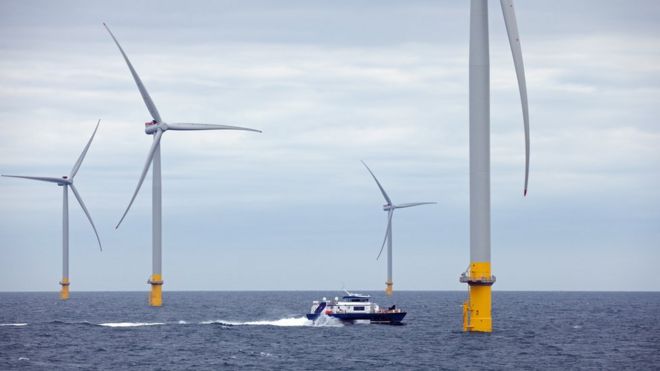
The document plans for a massive expansion in offshore wind
Greenpeace has joined a growing list of organisations demanding that the UK government puts protecting the environment at the heart of any post-COVID-19 economic stimulus package.
The campaign group has produced a detailed “manifesto” with measures to boost clean transport and smart power.
The document follows a comparable call from some of Britain’s most powerful business leaders earlier this week.
Last week, the prime minister also expressed a similar ambition.
The manifesto also contains measures to support the protection of nature, green buildings and the creation of an economy in which virtually everything is reused.
Greenpeace says the crisis has given Britain a “once in a lifetime” opportunity to transform life, travel and work.
It added that the plan would create hundreds of thousands of secure jobs.
Green business
On Monday, more than 200 chief executives of some of the UK’s top firms – including HSBC, National Grid, and Heathrow airport – signed a letter to the prime minister asking him to use the Covid-19 lockdown as a springboard to “deliver a clean, just recovery”.
Many people may be surprised how similar the recommendations of these two very different interest groups are.
Both Greenpeace and the chief executives are asking the government to prioritise investments in low carbon technologies and calling for the decarbonisation of the British economy to be speeded up
Both say they want to see a focus on sectors that best support the environment
Both are demanding that financial support for ailing businesses must come with a requirement for them to commit to taking action to reduce their impact on the environment.
Greenpeace’s manifesto is, however, considerably more detailed.
It is a 62-page document with a specific policy, spending and tax measures covering most of the British economy.
It calls on the government to deliver its 2050 net-zero emissions goal before 2045.
Controversial policies
Image copyrightGETTY IMAGESImage captionThe manifesto contains measures to encourage clean transport
But many drivers may balk at Greenpeace’s proposals to radically redesign the road network to favour walking and cycling, at the suggestion that petrol and diesel cars are banned by 2030 or that fuel duty is steadily increased.
Many homeowners might be reluctant to spend money to upgrade their properties to meet tough energy efficiency standards.
At the same time, many local communities are likely to resist the plan for a big increase in onshore wind and solar power to complement a proposed massive expansion of offshore wind farms – few things unite local communities like a proposal to put in an array of wind turbines.
Image copyrightGETTY IMAGESImage captionThe manifesto proposes the creation of an economy in which virtually everything is reused
But, says Greenpeace, tough policies like these are essential if the government is going to take meaningful action to tackle climate change.
“The choices our government makes now will define… whether or not we succeed in the fight against the climate emergency”, says John Sauven, executive director of Greenpeace.
“If we fail to get this right, we may never get another chance. Now is the time for a green recovery, and for that, we need action, not words.”
It says there would be huge dividends in terms of job creation, should its programme be adopted.
Greenpeace calculates that its plans would create hundreds of thousands of new high-skilled jobs as well as helping to level up inequalities between communities in the UK.
Unique opportunity
The UK government has already indicated that protecting the environment will feature heavily in any stimulus package.
Back in April, Boris Johnson said a post-COVID-19 recovery plan should include efforts to “turn the tide on climate change”.
Last week, it said it planned to commit a whopping €750bn (£667bn; $841bn) to its recovery package.
Add in spending from future budgets and the total financial firepower the European Commission says it will be wielding is almost €2tn (£1.8tn; $2.2tn).
Fighting climate change is at the heart of the bloc’s recovery from the pandemic.
There will be tens of billions of euros to make homes more energy-efficient, to de-carbonise electricity and phase out petrol and diesel vehicles.
The idea is to turbo-charge the European effort to reduce carbon emissions to net-zero by 2050.
“If we do not do it, we will be taking much more risk,” Teresa Ribera, deputy prime minister of Spain, told the BBC.
“The recovery should be green or it will not be a recovery, it will just be a shortcut into the kind of problems we are facing right now.”





 Wetravel2u's Weblog