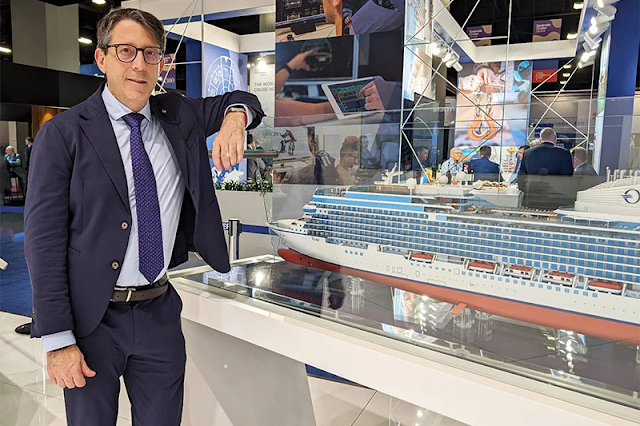
Fincantieri: ‘Covering All Brands’ with Eye on Future Fuels

Coming off a big newbuild order from Norwegian Cruise Line Holdings, Daniele Fanara, director of new building and after-sales at Fincantieri, is positive about the future.

“We are serving all segments of the market, from small luxury vessels to mega-size vessels to upper premium,” said Fanara, speaking to Cruise Industry News. “This covers all the brands in the cruise industry.”

Fanara said Fincantieri was very proud to be working with a variety of operators and being able to serve each of them in a tailored customized way.

“We have cross-fertilization with our technology, including the capacity to design the vessel,” he added.

NCLH Order

The new Norwegian Cruise Line Holdings order for eight ships includes orders for all three company brands, with new classes of ships for each of them. Norwegian, Oceania and Regent will all get new bigger ships, with orders for the Norwegian brand stretching to 2036.

“We are proud of the trust that Norwegian gave us to develop such an important program,” said Fanara.

Looking at future technologies, Fanara said the ships were being developed.

“Our attention is focused on three main fuels,” he said. “One is LNG, one is methanol, and one is hydrogen. Hydrogen is the most innovative one. We are developing new ideas on how and when we can implement hydrogen onboard the vessels.”

New ships for Oceania and Regent are being developed to be methanol-ready.

“Today there is no real answer on the fuel of the future,” Fanara continued. “It’s a matter of availability. What’s important from our side is that we are always studying the latest technology available. We are also exploring CO2 capture technology.”

Fanara said among the alternative fuels, LNG was notable in the fact it was being used today.

“Ships are sailing on LNG. The other technology is in a different phase of development. We need to monitor them so we are ready to implement them if necessary,” he explained.

Questions are coming in from cruise lines on alternative fuel practicalities, Fanara said, but with the most questions on hydrogen.

“It is the most innovative, it is the most unknown.”

Industry

Fanara called the cruise industry resilient.

“Soon after Covid, the speed at which the industry recovered and came back to strong booking and revenue levels is incredible,” he said.

Fanara expects other orders to follow, citing market demand and the value gap between cruise- and land-based vacations.

Shipbuilding Costs

Costs are up to build ships.

“A greener vessel is for sure more expensive to build,” Fanara noted. “But is the value of this additional cost worth it for the industry?

“The owners can say the ships are more expensive. We had Covid, we had wars and the result of this has been inflation. If you mix inflation and the technology transition, the result is not less expensive ships.”

AIDA Reaches Milestone in Decarbonization Efforts

AIDA Cruises has expanded the use of shore power in its fleet, reaching a significant milestone in its decarbonization efforts, according to a press release.

The AIDAsol was recently connected to shore power in nearly all ports during its recent voyage from April 16 to 21, 2023.

The ship was supplied with green energy from shore in Rostock-Warnemünde, Aarhus (Denmark), Kristiansand (Norway), and Hamburg.

The growing shore power infrastructure in Northern Europe has made it possible for AIDA Cruises to achieve this milestone.

AIDA President Felix Eichhorn stated that the company’s goal is to use shore power in all ports where port infrastructure is available. He added that the company’s investments in clean technology are actively supporting the goals of the EU’s “Fit for 55” program to build a corresponding infrastructure in all major EU ports by 2030.

During its recent voyage, AIDAsol made history by being the first cruise ship to conduct shore-side and shipboard integration tests on a newly built facility in Aarhus, Denmark. The official opening of Denmark’s first shore power plant for cruise ships is scheduled for later this year.

The AIDAsol was also supplied with energy from shore during its stop in Kristiansand, Norway, which it already did in 2022.

AIDA Cruises has been investing in sustainable cruising for many years, with a goal to achieve carbon-neutral ship operation for its fleet by 2050.

The company has been considering the use of environmentally friendly technology since 2004, and more than ten years have passed since it was able to start the usage of shore power in regular operation with an AIDA ship in Hamburg Altona in 2017. The company signed a memorandum of understanding in April 2022 with Cruise Baltic, a network of 31 ports and destinations, to use shore power in the ports of the Baltic Sea region.

AIDAsol’s arrival in Hamburg, its home port for this year’s summer season, marked another significant moment in AIDA Cruises’ decarbonization efforts. The ship was connected to Europe’s first shore power plant for cruise ships and switched off its main engines shortly after docking at the Cruise Center Altona.

The expansion of the use of shore power is part of AIDA Cruises’ efforts to use low-emission liquefied natural gas (LNG) and other alternative energy sources such as batteries and fuel cells. The company is working with various partners to find solutions for the use of regenerative and synthetic fuels.

“AIDA Cruises shows what can already be possible today,” said Eichhorn. “We can only achieve the energy transition together.”

Norwegian Optimizes Sky Cruise Itinerary to Reduce Carbon Footprint

Norwegian Cruise Line is optimizing Apr. 17, 2023, sailing onboard the Norwegian Sky.

According to a statement sent to booked guests, the itinerary of the cruise was adjusted as part of the company’s commitment to driving a positive impact on society and the environment.

“We are continually seeking opportunities to reduce our overall carbon footprint, and recently committed to pursuing net zero greenhouse gas emissions across our operations and value chain by 2050,” Norwegian Cruise Line said.

“To support this mission, we have optimized our arrival and departure times for Norwegian Sky’s sailing on April 17, 2023,” the company added.

As part of the changes, the cruise saw part of its itinerary reversed and a reduction of the time docked in most of the ports of call.

Sailing to the Eastern Caribbean, the nine-night cruise includes visits to the Bahamas, Puerto Rico, St. Maarten, the U. S. Virgin Islands, Antigua, and the Dominican Republic.

Instead of visiting Great Stirrup Cay on Apr. 18, the Norwegian Sky is now spending the first day of the cruise sailing in the Caribbean.

On Apr. 19, the vessel replaces a sea day with an eight-hour visit to Puerto Plata. The length of stay at the Dominican port was increased by one hour.

The three subsequent ports of call – San Juan on Apr. 20, Philipsburg on Apr. 21 and St. John’s on Apr. 22 – remained unchanged but had their arrival and departure times adjusted, resulting in a total reduction of eight and a half hours in port.

On Apr. 23, instead of visiting Puerto Plata as originally planned, the Norwegian Sky is spending the day at sea to anchor at Great Stirrup Cay on Apr. 24.

The visit to Norwegian’s private island in the Bahamas replaces a sea day on the original cruise schedule.

“We appreciate your understanding and support on this important sustainability initiative,” Norwegian Cruise Line added.