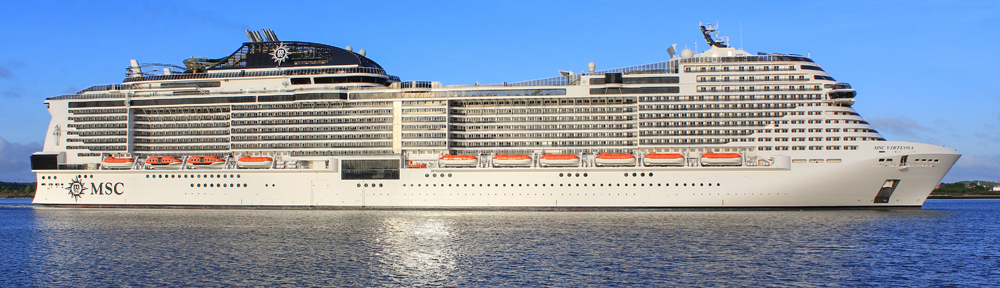
The World to Undergo Major Refit During Six-Week Drydock

The company announced in a press release that the World Residences at Sea is set to undergo a major upgrade.

The refurbishment will take place during a six-week drydock at the Navantia Shipyard in Cadiz, Spain.

According to the ship’s operator, the project aims to bring an array of transformative enhancements to the vessel, including environmental, technical and hotel upgrades.

“This extraordinary 40-day, $30+ million outlay in the ship demonstrates residents’ commitment to keeping The World at the forefront of luxury living and represents the next chapter in that journey,” said Jessica Hoppe, president and CEO of The World.

The ship was also recently awarded a “Statement of Extended Life” from Det Norske Veritas (DNV).

“Our resident owners continue to invest in the ship, ensuring that it not only evolves with their needs but also stays ahead of global innovations. Our recent Statement of Extended Life from DNV is a testament to the exceedingly high standards that we set, how hard our deck and engine teams work to meet those standards, and the support that we receive from the resident community,” she added.

As part of its regular schedule, The World is said to enter a planned drydock every three years to conduct routine technology and maintenance upgrades, as well as updates to public spaces based on current design and lifestyle trends.

The DNV statement is a result of the company’s commitment to maintenance.

After the completion of a comprehensive study and extensive evaluation, DNV recognized its commitment to maximizing the sustainable lifespan of the vessel.

“Most notably, The World’s physical condition is that of a ship that is just 5.6 years old, far younger than her chronological age—providing confidence in her long-term quality, efficiency, and environmental responsibility,” the company stated.

The 2025 drydock will focus on energy efficiency and sustainability, ensuring that the World continues to meet and exceed global climate targets.

Among the updates is the installation of shore power, also known as cold ironing, a High Voltage Shore Connection (HVSC) system.

The ship’s bulbous bow will be replaced as part of a decarbonization project.

Originally optimized for a speed of 19 knots, the new design will reduce hull resistance by up to 10 percent and significantly cut greenhouse gas emissions.

The World will also debut a reimagined pool deck, a refreshed spa and more.

MSC Cruises and Gasum Partner for LNG Solutions

The Cruise Division of MSC Group and Gasum have signed a long-term agreement for the supply of liquefied natural gas (LNG) to the new flagship of its MSC Cruises brand, MSC Euribia, as well as a Letter of Intent (LOI) with the goal of cooperating on the supply of synthetic e-LNG made with renewable energy, according to a joint company statement.

This is part of the cruise company’s strategy to achieve net zero greenhouse gas emissions from its marine operations by 2050.

The LOI between MSC Cruises and Nordic energy company Gasum is a landmark cooperation that aims at securing MSC access to liquefied synthetic gas, or e-LNG, which is produced using hydrogen, created by hydrolysis with renewable energy and captured CO2, the companies said.

Gasum and MSC Cruises are together creating an actionable roadmap for cutting emissions in MSC’s cruise operations with sizeable volumes of several thousand tons of e-LNG starting in 2026.

The companies also signed a long-term agreement on the delivery of LNG for MSC Euribia.

With this agreement, Gasum supports MSC Cruises in cutting emissions with the immediate use of LNG.

Linden Coppell, Vice President of Sustainability & ESG, MSC Cruises, said: “We are delighted to be partnering with Gasum on our journey to net zero greenhouse gas emissions. Securing a reliable supply of LNG and e-LNG is of critical importance to our decarbonisation efforts, and the LOI and long-term agreement that we have announced today are significant steps on that journey. Partnering with Gasum will enable us to access new and cleaner fuels needed to make net zero cruising a reality. We need more suppliers like Gasum to step up and support our industry with its environmental targets. We are ready and waiting to buy more of these new fuels.”

Mika Wiljanen, CEO, Gasum added: “As an alternative fuel supplier dedicated to the energy transition, Gasum is proud to offer support to MSC Cruises, a major maritime player, in their quest to improve the environmental footprint of their operations. At the same time, MSC Cruises is supporting the development of the most promising alternative fuel by proving demand for it. This LOI on e-LNG is a landmark agreement for the shipping industry as it demonstrates that e-LNG will be available to the maritime transport sector within a short timeframe. We are also very happy about the long-term LNG supply agreement which we believe is the start of long-lasting cooperation.”

Saipem Wins More Offshore Wind Work for Saipem 7000

The Saipem 7000 installs a wind turbine at the Hywind offshore wind project located approximately 30 km off the coast of Aberdeenshire, Scotland. Photo courtesy Saipem

Italian oil services giant Saipem has announced multiple new contract awards related to offshore wind projects currently under development off the coasts of England, Scotland and France.

First, the Dogger Bank Offshore Wind Farms, the joint venture between Equinor and SSE Renewables, has awarded Saipem with a contract for the transportation and installation of two offshore High Voltage Direct Current platforms for the first two phases of the Dogger Bank project: Dogger Bank A and Dogger Bank B. Both platforms will have a capacity of 1.2 GW and will consist of a 2,900-ton jacket and a. 8,500-ton topside.

Once completed, Dogger Bank will be the world’s biggest offshore wind farm, located some 130km off the North East coast of England. The project is the first to use HVDC technology in the UK’s offshore wind market.

Next, Saipem has also been awarded an installation contract by Seaway 7 related to the Seagreen Offshore Wind Farm, a 1,075 MW joint venture project between SSE Renewables (49%) and Total (51%) off the East coast of Scotland. The scope of work entails the installation of 114 foundations for an equivalent number of wind turbines.

Finally, Saipem has been awarded a contract for the transportation and installation of the jacket and topside of the offshore substation at St-Brieuc offshore wind farm, located in Brittany, France, which is being developed by Ailes Marines, part of the Iberdrola group. All project management and engineering activities shall be executed by Saipem SA, Saipem’s French subsidiary established in Paris.

All three offshore installation projects will be carried out by the crane vessel Saipem 7000. Previously the Saipem 7000 was hired to mount five floating offshore wind turbines for the Highwind project in the UK North Sea.

Saipem values the contracts in the north of 90 million euros combined. The company says the contracts help to further establish the company within the renewables sector, for which a dedicated business line has been recently established within the E&C Offshore division.

“These new contracts confirm Saipem’s participation in the most relevant offshore wind farm developments and are the tangible results of a strategy which has led us to become a global reference player in the energy transition,” said Francesco Racheli, Chief Operating Officer of Saipem’s E&C Offshore Divisio. “This significant achievement has been attained by leveraging on our capabilities, our technological flexibility and our distinctive assets.”