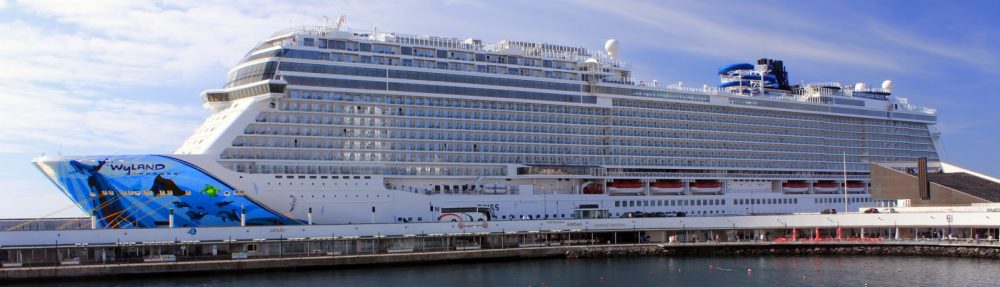
Viking Yi Dun Departs Shanghai, Concludes Its Chinese-Flag Era

Viking Yi Dun Departs Shanghai, Concludes Its Chinese-Flag Era

The Viking Yi Dun slipped her moorings at Shanghai’s North Bund International Cruise Terminal on June 5, beginning a roughly 60-day positioning voyage across the South China Sea.

The ship will sail past Southeast Asia and the Indian Ocean, around the Cape of Good Hope and into the Mediterranean, with a scheduled arrival in Barcelona, Spain, in early August.

Viking said in a press release that the departure also marked the formal launch of what it has promoted as its first Chinese-language transcontinental itinerary, the “60-Day Afro-Euro-Asian Discovery Journey.”

At an onboard ceremony earlier in the day, Brendan Tansey, managing director of Viking China, said the voyage will cross the Pacific, Indian and Atlantic oceans, calling at 27 destinations across 16 countries including Singapore, Phuket, Sri Lanka, Seychelles, South Africa, Namibia and Morocco before reaching Tarragona.

Tansey added that the company is marking its 10th anniversary in the Chinese market and framed the sailing as a milestone: Viking’s first all-Chinese-service (long) ocean voyage, designed around a familiar, senior-focused onboard environment (Mandarin-speaking hotel team, Chinese menus and signage, as well as no casino), and the bridge to a regular Chinese-language Mediterranean season starting August 3 in Barcelona.

The departure also closes the book on the vessel’s time as China’s first “five-star-flag” oceangoing cruise ship.

Built as the Viking Sun and later acquired by the China Merchants and Viking joint venture, she was reflagged to the Chinese register and renamed the Zhao Shang Yi Dun.

In recent months, however, that joint venture structure unwound; the hull was repainted and the name formalized as the Viking Yi Dun, and the flag changed to Norwegian.

When cruise lines went global

By Tom Stieghorst
*InsightIt is easy to forget that the cruise industry was not always the global, or even national business that it is today.

In the early period of modern cruising, the airlines were still regulated and selling cruises was mostly a drive-port business. I was reminded of that in talking with Carnival Corp. COO Alan Buckelew, who began his career in the 1970s at Sitmar.

Buckelew’s latest assignment takes him to China, where he will function as Carnival’s point person in that key emerging market. Buckelew said China in many ways reminds him of the cruise market in North America back in its infancy.

In the mid-1970s, Buckelew recalls, each part of the U.S. had its own cruise players.*TomStieghorst

“There were a couple of brands in Miami, one or two in New York, one in L.A., and they pretty much kept to their own neighborhoods — the Miami guys in the Caribbean, New York in the Caribbean as well, the L.A. guys in Alaska and Mexico.”

With the deregulation of airlines in 1979, flying became more affordable.

“As cruise lines began to create an air package program and began flying, more ships came into the business, and it became more of a national business rather than a regional business,” he said. “And now it’s a global business.”

As it played out, the regional cruise lines consolidated in Miami. Princess Cruises, which merged with Sitmar, and Holland America Line became part of Carnival Corp. As did Cunard Line. Another big player in the New York market, Celebrity Cruises, became part of Royal Caribbean Cruises Ltd.

Now the competitive arena has shifted to China, where, Buckelew says, “we’re back in the 1970s.”

“It’s still pretty regional, not that many guests flying to the ships,” he said. Hong Kong, Shanghai and Tianjin all draw passengers from their own geographic areas.

One big difference, however, is the scale. China’s population is four times that of the U.S. There are 24 million people in greater Shanghai alone. “When I go back home to L.A. or Miami, they seem like little villages in contrast to Shanghai,” Buckelew said.

Amid Asia tensions, uncertainty over expansion

Amid Asia tensions, uncertainty over expansion

By Tom Stieghorst
*InsightMaritime disputes in Asia have thrown a crimp into the cruise industry’s plans to expand in that fast-growing area of the world, and signs are the problem is growing worse.

The latest is a report in the Wall Street Journal that China is challenging archaeological exploration of hundreds of shipwrecks, many of them distant from its own shores.

The article says China views the wrecks as proof of Chinese exploration of islands in the South China Sea, in areas close to the Philippines, Malaysia, Vietnam and Brunei.

According to the report, of particular concern was an incident last year off the coast of the Philippines, when Chinese vessels forced a French archaeological team to abandon its exploration of a 13th century Chinese junk.*TomStieghorst

Already, China and Japan are in a standoff over disputed islands in the East China Sea. As a result, Royal Caribbean International and other cruise lines are not including Japan on their itineraries from China, opting for only Korean ports on cruises from northern Chinese cities.

The tensions in that area have escalated, too, with China claiming air rights over a wide swath of international ocean, including the disputed islands known as Diaoyu in China and Senkaku in Japan.

In its new air defense identification zone, China seeks to require all aircraft to file flight plans before entering the area. Japan and the U.S. immediately sent military planes into the space unannounced, to challenge the newly asserted Chinese zone.

None of this can improve the chance that China will get more big cruise ships. Until the uncertainty clears, the cruise industry’s Asia expansion, certainly in China, will not be full steam ahead.

Speaking on a third-quarter conference call to analysts, before China asserted its new air defense rights, Royal Caribbean International President Adam Goldstein said Royal had been hoping in 2013 to announce plans to resume calls in Japan on its China cruises aboard the Mariner and Voyager of the Seas. Instead, it has been forced to open 2014 bookings with only Korean destinations again.

“This is, of course, frustrating particularly since we do not see any signs of positive geopolitical change in the dynamic between China and Japan,” Goldstein said. “We continue to build our brand, our distribution and our management team in China with a view to making the best of the itinerary options that are available to us.”