Mein Schiff: Aggressive Growth

Mein Schiff: Aggressive Growth

With the new Mein Schiff Flow to be introduced next year, following the sister ship, Mein Schiff Relax, this spring, and Mein Schiff 7 last year, the brand is on an aggressive growth path, more than doubling its guest capacity from 2023 to 2026.

With nine ships in service, Mein Schiff will have a 35.5 per cent share of the German-speaking cruise market as estimated by the 2025 Cruise Industry News Annual Report.

Mein Schiff is sailing into 2025 with a tailwind, according to the cruise line, noting strong demand from the German-speaking markets, Germany, Austria and Switzerland, and also increasingly from neighbouring European countries.

According to Wybcke Meier, CEO, the clear and differentiated position of the brand and the Mein Schiff fleet is in the premium segment of European cruises, thus seeking to appeal also to customers beyond the German market.

Clas Eckholt, Vice President of Commercial, said in a prepared statement that the focus is on offering an international cruise experience with a distinctly German touch.

At some 160,000 tons and with a double occupancy capacity of more than 4,000 guests, the new ship class is introducing a new era for the brand. The new ships are not only significantly larger than the rest of the fleet but are also fueled by LNG and are described as being future-compatible with low emissions bio- and e-LNG.

Also, introduced last year, the Mein Schiff 7 is said to be methanol-ready.

The rest of the ships are kept up to date with the latest project being the drydocking of the 2015-built Mein Schiff 4, which underwent a facelift earlier this year.
TUI’s Mein Schiff 7 Delivered by Meyer Turku

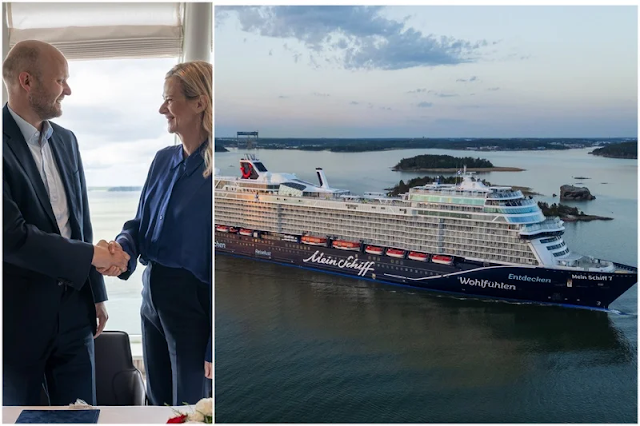
The new Mein Schiff 7 was officially delivered to TUI Cruises today at the Meyer Turku Shipyard in Finland, according to a press release.

The 2,894-guest vessel is the first built by the shipyard with methanol capability, Meyer Turku said in a prepared statement.

At the official signing ceremony, the shipyard was represented by CEO Tim Meyer and Head of Projects Tom Degerman, while TUI Cruises was represented by CEO Wybcke Meier and CFO Frank Kuhlmann.

The Mein Schiff 7 is the seventh ship of the Mein Schiff series built by the shipyard, Meyer Turku highlighted.

“Mein Schiff 7’s symbolic start of production, the steel cutting ceremony, took place at our shipyard on June 14, 2022,” said Tim Meyer, CEO of Meyer Turku.

“We are very proud to have delivered the Mein Schiff 7 to TUI Cruises today, less than two years later. This was made possible by our long-standing and close cooperation.”

The Mein Schiff 7 is also the first ship in the Mein Schiff fleet to run exclusively on low-emission marine diesel (with a maximum sulfur content of 0.1%).

The 111,500-ton ship has a shore power connection and is equipped with catalytic converters, the shipyard said.

In addition, the Mein Schiff 7 is built so that it can also run on methanol, which with the green methanol of the future, will make the ship’s propulsion power almost CO2-neutral.

“Receiving this ship is a special moment for us. Ten years ago, we acquired our first Blu Motion class ship here in Turku, and by 2019 we had built a total of six vessels,” said Wybcke Meier, CEO of TUI Cruises.

“We would like to thank the Meyer Turku shipyard for the excellent cooperation and the development of our well-being fleet. We are now sailing on the Mein Schiff 7 to Kiel, where we will welcome the first guests on board on June 12,” she added.

Costa and AIDA Eye Methanol With New Agreement

Costa Group and the leading methanol producer, Proman, have signed an MOU to drive further the implementation of methanol as a marine fuel for the cruise industry, according to a press release.

The partnership aims to accelerate the energy transition and decarbonization of the existing fleet for Costa and AIDA by enhancing the supply of sustainable methanol, paving the way for the retrofitting of existing vessels to operate on clean fuel, as well as investment in further methanol-fueled new builds.

“The technology to retrofit a vessel to accept methanol as a fuel is available today. Our methanol products can facilitate the transition to low-carbon intensity fuels. Methanol-powered vessels have a proven track record of reducing and eliminating major greenhouse gas emissions, delivering immediate air quality improvements around major ports and shipping lanes. We are excited to bring our expertise along the full methanol value chain to help deliver on Costa Group’s bold ambitions,” said Tim Cornelius, Proman’s Managing Director of Corporate Development.

“We are reducing the carbon footprint of our fleet while at the port and at sea, investing in advanced environmental technologies and partnering with companies such as Proman who share a passion for the sustainable energy transition. By enabling cruise ships to use methanol as a propulsion fuel, Costa follows the ambition to take the next big step towards GHG-neutral operations of our fleet by 2050,” added Dr Christoph Schladoer, VP of Decarbonization Costa Group.