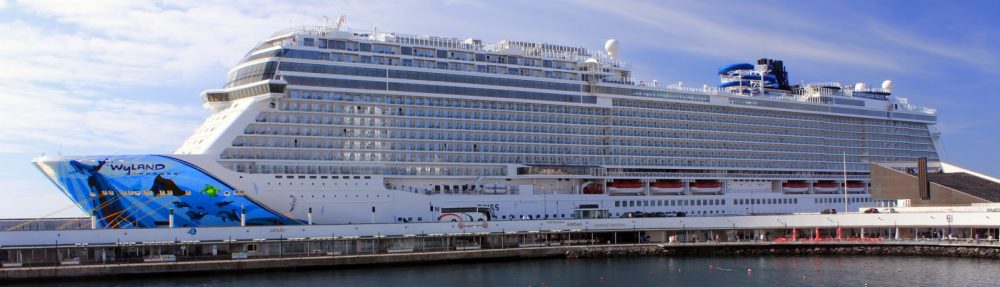
The cruise ship drydock market will be hot for 2021, as operators push scheduled refits and class surveys forward ahead of returning to service
Work scopes are expected to be mandatory class surveys, inspections, and technical and safety maintenance, as the majority of big projects scheduled for 2020 and 2021 have been pushed back, Cruise Industry News reported in its 2021 Drydocking and Refurbishment Report.
Without passengers on the ship, the drydocking is when the cruise lines pounce to make any changes ranging from repair to hotel and facility upgrades.
Among the cruise ships that recently drydocked is the 1,778-guest Marella Explorer 2. She is staying at Damen in Amsterdam, Netherlands.
The Marella Explorer 2 has had her cabin ceilings and walls resprayed, bathrooms updated. Some of her suites got brand new solid wood floorings, and the Market Place got a contemporary resin floor.
The 2,600-passenger Sapphire Princess, which is operated by Princess Cruises, is currently drydocking at the Sembawang Shipyard in Singapore. The ship was previously scheduled for a drydock in April 2020, which got postponed after the start of the pandemic.
Finally, Dream Cruises’ 1,804-passenger Explorer Dream is not drydocking yet but will be between Feb. 19 and 25. The works will take place in Kaohsiung, Taiwan.
“HVAC is one of the most important systems aboard a cruise ship. To that end, we designed our ship based on industry best practices, working with Fincantieri and HVAC engineers. We are trading off energy consumption for passenger comfort, quality, and safety,” Andy Schwalb, chief marine and technology for Virgin Voyages, told Cruise Industry News.
“So, instead of building the most efficient air-conditioning system possible, we built the best air circulation system possible for the comfort of our guests and crew,” he added.
Aboard the Scarlet Lady, each public space has its own air-handling system, designed and optimized for each space.
“We are constantly putting fresh air into public spaces and cabins. While other ships may pump in the fresh air too, the question is how often that air is exchanged. Our system is smart and adjusts according to how many people are in the room. So, the air may be exchanged every couple of minutes or every five to seven minutes. It can go faster or slower.
“Some large spaces also have cooling coils that help keep the air cool, but we are not recirculating air.
“We also change the air in every cabin every few minutes. Each cabin has its own cooling unit, and there is no cross-contamination between cabins.”
“There are many ways to clean the air,” Schwalb said. “The most basic is to move fresh air through a filter and suck out the old air. That works up to a point, depending on how often the air is exchanged and how big or small the particles are that go into the filters. Some companies have gone to MERV 13 filters, which have a finer mesh, and some are putting UV lamps in their air handlers.
“We have chosen a different route, covering 100 per cent of the ship with bipolar ionization.”
Schwalb explained how it works: “The fresh air comes into the space ionized with positively and negatively charged ions. They are attracted to particulate matter – pathogens, allergens, bacteria dust – and attach themselves. By doing so, they destroy the pathogens by stripping the hydrogen atom and make them bigger and heavier, which means the filters can better trap them, they are no longer able to attach themselves to people’s lungs, and they also fall to the floor.
“99.92 per cent of viruses are killed instantaneously.”
In-door air quality, in general, is a problem, according to Schwalb, not just on cruise ships. Any building, any enclosed space, has challenges such as norovirus and influenza, for example, and the ionization takes care of all of that.
“In addition, we are also upping our filtration to MERV 13 where it makes sense,” he added. “We are doing absolutely everything that is possible. First of all, we want to keep everybody safe and healthy; and secondly, we think this will improve the (cruise) experience over the long run.”
Holland America Line is preparing for a gradual restart and is said to be moving six cruise ships toward the U.S. citing positive signs and a new conversation around the return to service.
The news came in a letter sent to crew from President Gus Antorcha, reported by Crew Center, and also obtained by Cruise Industry News.
“Following in-depth discussions with the CDC, other government agencies, and medical and science authorities, we have decided to start moving six Holland America Line ships toward U.S. waters over the next several weeks to begin completing the requirements for conditional sailing,” Antorcha said in the letter sent to the crew.
The ships heading to U.S. waters are the Koningsdam, Nieuw Statendam, Nieuw Amsterdam, Westerdam, Zuiderdam, and Noordam. Holland America did not specify port information but the line has traditionally had a strong presence in the winter from Port Everglades and Tampa, which would pull from a large drive-to market.
“While there is still much to be done, this is an important first step toward our goal of resuming cruise operation,” the letter said.
“Holland America Line will continue to work with the CDC on our eventual return to guest cruise operations. We are fully aligned with the CDC on our top priorities for compliance, protecting the environment, and the health, safety, and well-being of our guests, the people in communities we touch, our crew, and shoreside employees.”