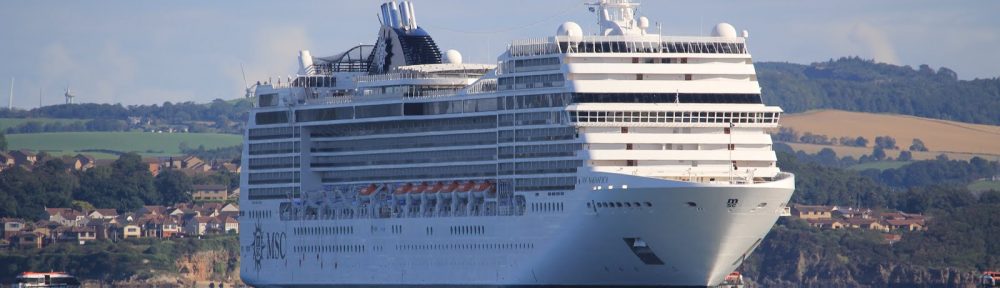
Hapag-Lloyd Ships Meet Off the Coast of Norway

Hapag-Lloyd Cruises’ luxury vessels met in the open sea earlier this month.

Sailing off the coast of Norway, the Europa and the Europa 2 held a ceremony to mark the occasion.

With crew members from both ships meeting in boats, Europa’s Captain Dag Dvergastein handed over a bottle of champagne, along with a greeting message.

Sören Anderl, the Captain of Europa 2, also offered a bottle of champagne, in addition to his own greeting message.

According to Hapag-Lloyd, the ceremony ended with the ships sounding their horns, while passengers and crew waved at each other.

Cruising from Kiel to Hamburg, the Europa was offering a 13-night itinerary to Norway during the encounter.

Sailing all the way to the Cape North, the itinerary included visits to several sites in the Scandinavian country, including Eidfjord, Alesund, Skarsvarg, Tromso, Leknes, Skjolden, Stavanger and Oslo.

Also sailing in the region, the Europa 2 was offering an eight-night cruise to the Norwegian Fjords. Sailing between Kiel and Bergen, the itinerary featured Oslo, Arendal, Stavanger, Olden, Molde, Vik and Flam as ports of call.

Built at the Chantiers de l’Atlantique shipyard in France, the Europa 2 entered service in May 2013. With eight restaurants, six bars, a large spa, a fitness complex and multiple facilities, the 516-guest ship is said to offer the greatest space per passenger in the entire industry.

Replacing the 1981-built Europa, the Europa was built at the Kvaerner Masa-Yard in Finland and entered service in 1999.

According to Hapag-Lloyd, the 401-guest ship helped set global standards for luxury cruising and offers an “incomparable amount of freedom,” with amenities that include a pool deck, a spa and several bars and restaurants.

Hapag-Lloyd Cruises also operates a fleet of three purpose-built expedition ships, the Hanseatic Nature, the Hanseatic Inspiration and the Hanseatic Spirit.

German Market Growth to be Driven by TUI

Mein Schiff 3 photo credit Spacejunkie2 (flickr)

The cruise brands catering to the national German market have an estimated capacity of 2.1 million passengers (double occupancy) in 2023, forecast to grow to 2.5 million by 2020, according to the 2023 Cruise Industry News Annual Report.

The growth will mainly be driven by TUI Cruises which will launch three new ships over the time period, boosting its annual passenger capacity from approximately 600,000 to nearly 1 million.

TUI is focused on the German premium market along with Phoenix Reisen and Plantours. In the luxury segment are Hapag-Lloyd and Sea Cloud.

AIDA is the largest national brand today with an estimated annual passenger capacity of about 1.4 million, but has no new builds on order, and barring any further retirements of ships, will maintain its position, dominating the contemporary market segment.

These brands offer a German-language products. In addition, other European brands also market in Germany, including MSC and Costa, as well as North America-based brands.

Germany is the single largest national cruise market in Europe.

AIDA Reaches Milestone in Decarbonization Efforts

AIDA Cruises has expanded the use of shore power in its fleet, reaching a significant milestone in its decarbonization efforts, according to a press release.

The AIDAsol was recently connected to shore power in nearly all ports during its recent voyage from April 16 to 21, 2023.

The ship was supplied with green energy from shore in Rostock-Warnemünde, Aarhus (Denmark), Kristiansand (Norway), and Hamburg.

The growing shore power infrastructure in Northern Europe has made it possible for AIDA Cruises to achieve this milestone.

AIDA President Felix Eichhorn stated that the company’s goal is to use shore power in all ports where port infrastructure is available. He added that the company’s investments in clean technology are actively supporting the goals of the EU’s “Fit for 55” program to build a corresponding infrastructure in all major EU ports by 2030.

During its recent voyage, AIDAsol made history by being the first cruise ship to conduct shore-side and shipboard integration tests on a newly built facility in Aarhus, Denmark. The official opening of Denmark’s first shore power plant for cruise ships is scheduled for later this year.

The AIDAsol was also supplied with energy from shore during its stop in Kristiansand, Norway, which it already did in 2022.

AIDA Cruises has been investing in sustainable cruising for many years, with a goal to achieve carbon-neutral ship operation for its fleet by 2050.

The company has been considering the use of environmentally friendly technology since 2004, and more than ten years have passed since it was able to start the usage of shore power in regular operation with an AIDA ship in Hamburg Altona in 2017. The company signed a memorandum of understanding in April 2022 with Cruise Baltic, a network of 31 ports and destinations, to use shore power in the ports of the Baltic Sea region.

AIDAsol’s arrival in Hamburg, its home port for this year’s summer season, marked another significant moment in AIDA Cruises’ decarbonization efforts. The ship was connected to Europe’s first shore power plant for cruise ships and switched off its main engines shortly after docking at the Cruise Center Altona.

The expansion of the use of shore power is part of AIDA Cruises’ efforts to use low-emission liquefied natural gas (LNG) and other alternative energy sources such as batteries and fuel cells. The company is working with various partners to find solutions for the use of regenerative and synthetic fuels.

“AIDA Cruises shows what can already be possible today,” said Eichhorn. “We can only achieve the energy transition together.”